
Rabati Castle
რაბათის ციხე — Rabati qale
Georgia · Samtskhe-Javakheti, Akhaltsikhe · Near Akhaltsikhe
Built 900 · Reconstructed medieval-Ottoman-Georgian fortress complex — the site's original construction dates to the 9th century as 'Lomsia Castle,' seat of the Kartvelian lords of the region; the Jaqeli (Jakeli) dynasty built the castle into a major fortified residence in the 13th century; the site underwent significant Ottoman-period modifications through the 16th–18th centuries, including the construction of the 1752 mosque modeled architecturally on Hagia Sophia; the fortress as visitors see it today is predominantly the result of a controversial Georgian government reconstruction programme in 2011–2012 (approximately 34 million lari in public funds) that rebuilt much of the complex rather than conserving it as a ruin; the reconstructed complex includes the 1752 mosque (restored and presented as a mosque), an Orthodox church, a minaret, a madrasah, a museum, and tower fortifications; comparison with a reconstructed monument (rather than an unaltered medieval survivor) is appropriate — see the site's Bobolice Castle page for a similar framing
This page is part of an independent travel guide and is not affiliated with, endorsed by, or operated by Rabati Castle.
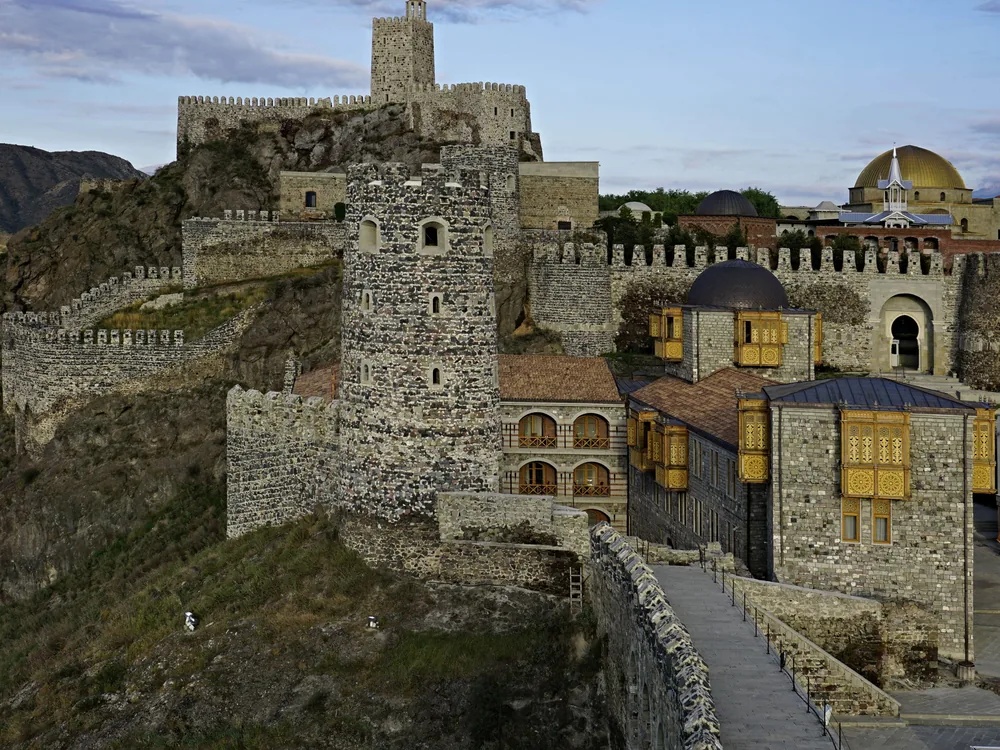
© Castles & Palaces
Quick Facts
- Hours
- Daily 10:00–22:00
- Guided tour from
- €35
- Duration
- 1–2 hours (complex tour); 14 hours (GetYourGuide full Borjomi/Rabati/Vardzia day trip from Tbilisi)
- Best time
- April to October
- Nearest city
- Akhaltsikhe
Featured Tour
Tbilisi: Borjomi, Rabati Castle & Vardzia Adventure Day Trip
Cancellation available · Instant confirmation
Highlights
- ✦The 1752 mosque modeled on Hagia Sophia — the most architecturally remarkable building in the complex; commissioned by Haji Ahmed-Pasha Jaqeli, Georgian ruler of Akhaltsikhe under Ottoman suzerainty; the mosque was designed architecturally on the model of Constantinople's Hagia Sophia but built using the structural methods of a Georgian Orthodox church, complete with an added minaret and madrasah; a single building combining Ottoman patronage, Byzantine architectural reference, and Georgian construction tradition
- ✦Three religious identities, one building — the 1752 mosque functioned as a mosque for 76 years until Russian conquest in 1828; was reconsecrated as a Russian Orthodox church by order of the Russian emperor in 1850 and served that role for 92 years; was secularized in 1920; then reconstructed and presented as a mosque again in 2012 — one of the most remarkable single-building religious identity cycles in the Caucasus
- ✦Seat of the Jaqeli dynasty — the Jaqeli (Jakeli) princes ruled the Samtskhe-Saatabago principality from this site between the 13th and late 15th centuries, a semi-autonomous region between the Georgian kingdom, the Mongol Empire, and eventually the Ottoman Empire; the dynasty's conversion to Islam in 1486 (under Ottoman pressure) is one of the defining moments of Samtskhe's history
- ✦Honest disclosure on the reconstruction — the castle as seen today is almost entirely the product of a 2011–2012 Georgian government reconstruction programme that spent approximately 34 million lari rebuilding much of the complex from the foundations up; critics have called this approach 'Disney-fication'; the castle should be understood as a reconstructed monument interpreting a historic site, not an unaltered medieval survivor
- ✦GetYourGuide Borjomi, Rabati & Vardzia day trip from Tbilisi — the #1 selling day trip from Tbilisi by review volume; covers the Borjomi spa resort, Rabati Castle, and the Vardzia cave monastery complex in a single 14-hour day from the capital
Skip the queue with a guided tour
Skip-the-line tickets & expert guides
Rabati Castle in Akhaltsikhe is one of the most visited historical monuments in Georgia outside Tbilisi — and also one of the most controversial. The fortress occupies a prominent hilltop position above the Mtkvari (Kura) River in the Samtskhe region of southwestern Georgia, and the complex that visitors enter today is unmistakably impressive: towers, walls, churches, a mosque with a minaret, a madrasah, museum spaces, and a reconstructed medieval residential quarter arranged around landscaped courtyards. What the site's marketing does not always make clear is that what you are walking through is overwhelmingly the product of a 2011–2012 reconstruction programme that spent approximately 34 million lari — a large sum for the Georgian state's cultural budget — rebuilding what had been a partially ruined medieval site into a comprehensively restored theme-park interpretation of itself.
This is not to say that Rabati is without genuine historical content, or that the reconstruction has no value. The site has been fortified since at least the 9th century, when it was known as Lomsia Castle and functioned as the fortified residence of the lords of the Samtskhe region. In the 13th century, the Jaqeli dynasty — the Jakeli princes who ruled the semi-autonomous principality of Samtskhe-Saatabago — made the Akhaltsikhe fortress their primary seat, developing it into the most significant fortified complex in southwestern Georgia. The Samtskhe-Saatabago principality occupied a precarious position between the Georgian kingdom (which nominally claimed suzerainty), the Mongol Empire (which had devastated Georgia in the 1220s and 1230s), and subsequently the Ottoman and Safavid Persian empires competing for Caucasus dominance. The Jaqeli rulers navigated this complexity through a combination of military capacity, diplomatic flexibility, and periodic submission to whichever power was most threatening — a strategy that kept the principality in existence long after many of its neighbors had been absorbed.
In 1486, the Jaqeli dynasty converted to Islam under Ottoman pressure — a conversion with profound consequences for the region's cultural and architectural history. The Ottoman framework brought new patronage patterns, new building typologies, and a new relationship between the Samtskhe lords and the imperial court in Constantinople. The most remarkable physical expression of this complex cultural moment is the mosque built in 1752 by Haji Ahmed-Pasha Jaqeli — a Georgian-origin ruler operating under Ottoman suzerainty who commissioned a building modeled on the greatest structure of the Islamic world (Hagia Sophia, by then a mosque for three centuries) but built using the structural techniques of a Georgian Orthodox church. The mosque has a ground plan and structural system that reflects Georgian religious building tradition, a dome that references Hagia Sophia's proportions, a minaret added to signal its Islamic function, and a madrasah attached for Islamic religious education. It is a building that cannot be understood within any single cultural tradition: it is the product of a moment when Orthodox, Ottoman, and Byzantine layers were all simultaneously present in the same commission.
The building's subsequent history added further layers. When Russian forces under General Ivan Paskevich conquered Akhaltsikhe in 1828 — bringing the Samtskhe region into the expanding Russian Empire and ending the Ottoman administration that had controlled it since 1578 — the mosque's function changed immediately. In 1850, by order of the Russian emperor, the building was reconsecrated as a Russian Orthodox church and served that purpose for 92 years, until 1920. The minaret was retained (if not used), the interior adapted for Orthodox worship, the religious furniture changed while the architectural shell remained the same. The building functioned as a church from 1850 to 1920, as a mosque from 1752 to 1828, was secularized in 1920, and then in the 2012 reconstruction was presented as a mosque once again — three formal religious identities, one building, across 270 years.
The reconstruction that produced the current appearance of the complex has been widely criticized by architectural historians and heritage professionals in Georgia and internationally. The critics' case is that what was a genuine, partially ruined medieval site with complex historical layering has been replaced with a reconstruction that prioritizes visual spectacle over archaeological integrity, eliminates the ambiguity and complexity of the actual historical record in favour of a clean interpretive narrative, and uses new building materials and techniques in ways that will mislead future historians about what was original. The Georgian government's defenders respond that the reconstruction created a functioning cultural and tourist attraction, generates significant revenue for Akhaltsikhe, and has made the site's history accessible to many visitors who would not have engaged with a ruin.
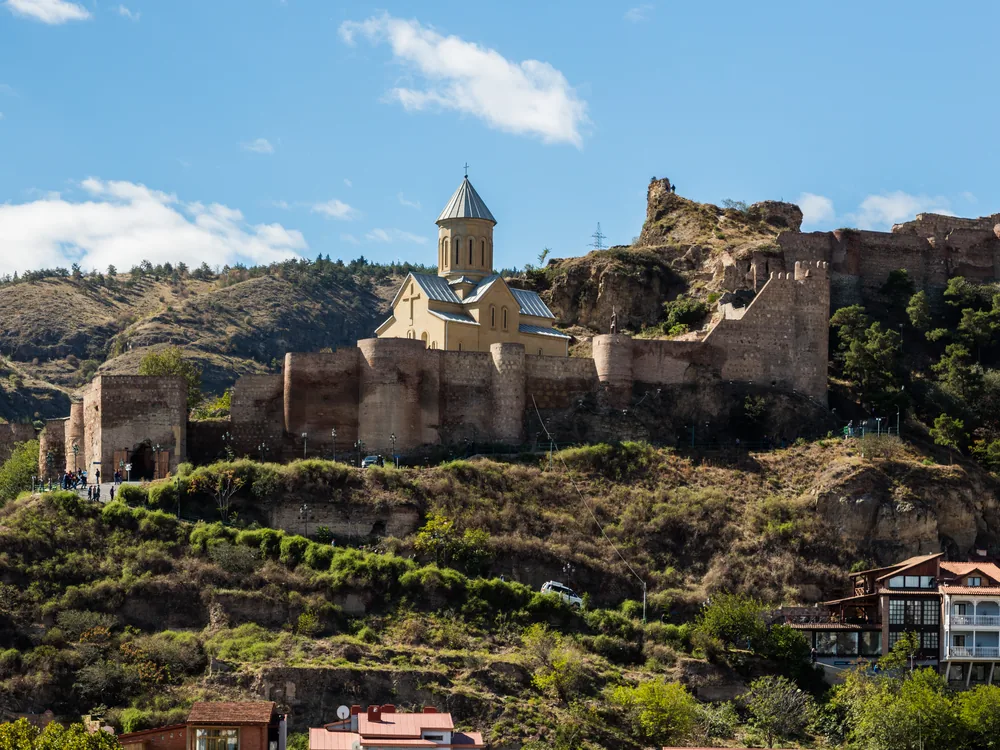
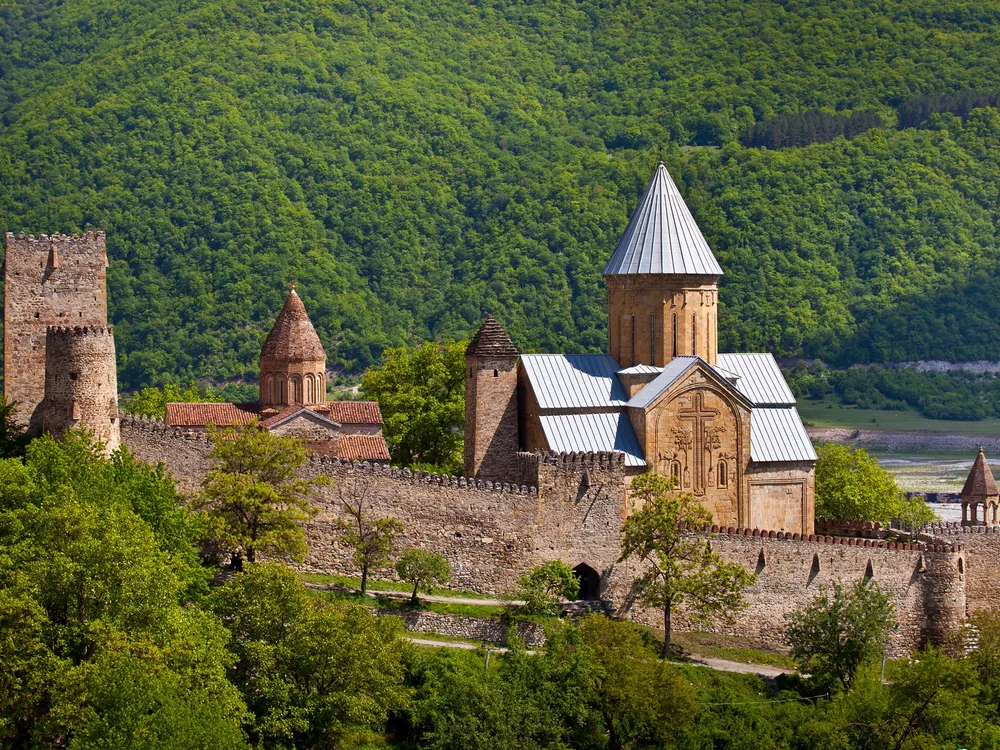
For Georgia's other principal fortifications on this site: [Narikala Fortress](/castles/georgia/narikala-fortress), Tbilisi's hilltop citadel with over 1,600 years of continuous fortification history, is approximately 200 kilometres northeast by road. [Ananuri Fortress](/castles/georgia/ananuri-fortress) and [Azeula Fortress](/castles/georgia/azeula-fortress), both in the Aragvi River valley north of Tbilisi, are closer to the capital and more easily combined with a Tbilisi visit.
History
The hilltop at Akhaltsikhe has been fortified since at least the 9th century, when the structure known as Lomsia Castle served as the fortified residence of the lords of the Samtskhe region. The Jaqeli (Jakeli) dynasty made it their primary seat in the 13th century and governed the Samtskhe-Saatabago principality from here — navigating with considerable skill the competing pressures of Georgian royal authority, Mongol invasion, Ottoman expansion, and Safavid Persian rivalry across three centuries of extraordinary political turbulence. The dynasty's 1486 conversion to Islam under Ottoman pressure began the process of religious transformation that would define the site's most complex layers.
Ottoman formal annexation of the Samtskhe region followed the Ottoman-Safavid wars of 1578. In 1752, Haji Ahmed-Pasha Jaqeli built the mosque that occupies the centre of the complex — modelled on the Hagia Sophia and constructed using Georgian Orthodox church-building methods, a hybrid of faith and craft that reflects the specific cultural moment. The mosque functioned as an Islamic place of worship for 76 years before Russian forces under General Paskevich took Akhaltsikhe in 1828. By 1850, the Russian emperor had ordered the building reconsecrated as a Russian Orthodox church — a status it held for 92 years until secularisation in 1920.
A Georgian government reconstruction programme in 2011–12 spent approximately 34 million lari rebuilding the complex, presenting the central building as a mosque again in the reconstruction. The result is the most visited and most debated historical site in southwestern Georgia — contested as much for what the reconstruction says about present identity as for what the original building says about the past.
How to Visit
Getting there: Akhaltsikhe is approximately 200 km from Tbilisi by car (2.5–3 hours on the E60 highway via Gori). Shared taxis (marshrutka) run from Tbilisi's Didube bus station. The castle is on the hill above the town centre, clearly visible on arrival.
Tickets: The outer castle grounds are free to enter. Some interior buildings (museum, mosque interior) may charge small fees. The GetYourGuide "Tbilisi: Borjomi, Rabati Castle & Vardzia Adventure Day Trip" (14 hours) covers Rabati alongside the Borjomi spa resort and the Vardzia cave monastery complex — the most-reviewed Tbilisi day trip on GetYourGuide.
Practical tips: The complex is largely a 2011–2012 reconstruction rather than a medieval survivor — understand it as an interpretation of the historic site. The 1752 mosque modelled on Hagia Sophia (but built using Georgian Orthodox church construction methods) is the most historically significant building and the main reason to come. The complex is illuminated in the evenings and is particularly atmospheric after dark.
Combine with: Narikala Fortress in Tbilisi is 200 km northeast — the capital's 1,600-year-old hilltop citadel, a natural contrast in historical character. Ananuri Fortress on the Georgian Military Highway north of Tbilisi completes the Georgian fortress triangle for those doing a broader itinerary.
Frequently Asked Questions
The mosque is a real historic building — it was originally built in 1752 by Haji Ahmed-Pasha Jaqeli, designed in the style of Hagia Sophia but using Georgian Orthodox church construction methods, with a minaret and madrasah added. It then functioned as a Russian Orthodox church from 1850 to 1920. The building itself is authentic; what changed in the 2011–2012 reconstruction was the surrounding complex (towers, walls, residential buildings, courtyard structures) that was rebuilt rather than conserved as ruins. The mosque building has been significantly restored and presents itself as a mosque, but the core historic structure dates to 1752.
Location
Rabati Castle, Akhaltsikhe, Samtskhe-Javakheti, Georgia
Nearby Castles
Tours & Tickets
Powered by GetYourGuide
From
€35/ person