
Ananuri Fortress
ანანურის ციხე
Georgia · Mtskheta-Mtianeti · Near Tbilisi
13th century · Medieval Georgian
This page is part of an independent travel guide and is not affiliated with, endorsed by, or operated by Ananuri Fortress.
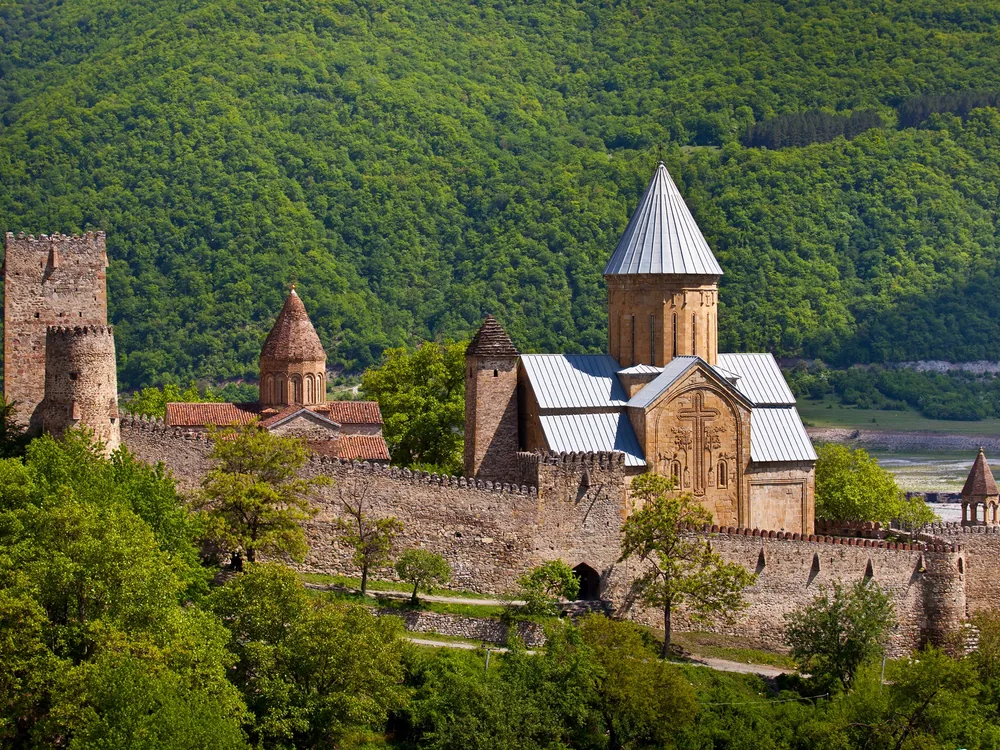
© Unsplash
Quick Facts
- Hours
- Daily 10:00–18:00
- Day trip from
- €12.94
- Duration
- 1–2 hours
- Best time
- Spring and autumn for clear Caucasus views
- Nearest city
- Tbilisi
Featured Tour
From Tbilisi: Kazbegi, Gudauri & Gergeti Group Day Tour
Cancellation available · Instant confirmation
Highlights
- ✦One of the most photogenic medieval fortresses in the Caucasus — twin towers and two churches reflected in the turquoise Zhinvali Reservoir
- ✦A complex of the Aragvispiri clan (Dukes of Aragvi), built between the 13th and 17th centuries to control the Georgian Military Highway
- ✦The Church of the Assumption (17th century) with original Georgian frescoes of warrior saints and the Virgin Mary
- ✦The Church of the Redeemer (16th century) with elaborate relief carvings of grapevines, crosses, and deer — unique in Georgian ecclesiastical art
- ✦The reservoir created in the 1980s transformed the fortress's valley setting into an island-like position above turquoise water
Tickets & tours
Book through GetYourGuide
Ananuri Fortress appears around a bend in the Georgian Military Highway as if arranged by a set designer: two medieval towers and two stone churches rising from a rocky promontory above the turquoise surface of the Zhinvali Reservoir, with the ridges of the Great Caucasus receding into blue haze behind. It is one of the most compelling medieval sights in the Caucasus region, and its position 72 km north of Tbilisi on the main road to the mountains makes it the most accessible.
The fortress was the stronghold of the Aragvispiri — the Dukes of Aragvi, a feudal clan who controlled the mountain pass and the trade route through the Dariali Gorge for four centuries. The complex developed gradually from the 13th century, with the main keep, the smaller tower, and the two churches added at different periods. The Dukes collected tolls from merchants, soldiers, and pilgrims using the military highway — the same route that Alexander the Great is said to have used and that the Russian Imperial road-builders followed in the 19th century.
The two churches inside the fortress are the most architecturally significant elements. The Church of the Redeemer (16th century) is covered in relief carvings of extraordinary quality — grapevines spiralling around doorframes, hunting scenes, and pairs of deer framing the windows — representing the peak of Georgian medieval decorative stonework. The Church of the Assumption (17th century) retains fragments of original fresco painting inside, depicting warrior saints and the life of the Virgin in the Byzantine tradition.
History
Ananuri's documented history begins in the 13th century, when the Aragvispiri clan established control over the Aragvi River valley and its mountain pass during the period of Mongol invasion and the fragmentation of the Georgian kingdom. The fortress served as the clan's administrative centre and defensive stronghold, controlling the vital trade and military route through the Caucasus.
The Aragvispiri were important enough to negotiate with both the Georgian Crown and the Ottoman and Persian empires competing for influence in the Caucasus through the 16th and 17th centuries. The 17th century saw the construction of the Church of the Assumption and significant expansion of the defensive walls. In 1743, the Aragvispiri clan was extinguished when Giorgi Saakadze of the rival Ksani principality attacked the fortress and killed the last Duke of Aragvi. The Georgian king Teimuraz II captured and demolished Ksani's forces in retaliation, but Ananuri never recovered its independent significance.
The fortress passed to the Russian Empire along with Georgia in 1801. The Zhinvali hydroelectric dam, constructed in the 1980s by the Soviet government, flooded the valley below the fortress and created the reservoir that now gives Ananuri its extraordinary setting. Several villages were submerged when the reservoir filled; the transformation of the landscape — from a river valley to a mountain lake — changed the context of the fortress entirely.
How to Visit
Getting there: Ananuri is 72 km north of Tbilisi on the Georgian Military Highway (S3/E117). By car, follow the road north toward Kazbegi — the fortress is visible from the road and well signposted, about 1.5 hours from Tbilisi. No direct bus serves the fortress; minibuses toward Kazbegi can drop you at the road junction, from which it is a short walk.
Tickets: Admission is approximately 1 GEL (under €1); children free. Tickets at the entrance — no advance booking needed. The GetYourGuide "From Tbilisi: Kazbegi, Gudauri & Gergeti Group Day Tour" includes Ananuri as a stop on an 11-hour mountain day trip from Tbilisi — the most popular way to visit for those without a car.
Practical tips: The classic photograph is from the road on the opposite side of the reservoir — the fortress reflected in turquoise water with mountains behind; walk down to the reservoir's edge for the best angle. Both churches are open to enter. The Church of the Redeemer's exterior relief carvings are best in morning light; inside the Church of the Assumption, let your eyes adjust to the dim interior before looking for the fresco fragments.
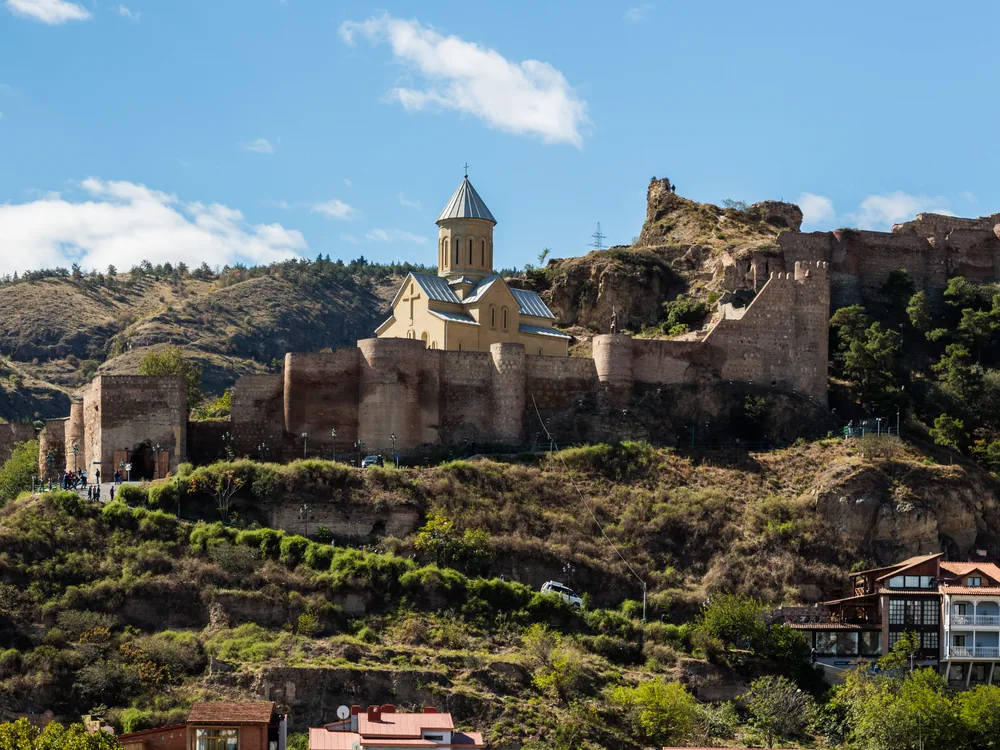
Combine with: Narikala Fortress in Tbilisi is the natural bookend — the city's hilltop fortress makes a logical start or end for the Georgian Military Highway day. Azeula Fortress is further north on the same road for those extending into the mountains.
Frequently Asked Questions
No — the Zhinvali Reservoir was created by the Soviet government in the 1980s when the Zhinvali hydroelectric dam was built downstream. The valley below the fortress was previously a river valley with several villages, which were submerged when the reservoir filled. The reservoir has dramatically changed the fortress's setting — transforming it from a valley fortress into what appears to be a clifftop castle above a mountain lake.
Location
Ananuri, Dusheti Municipality, Georgia
Nearby Castles
Tours & Tickets
Powered by GetYourGuide
From
€12.94/ person