
Narikala Fortress
ნარიყალა — Narikala
Georgia · Tbilisi, Old Town, Sololaki ridge above the Mtkvari River · Near Tbilisi
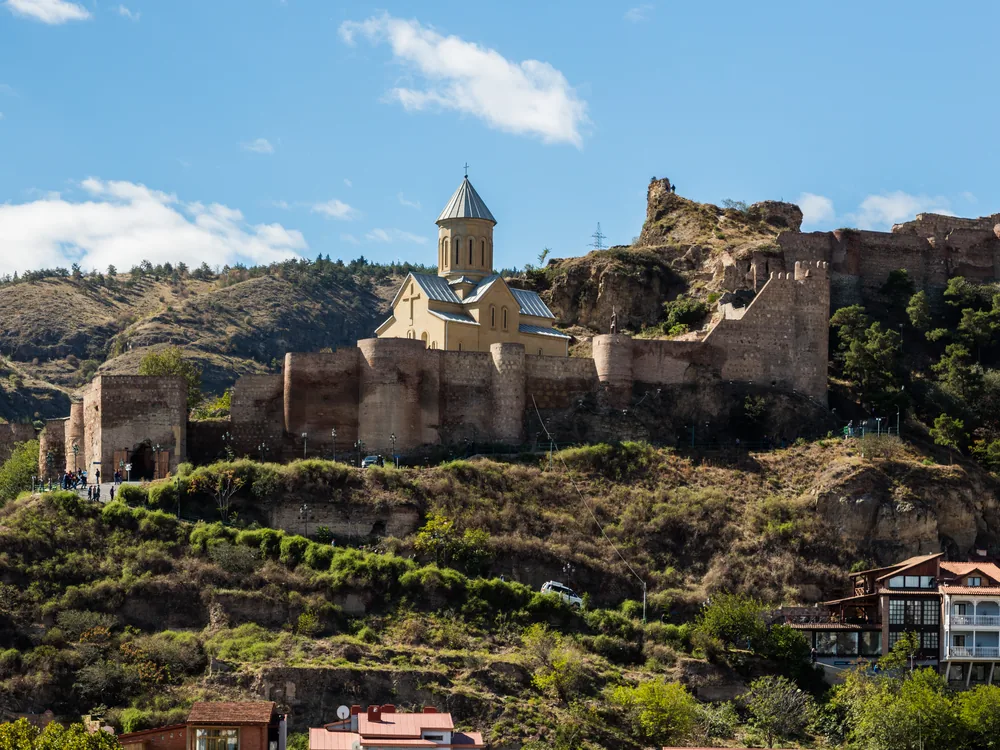
Built 364 · Layered Persian-Arab-Georgian hilltop citadel — the fortress occupies the Sololaki ridge above Tbilisi's Old Town, with the Mtkvari (Kura) River below on the west face; the surviving fabric represents multiple construction periods, the most visible being the thick rubble masonry of the Umayyad Arab expansion (7th–8th century) and the Georgian royal construction of the 11th–12th century under King David the Builder; the two enclosures (lower citadel, upper citadel) follow the ridge line; the Church of St. Nicholas within the fortress walls was rebuilt in 1996 after the 1827 explosion; the structure was severely damaged by a major earthquake and an ammunition depot explosion in 1827 and has been maintained as a consolidated ruin rather than reconstructed; the Kartlis Deda (Mother of Georgia) monument (1958, aluminium, 20 metres) stands on the adjacent hill immediately above the fortress and is visited together with it
This page is part of an independent travel guide and is not affiliated with, endorsed by, or operated by Narikala Fortress.
© Castles & Palaces
Quick Facts
- Hours
- Mon–Sun Open access (ruins)
- Guided tour from
- €19
- Duration
- 1–2 hours (fortress and Kartlis Deda monument); 1–2 hours (GetYourGuide guided private tour)
- Best time
- April to November
- Nearest city
- Tbilisi
Featured Tour
Tbilisi: Private Tour to Mother of Georgia & Narikala Fortress
Cancellation available · Instant confirmation
Highlights
- ✦Over 1,600 years of continuous fortification — the site has been fortified since approximately 364 AD under King Varaz-Bakur of Kartli (Iberia), making Narikala one of the oldest continuously occupied military sites in the Caucasus; Persian, Arab, Georgian, Mongol, and Safavid Persian forces have all held or attacked it at various points in its history
- ✦The Umayyad Arab expansion — after the Arab Emirate of Tiflis was established in the 7th century, Umayyad engineers significantly expanded the fortress, adding the lower enclosure that constitutes most of the visible fabric today; the thick rubble masonry of this period is the dominant surviving structural element
- ✦King David the Builder's enlargement (1089–1125) — during Georgia's Golden Age under David IV (David the Builder), the fortress received its most comprehensive Georgian-era expansion; David's military rebuilding of Narikala was part of the same programme that drove the Seljuk Turks out of Tbilisi and established Georgia as the dominant power in the Caucasus
- ✦The Kartlis Deda (Mother of Georgia) monument — a 20-metre aluminium figure on the hill immediately adjacent to the fortress, erected in 1958 by sculptor Elguja Amashukeli to mark Tbilisi's 1,500th anniversary; she holds a bowl of wine to welcome friends and a sword to meet enemies; the monument and the fortress are visited together and together define the visual identity of Tbilisi's skyline
- ✦Free and always-open ruin — Narikala is not a managed museum but an open consolidation of surviving walls, towers, and gate structures above the Old Town; entry is free at all hours; the fortress is as much a public park and viewpoint as a heritage site, and Tbilisi residents use it casually as part of their daily relationship with the Old Town landscape
- ✦GetYourGuide private Narikala and Kartlis Deda tour (1–2 hours) — a private guided tour covering both the fortress and the monument, the most structured way to engage with the site's layered history
Skip the queue with a guided tour
Skip-the-line tickets & expert guides
Narikala Fortress occupies the Sololaki ridge above Tbilisi's Old Town — the same hill that visitors see in virtually every aerial photograph of the city, its irregular rubble walls and empty tower shells silhouetted against the sky above the Mtkvari River. The name 'Narikala' is Mongolian, meaning roughly 'dear little fortress' or 'small fortress,' and it dates from the Mongol period of Georgian history; the fortress's earlier names — 'Shuris-tsikhe' (Rival Fortress) in Persian, 'Dedatsikhe' (Mother Fortress) in Georgian — suggest the degree to which this single hilltop has carried the weight of different layers of occupation and meaning. The aluminium figure of Kartlis Deda — the Mother of Georgia, sword in one hand and wine bowl in the other — that stands on the adjacent hill is not a medieval monument but a 1958 Soviet commission; together with the fortress walls below her, she forms the visual anchor of the Tbilisi skyline.
The earliest fortification on the Sololaki ridge dates to approximately 364 AD, attributed to King Varaz-Bakur of Kartli (the ancient kingdom of Iberia in present-day Georgia), whose rule coincided with a period of Persian Sasanid influence over the region. The site was strategic for obvious reasons: the ridge controls the narrows where the Mtkvari River cuts through the hills, the point at which any army moving along the river valley from the east or west had to pass directly below the walls. The original fortress — called Shuris-tsikhe, Rival Fortress — was a Kartli-Persian collaboration of sorts, reflecting the complex political position of the Caucasian kingdoms between the Persian and later Byzantine spheres.
The most substantial surviving construction dates from the 7th and 8th centuries, when Arab forces of the Umayyad Caliphate established the Arab Emirate of Tiflis (Tbilisi) as an outpost of the Islamic world in the Caucasus. The Umayyad engineers who expanded Narikala during this period are responsible for much of the thick rubble masonry visible today — the lower enclosure, the main curtain walls, the tower footings. The Arab Emirate of Tiflis persisted in various forms for nearly three centuries, creating a Muslim-majority city in the heart of Christian Georgia and generating the complex cultural layering that makes Tbilisi's history so distinctive.
The Georgian royal recovery came under King David IV — David the Builder — who captured Tbilisi from the Seljuk Turks and the Arab emirate in 1122 after a long campaign, making it the capital of a unified Georgia for the first time. David's reign (1089–1125) is considered the beginning of Georgia's Golden Age, a period of territorial expansion and cultural flourishing under the Bagrationi dynasty that extended through his great-granddaughter Queen Tamar (r. 1184–1213). David's military engineers expanded and reinforced Narikala as part of the programme to make Tbilisi the capital of an empire rather than a provincial city: the upper enclosure dates substantially from this period.
The fortress changed hands repeatedly over the subsequent centuries, reflecting the relentless competition for Caucasus dominance. Mongol forces took Tbilisi in 1236 as part of the broader Mongol sweep through the Caucasus and Central Asia. The Jalairid Sultanate, Timurid forces (Timur attacked Tbilisi multiple times between 1386 and 1403), the Safavid Persian Empire, and the Ottoman Empire all held or contested the city and its fortress at various points between the 13th and 18th centuries. Each period of foreign control added modifications to the fortress or simply used the existing structure — the Safavid Persians under Shah Abbas I took Tbilisi in 1615, massacred much of the population, and held the city for decades before the Kartli-Kakheti kingdom was reunified under Russian protection.
The current partially ruined condition of the fortress results primarily from two catastrophic events in 1827: a major earthquake that severely damaged large sections of the walls and towers, followed by an explosion in an ammunition depot stored within the fortress that destroyed additional sections. The Russian imperial authorities, who had annexed the Kartli-Kakheti kingdom in 1801, decided to consolidate the surviving walls rather than undertake a full reconstruction — which is why Narikala today presents as a dramatic but clearly incomplete ruin rather than a fully standing fortress. The Church of St. Nicholas within the fortress walls — a medieval structure that also suffered in the 1827 events — was rebuilt in 1996 following Georgian independence.
From Narikala, the view encompasses the essentials of Tbilisi's topography: the Old Town (Kala) directly below, the Mtkvari River curving westward, the Metekhi Church on its cliff above the opposite bank, the sulfurous hot springs whose vapour rises from the bathhouse district (Abanotubani) below the fortress on the southeastern side, and the Sioni Cathedral dome in the Old Town. This is the same view that Persian rulers, Arab emirs, Georgian kings, Mongol commanders, and Soviet tourists have all stood at and looked down upon — Narikala is the one position from which the whole of Tbilisi's historically layered geography is simultaneously legible.
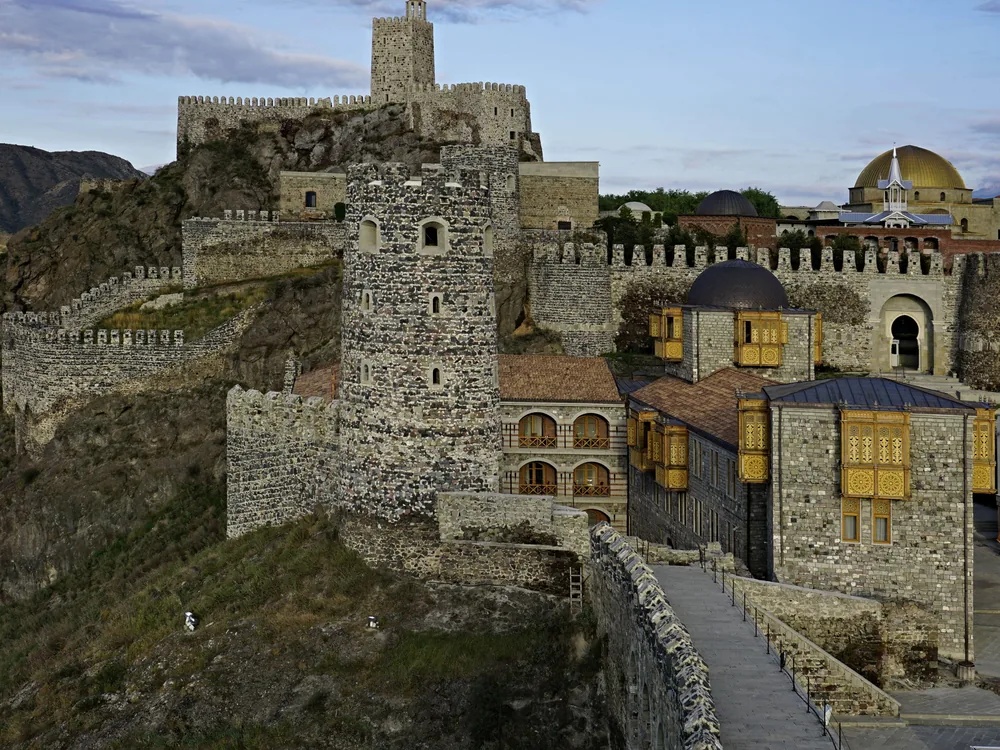
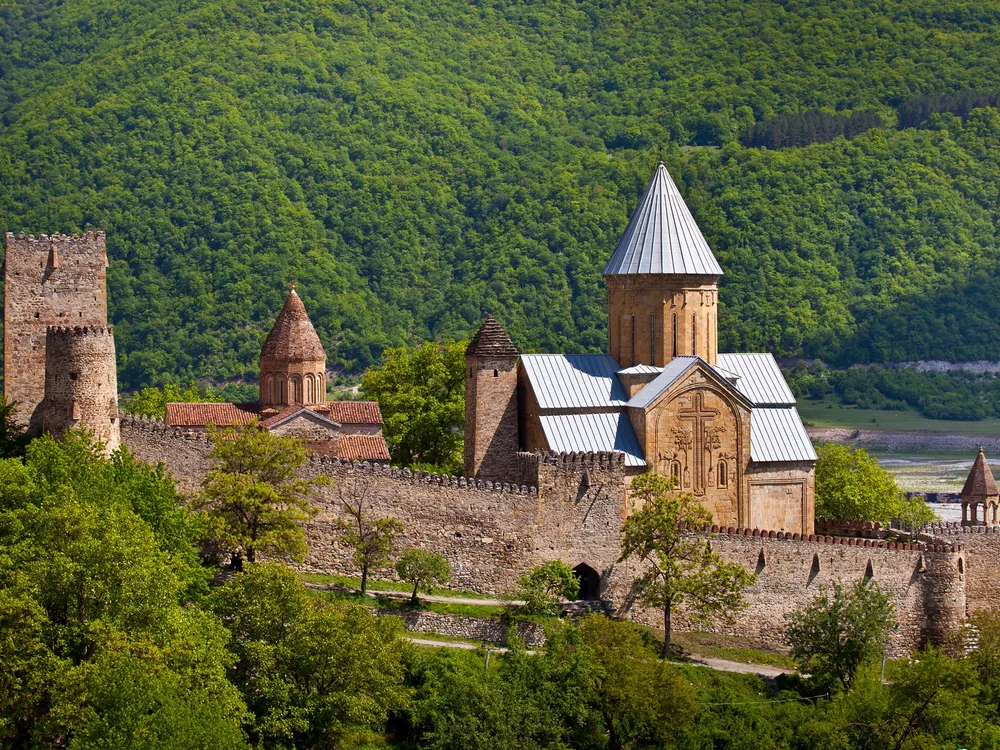
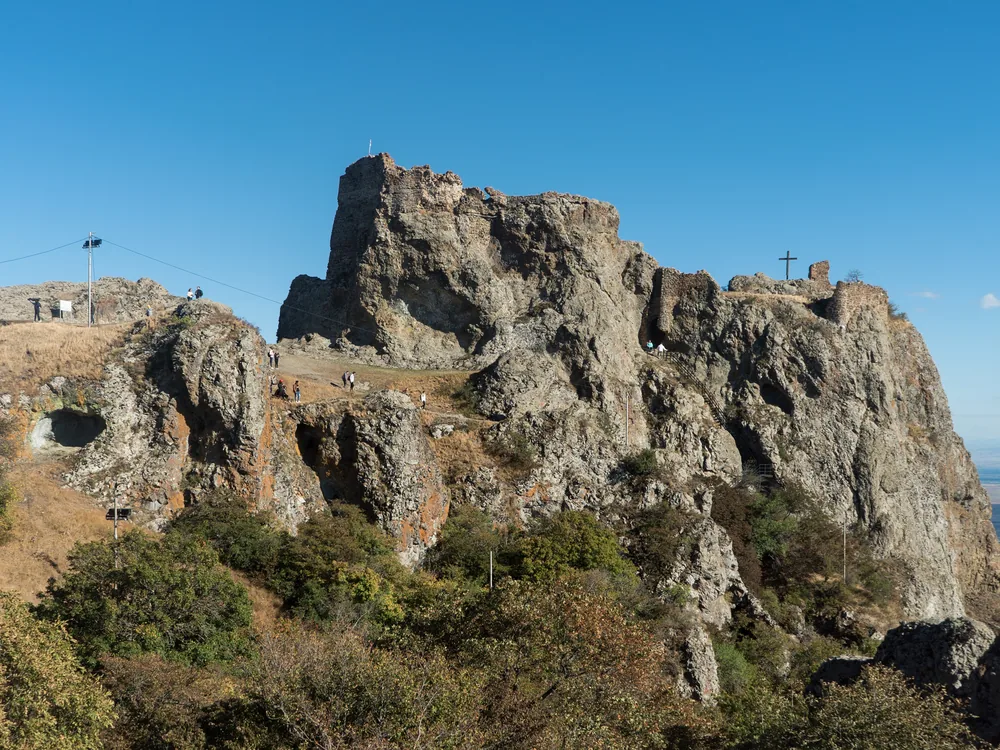
For Georgia's other principal fortifications: [Rabati Castle](/castles/georgia/rabati-castle) in Akhaltsikhe, approximately 200km southwest, is the Jaqeli dynasty's medieval seat with a 1752 Hagia Sophia-inspired mosque. [Ananuri Fortress](/castles/georgia/ananuri-fortress) and [Azeula Fortress](/castles/georgia/azeula-fortress), in the Aragvi River valley north of Tbilisi, are within 80km of the capital.
History
The Sololaki ridge above Tbilisi has been fortified since at least 364 AD, when King Varaz-Bakur of Kartli built the first defensive position here under Persian Sasanid influence — establishing the strategic logic that every subsequent power in the Caucasus would maintain. The Umayyad Arabs substantially expanded the fortress in the 7th and 8th centuries during the period of the Arab Emirate of Tiflis, and the lower enclosure and main walls of what visitors see today date substantially from this phase. The name 'Narikala' itself is Mongolian — meaning 'little fortress' — given when Mongol forces took Tbilisi in 1236.
The fortress reached its most architecturally ambitious state under King David the Builder, who reinforced and expanded it between 1089 and 1125 as part of the Georgian Golden Age programme, adding the upper enclosure. Through the 12th and 13th centuries, under David IV and Queen Tamar, Narikala served as the citadel of the Bagrationi kingdom's capital at its peak. The subsequent centuries brought a sequence of Jalairid, Timurid, Safavid Persian, and Ottoman occupations — each power holding the ridge that commanded the Mtkvari River crossing and the approaches to the city. Shah Abbas I of Safavid Persia took Tbilisi in 1615 with particular violence.
Russian annexation of Kartli-Kakheti in 1801 transferred the fortress to imperial administration. A major earthquake in 1827 damaged the walls, and an ammunition depot explosion destroyed additional sections; Russian authorities stabilised the surviving fabric rather than reconstructing it. The Church of St. Nicholas within the fortress was rebuilt in 1996. Today the consolidated ruin is freely accessible, with a cable car from Rike Park providing an alternative approach to the ridge.
How to Visit
Getting there: The fortress is 20–30 minutes' walk uphill from the Metekhi Bridge or the Abanotubani bathhouse district in Tbilisi's Old Town. Alternatively, take the cable car from Rike Park (near Avlabari metro station) — approximately 2.5 GEL one-way, 3 minutes — arriving near the Kartlis Deda monument, from where the fortress walls are a short walk.
Tickets: Free — no entry fee, no fixed opening hours; the fortress is an open consolidated ruin accessible at all times. The GetYourGuide "Tbilisi: Private Tour to Mother of Georgia & Narikala Fortress" (1–2 hours) is a private guided tour covering the fortress and the Kartlis Deda monument — the most structured way to engage with the site's 1,600 years of layered history.
Practical tips: The cable car from Rike Park gives the easiest approach to the ridge. The view from the fortress walls over Tbilisi's Old Town, the Mtkvari River, and the Metekhi Church on the opposite bank is the defining experience — afternoon and evening light are best. The fortress is freely accessible at night and is particularly atmospheric when the Old Town below is illuminated.
Combine with: Ananuri Fortress is 72 km north on the Georgian Military Highway — a half-day drive and a natural full-day extension from Tbilisi. Rabati Castle in Akhaltsikhe is about 200 km southwest for those doing a wider Georgia fortress circuit.
Frequently Asked Questions
Kartlis Deda (Mother of Georgia) is a 20-metre aluminium figure designed by sculptor Elguja Amashukeli and erected in 1958 to mark Tbilisi's 1,500th anniversary. She stands on the hill immediately adjacent to Narikala Fortress, holding a bowl of wine in her left hand (to welcome friends) and a sword in her right (to meet enemies) — an expression of the Georgian cultural tradition of generous hospitality combined with fierce independence. The monument and the fortress are visited together and together form the defining skyline image of Tbilisi as seen from the Metekhi side of the Mtkvari River. Despite being a 1958 Soviet commission, Kartlis Deda has become one of the most powerful symbols of Georgian national identity in the post-Soviet period.
Location
Narikala Fortress, Tbilisi, Georgia
Nearby Castles
Tours & Tickets
Powered by GetYourGuide
From
€19/ person