
Ujarma Fortress
უჯარმის ციხე
Georgia · Kakheti, Georgia · Near Sighnaghi
4th century · 4th-century royal residence and fortress on a plateau above the Iori River valley; the complex dates to the early Kartvelian kingdom and was a royal seat of the Iberian kings; the remaining walls and towers are primarily medieval construction in the characteristic Georgian stone-on-mortar technique, with foundations from the 4th century CE; the elevated plateau position gives panoramic views over the Iori gorge and the surrounding Kakheti lowlands
This page is part of an independent travel guide and is not affiliated with, endorsed by, or operated by Ujarma Fortress.
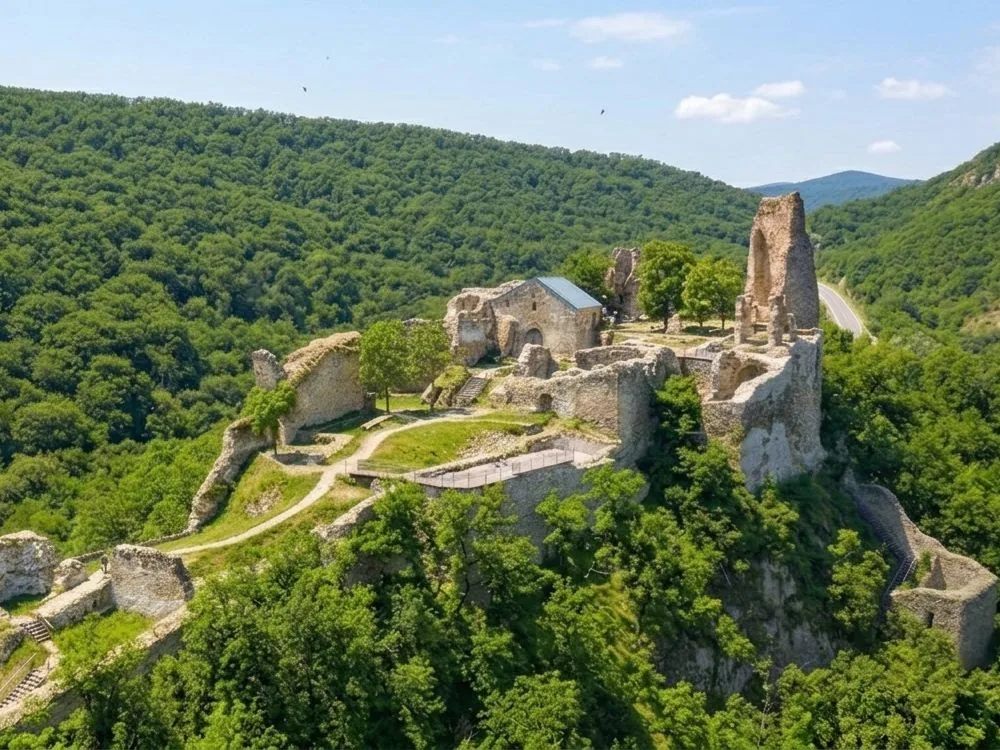
© Castles & Palaces
Quick Facts
- Hours
- Mon–Sun open
- Day trip from
- €55
- Duration
- 1 hour at the fortress ruins; full day on the GetYourGuide wine tour
- Best time
- April to October
- Nearest city
- Sighnaghi
Featured Tour
Tbilisi: Kakheti Wine Tour via Telavi and Gremi
Cancellation available · Instant confirmation
Highlights
- ✦The site of Georgia's Christianisation — according to Georgian tradition, the 4th-century evangelist Saint Nino first came to Ujarma and converted King Bakur of Iberia to Christianity here, an event that preceded the official royal conversion of King Mirian III in 327 CE; Ujarma is consequently one of the foundational sites in Georgian Christian history, predating even the construction of Mtskheta's famous Jvari Monastery
- ✦4th-century royal residence — the fortress complex dates to the early Kingdom of Iberia (eastern Georgia), making it one of the oldest royal residences in the Caucasus with documented history; the plateau position above the Iori river valley gave the early Iberian kings both a defensible seat and views over a strategic river crossing
- ✦Panoramic Iori River valley views — the fortress plateau gives views over the Iori gorge and the surrounding Kakheti lowlands that are among the most unobstructed in the region; unlike many Georgian fortresses embedded in steep gorges, Ujarma's elevated plateau position offers long sight lines in multiple directions
- ✦Shared GetYourGuide wine tour with Batonis Tsikhe — the Kakheti wine and culture day tour from Tbilisi visits Ujarma Fortress as a formal itinerary stop alongside Batonis Tsikhe, Gremi Citadel, Alaverdi Monastery, and Gombori Pass; the tour explicitly confirms the visit ('Visit to Ujarma Fortress' as a formal highlight) while also explicitly excluding the 10 GEL on-site entrance fee — bring lari for the gate
- ✦Off-the-beaten-path Kakheti — Ujarma receives far fewer visitors than Sighnaghi, Gremi, or the Alazani Valley's main wine route stops; for visitors who have already done the standard Kakheti circuit, it offers a more archaeological, less tourism-facing experience of the region's historical depth
Tickets & tours
Book through GetYourGuide
Ujarma Fortress stands on a plateau above the Iori River valley in eastern Kakheti, its remaining walls and towers rising from a position that gives long views over the surrounding lowlands. The site dates to the 4th century CE — one of the oldest documented royal residences in the Caucasus — and occupies a particular place in Georgian Christian tradition as the site where Saint Nino is said to have first preached and converted King Bakur of Iberia, an event that preceded the official royal conversion of King Mirian III in 327 CE.
The fortress's historical importance is inversely proportional to its current visitor numbers. Ujarma sits off the main Kakheti tourist circuit — the wine route along the Alazani Valley that connects Telavi, Gremi, and Sighnaghi draws the majority of visitors to the region — and the ruins themselves are more archaeological than spectacular in the manner of Rabati Castle or Narikala Fortress. The walls and towers that remain are medieval rebuildings over 4th-century foundations, partially consolidated in the 20th century, and the visit is most rewarding for visitors who come with an understanding of the site's place in Georgian early Christian history.
The GetYourGuide Kakheti wine and culture tour from Tbilisi (shared with Batonis Tsikhe) includes Ujarma as a formal itinerary stop — the tour lists 'Visit to Ujarma Fortress' as a confirmed highlight. The tour's written Includes section, however, also explicitly states in prose that entrance fees are not included in the tour price, and itemizes 'Visit to Ujarma Fortress: 10 GEL' as an optional on-site ticket that visitors pay separately at the gate if they choose to enter the ruins. The 10 GEL (~€3–4) is small, and the visit is typically worth it for the plateau views and the wall circuit.
History
Ujarma Fortress's documented history begins in the 4th century CE with the Kingdom of Iberia (eastern Georgia). Georgian chronicles record it as a royal residence of the Iberian kings and associate it with the early Christian mission of Saint Nino (c. 327 CE). The fortress was developed through the medieval Kingdom of Georgia and served as a royal seat during the Bagratid period. It was damaged and partially destroyed during successive Mongol, Persian, and Ottoman incursions but remained a recognisable fortress throughout. The complex was incorporated into the Russian Empire in the early 19th century and has been a protected historical monument since the Soviet period.
How to Visit
Getting there: Ujarma is approximately 75 km east of Tbilisi, off the main Kakheti highway near Sagarejo. The fortress is reached by a local road from the village of Ujarma. The GetYourGuide Kakheti day tour departs from Tbilisi and includes transport to Ujarma as part of the day's programme.
Tickets: On-site entrance approximately 10 GEL (~€3–4), paid at the gate. The tour confirms the stop at Ujarma but explicitly excludes this fee — bring lari for payment at the gate. Note: the tour text says the entry is optional if you prefer to visit the surrounding area without entering.
Practical tips: The plateau views over the Iori valley are the main reward of the visit; take time on the plateau rim before exploring the wall circuit. The fortress is less visited than most Kakheti sites, which means a quieter experience than at Sighnaghi or Gremi. The tour also visits Batonis Tsikhe, Gremi Citadel, Alaverdi Monastery, and Gombori Pass on the same day — a comprehensive Kakheti programme.
Combine with: Batonis Tsikhe (the Kakhetian royal palace-fortress in Telavi, covered by the same tour and in the same region) and Gremi Citadel (the 1565 royal citadel of the Kingdom of Kakheti, also on the same tour).
Frequently Asked Questions
Georgian tradition holds that Saint Nino — a Cappadocian woman who brought Christianity to Georgia in the early 4th century CE — first arrived at Ujarma and converted King Bakur of Iberia, an event that reportedly preceded the official royal conversion. King Mirian III subsequently converted to Christianity in 327 CE and declared it the state religion of Iberia (eastern Georgia), making Georgia one of the earliest Christian states in the world (along with Armenia, which converted in 301 CE). Ujarma's association with Saint Nino's mission gives it a foundational significance in Georgian Christian identity that its physical appearance — impressive ruined walls rather than a visually spectacular fortress — does not immediately suggest.
Location
Ujarma, Kakheti, Georgia
Nearby Castles
Tours & Tickets
Powered by GetYourGuide
From
€55/ person