
Gremi Citadel
გრემის ციხე
Georgia · Kakheti, Georgia · Near Telavi
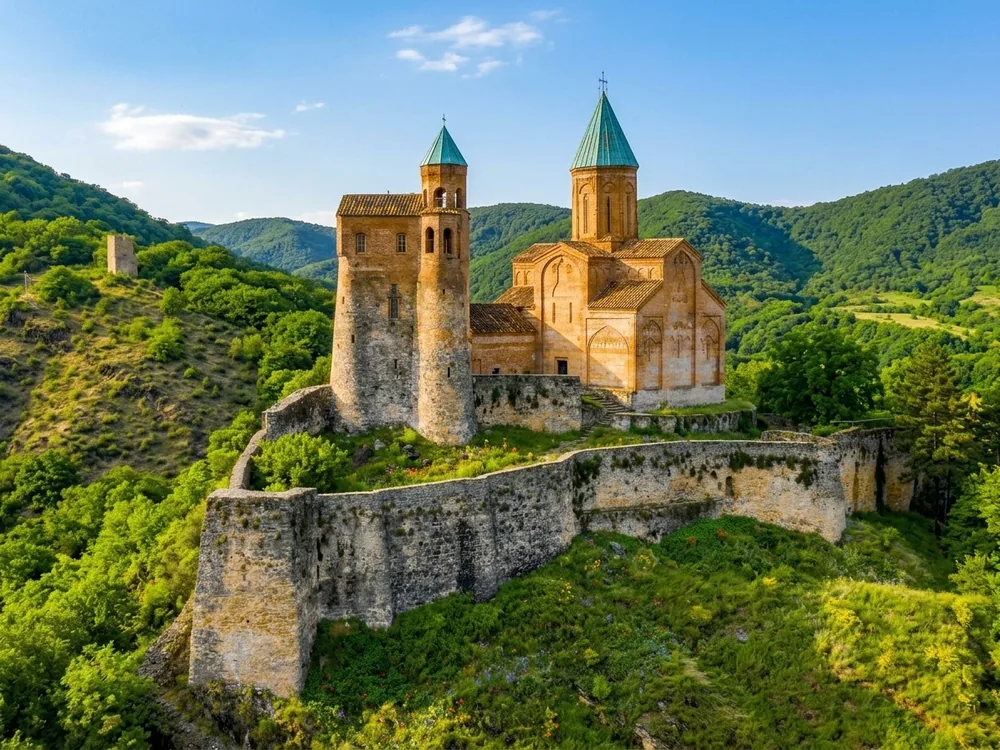
Built 1565 · 16th-century royal citadel and attached Church of the Archangels on a rocky outcrop above the Alazani Valley; built by King Levan of Kakheti (r. 1520–1574) as the royal capital of the Kingdom of Kakheti; the citadel tower serves as both a defensive keep and a bell tower, rising above the domed church below; the complex represents the characteristic Kakhetian blend of military and ecclesiastical architecture at the height of the kingdom's power
This page is part of an independent travel guide and is not affiliated with, endorsed by, or operated by Gremi Citadel.
© Castles & Palaces
Quick Facts
- Hours
- Daily 10:00–17:00
- Day trip from
- €207
- Duration
- 45 minutes – 1 hour at the citadel; full day on the GetYourGuide wine-region tour
- Best time
- April to June, September to November
- Nearest city
- Telavi
Featured Tour
Tbilisi: Regional Wine Tour in Kakheti (Full Day, Private)
Cancellation available · Instant confirmation
Highlights
- ✦The lost capital of Kakheti — Gremi was the royal capital of the Kingdom of Kakheti from its founding in the 15th century until 1615, when Shah Abbas I of Persia sacked and burned the city during his devastating campaign through Georgia; the citadel and the Church of the Archangels are the only major structures to survive the destruction, preserved on their rocky outcrop above the ruins of what was once a substantial royal city
- ✦King Levan's church-citadel, built in one — the most architecturally distinctive feature of Gremi is the integration of the Church of the Archangels (1565) with the defensive tower immediately above it; the tower serves simultaneously as the church's bell tower and as the citadel's defensive keep, a dual function that reflects the Kakhetian tradition of treating sacred and military architecture as complementary expressions of royal authority
- ✦The Alazani Valley panorama — Gremi's rocky outcrop position gives views over the full breadth of the Alazani Valley, the agricultural heartland of Kakheti and the principal wine-producing region of Georgia; the valley's combination of vineyard-covered slopes, the Caucasus foothills to the north, and the Alazani river plain is one of the defining landscapes of the eastern Caucasus
- ✦Kakheti wine-region day tour with entrance included — the GetYourGuide full-day private tour covers Gremi Citadel with entrance fees included in the GetYourGuide Includes section, alongside Twins Winery Museum, the Kindzmarauli Corporation winery, and Tsinandali Museum; this is a complete Kakheti day that pairs Georgia's most important fortress with its most important wine-producing context
- ✦Shah Abbas's 1615 destruction — the Safavid Persian campaign of 1615 under Shah Abbas I is one of the defining catastrophes of Georgian history; the army destroyed Gremi city, killed or deported a large proportion of the Kakhetian population, and effectively ended Kakheti's period as an independent kingdom; the visible contrast between the intact citadel and church (which survived) and the complete absence of the former royal city below gives Gremi a melancholy weight unusual even among Georgian fortress sites
Tickets & tours
Book through GetYourGuide
Gremi Citadel and its Church of the Archangels stand on a rocky outcrop above the Alazani Valley in Kakheti, the wine-producing region of eastern Georgia. They are the only substantial remains of Gremi, a royal city that was once the capital of the Kingdom of Kakheti and was destroyed in 1615 by Shah Abbas I of Persia's devastating campaign through Georgia.
The complex was built in 1565 by King Levan of Kakheti (r. 1520–1574), who commissioned both the citadel tower and the Church of the Archangels as integrated expressions of royal and divine authority. The two structures are architecturally inseparable: the church rises from the rock face on carved stone pendentives, and the defensive tower above it serves simultaneously as bell tower and keep — a design that treats worship and defence as aspects of the same royal function. This Kakhetian blending of military and ecclesiastical architecture is characteristic of the region and has no precise equivalent elsewhere in Georgia.
The Kingdom of Kakheti that Gremi served as capital was a significant state at the eastern edge of the Christian world, wedged between the Ottoman Empire to the west and the Safavid Persian Empire to the east. Its survival depended on alternating alliances and payments to both powers, a political tightrope that broke catastrophically in 1615 when Shah Abbas I launched a full-scale military campaign against Georgia. The Persians sacked and burned Gremi, killing a substantial portion of the population and deporting survivors to Iran; the city that had accumulated around the royal citadel was destroyed so thoroughly that its archaeological remains are still being excavated. The citadel and church on the rocky outcrop were preserved by their position and their stone construction while the city below disappeared.
The GetYourGuide full-day Kakheti wine tour includes Gremi among its four confirmed stops — entrance fees at Gremi are included in the GetYourGuide Includes section. The tour structure reflects the logic of the Kakheti region: the area's importance in Georgian history is inseparable from its identity as the country's primary wine-producing zone, and the tour combines the region's military and ecclesiastical history (Gremi) with its living wine culture (Twins Winery, Kindzmarauli, Tsinandali). For visitors with a single day in Kakheti, this multi-stop format is the most efficient way to understand both dimensions of the region.
History
A fortified position at Gremi is documented from the medieval Kingdom of Kakheti, which became an independent state in the late 15th century after the fragmentation of the Kingdom of Georgia. King Levan of Kakheti commissioned the current church and tower complex in 1565, establishing Gremi as the royal capital. The city that grew around the citadel was a significant commercial and administrative centre by the late 16th century. Shah Abbas I of Persia's 1615 campaign through Georgia destroyed the city and massacred or deported a large part of the Kakhetian population; Gremi was never rebuilt as a royal capital. The Kakhetian kingdom was subsequently absorbed into the Russian Empire in 1801. The citadel and church were designated a protected historical monument in the Soviet period and have been partially restored.
How to Visit
Getting there: Gremi is approximately 25 km from Telavi, the main city of Kakheti, on the road toward Lagodekhi. From Tbilisi, Kakheti is approximately 90 km via the Gombori Pass route or via Mtskheta on the faster road; most visitors approach Gremi as part of a Kakheti day tour from Tbilisi. The GetYourGuide full-day wine tour departs from Tbilisi and handles all transport.
Tickets: Walk-up entry to the Gremi Citadel and Church of the Archangels is a small fee payable on-site (approximately 5 GEL). The GetYourGuide full-day Kakheti private tour confirms entrance to Gremi included in the tour price — one of four confirmed stops on a full-day programme also covering Twins Winery Museum, Kindzmarauli Corporation, and Tsinandali Museum.
Practical tips: The view from the citadel tower roof over the Alazani Valley and toward the Greater Caucasus is the visual high point of the visit — take time at the top before descending into the church interior below. October is grape harvest season in Kakheti and the most atmospheric time to visit; the valley's vineyards and the active winery operations at the tour's wine stops make the wine-culture dimension of Kakheti most legible in autumn.
Combine with: Narikala Fortress (the historic fortress above Tbilisi's Old Town, the starting or ending point for most Kakheti day tours) and Ananuri Fortress (a 17th-century fortress complex on the Georgian Military Highway north of Tbilisi, often combined with the Kakheti day on the return drive via the Gombori Pass).
Frequently Asked Questions
The 1615 Persian campaign under Shah Abbas I was one of the most devastating events in Georgian history, targeting Kakheti specifically because its king Teimuraz I had expelled and killed the Persian governor and sought alliances with Russia. Shah Abbas's response was a systematic depopulation — Georgian historians estimate that 100,000 or more Kakhetians were killed or deported to Iran over the course of the campaign. Gremi, as the royal capital, was destroyed completely. Teimuraz I survived by fleeing, but the population and infrastructure that supported the royal city were gone. When Kakheti was gradually reestablished in the following decades, the political centre shifted to Telavi, where Batonis Tsikhe fortress was built as the new royal residence in the 17th and 18th centuries. Gremi was not rebuilt because there was no longer a population to sustain a city there.
Location
Gremi, Kakheti, Georgia
Nearby Castles
Tours & Tickets
Powered by GetYourGuide
From
€207/ person