
Mystras
Μυστράς
Greece · Peloponnese, Laconia, 8km west of modern Sparta · Near Sparta
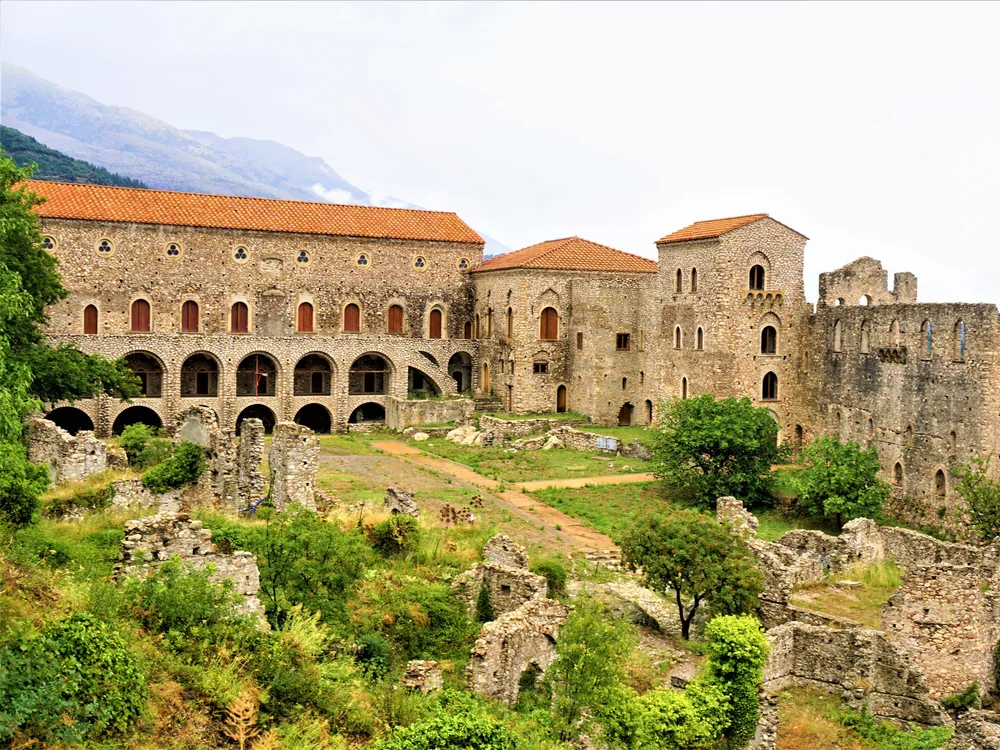
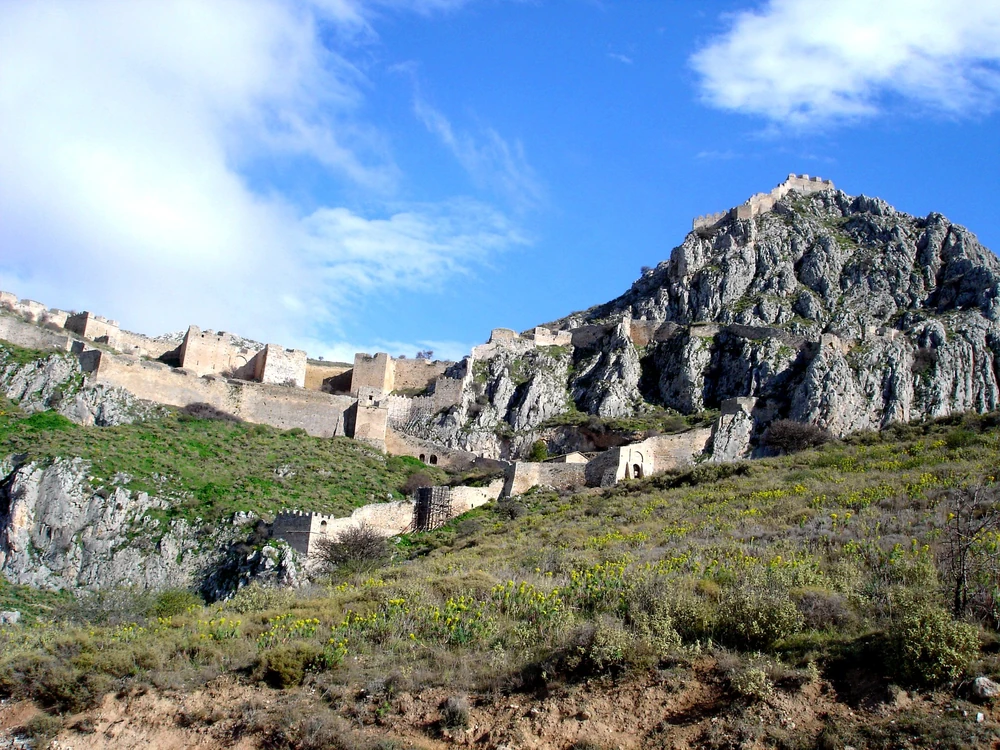
Built 1249 · Fortified Byzantine hill city — Frankish castle (1249) at the summit with curtain walls rebuilt under Byzantine and Despotate rule; Palace of the Despots (mid-14th century) on the upper slope, a substantial secular complex with arched halls; Late Byzantine churches and monasteries (Peribleptos, Pantanassa, Metropolis of Saint Demetrios) across the middle and lower town, preserving the finest surviving ensemble of 14th–15th-century Byzantine fresco painting; the site is an archaeologically preserved ghost city — uninhabited since the 1830s — and was inscribed as a UNESCO World Heritage Site in 1989 for its exceptional completeness as a medieval Byzantine urban landscape
This page is part of an independent travel guide and is not affiliated with, endorsed by, or operated by Mystras.
© Castles & Palaces
Quick Facts
- Hours
- Daily 08:00–20:00
- Guided tour from
- €230
- Duration
- 2–3 hours (upper + lower town walking circuit)
- Best time
- April to June or September to October
- Nearest city
- Sparta
Featured Tour
From Athens: Ancient Sparta and Nemea Wine Country Day Trip
Cancellation available · Instant confirmation
Highlights
- ✦The only intact medieval Byzantine ghost city in Greece — uninhabited since the 1830s when its population moved to modern Sparta; the castle, palace, churches, and monasteries survived without the demolition that typically follows urban abandonment, leaving a complete Byzantine cityscape accessible as an open archaeological site
- ✦UNESCO World Heritage Site (1989) — inscribed for its exceptional preservation as an abandoned medieval urban landscape and for the finest surviving ensemble of Late Byzantine fresco painting outside Constantinople itself
- ✦George Gemistos Plethon's Platonic Academy — the philosopher who settled at Mystras around 1410 and taught there until 1452 was the direct catalyst for Cosimo de' Medici's Platonic Academy in Florence; Plethon's lectures at the Council of Florence in 1438 introduced Italian humanists to Platonic philosophy through the living Byzantine scholarly tradition; his tomb is at Mystras
- ✦The last Byzantine stronghold to fall — Constantinople fell to Mehmed II in May 1453; Mystras, under Despot Demetrios Palaiologos, held out for seven more years; its surrender in 1460 was the final end of the Byzantine political presence in mainland Greece
- ✦The Peribleptos and Pantanassa frescoes — mid-14th-century Byzantine painting at its technical zenith; the spatial depth, expressive figures, and narrative invention of the Mystras workshops are considered the culmination of the Byzantine tradition and a direct influence on the earliest Italian Renaissance painters who encountered Greek scholars fleeing the fall of Constantinople
- ✦Private day trip from Athens covering Mystras + ancient Sparta + Nemea wine country (from €230 private tour; independent entry approximately €12)
Skip the queue with a guided tour
Skip-the-line tickets & expert guides
Mystras is a medieval city built into a Peloponnesian hillside that has been empty for nearly two hundred years. The churches still stand. The palace walls are still standing. The frescoes painted inside the Peribleptos monastery in the mid-14th century — a Byzantine art form that reached its technical zenith here, in this remote provincial capital, at the same moment that Constantinople was entering its final century — are still visible on the walls. The city abandoned in the early 1830s in favor of a new, purpose-built Sparta on the plain below, Mystras survived as a ghost, and the ghost is now a UNESCO World Heritage Site.
The site's history begins with a Frankish castle. In 1249, William II of Villehardouin — Prince of Achaea, one of the Latin rulers who had divided Byzantine Greece among themselves after the Fourth Crusade sacked Constantinople in 1204 — built a castle on a steep conical hill eight kilometres west of ancient Sparta. The choice of location was military: the hill offered a commanding position over the Eurotas River valley and the passes into the Taygetos Mountains. A town began to grow on the slopes below the castle walls.
William's castle did not remain Frankish for long. In 1262, he was forced to cede it to Michael VIII Palaiologos — the Byzantine emperor who had just retaken Constantinople from the Latins — as a condition of his release from Byzantine captivity following his capture at the Battle of Pelagonia. The Byzantine reconquest of Mystras was the beginning of something unexpected: the slow repopulation and extension of Byzantine political authority in the Peloponnese over the following decades, as the territory around the castle was gradually wrested from the remaining Frankish principalities. By the mid-14th century, the Despotate of Morea — the Byzantine semi-autonomous principality governing the Peloponnese — had made Mystras its capital, and the Palaiologos dynasty's despots were building it into the last major flowering of Byzantine civilization in Greece.
The churches and monasteries built on the hillside during the Despotate period constitute what is generally considered the finest surviving ensemble of Late Byzantine ecclesiastical art anywhere. The Peribleptos monastery, the Pantanassa convent — the only site at Mystras still inhabited, where a small community of nuns remains in residence and receives visitors — the Metropolis of Saint Demetrios: each preserves frescoes from the 14th and 15th centuries painted by artists working in a tradition that was simultaneously refining Byzantine icon-painting into something more spatially dynamic, with deeper landscape settings and more expressive human figures, than anything the Byzantine tradition had produced before.
The intellectual life of Mystras in its last decades is inseparable from George Gemistos Plethon, the philosopher who settled in the city around 1410 and remained there until 1452 — the year before Constantinople fell. Plethon was a neo-Platonist at a moment when Aristotelianism dominated both Byzantine and Latin scholasticism; his project of reviving Platonic philosophy placed him at the centre of the intellectual movement that would connect the Byzantine world to the Italian Renaissance. He attended the Council of Florence in 1438, where his lectures directly inspired Cosimo de' Medici to establish his Platonic Academy in Florence — the institution through which Platonic thought re-entered Western European intellectual life after a thousand years of eclipse. Plethon died at Mystras in 1452; his tomb is in the lower town, marked simply and visited by scholars who understand what he set in motion.
Constantinople fell to Mehmed II in May 1453. Mystras, under Despot Thomas Palaiologos, held out for seven more years. When the city's last despot, Demetrios Palaiologos (Thomas's brother), finally surrendered to Mehmed II in 1460, he was ending the Byzantine political presence in mainland Greece. The city continued under Ottoman and later alternating Venetian and Ottoman rule through the 17th and 18th centuries, but its population shrank progressively. When the Greek War of Independence established the modern Greek state, the new government built a modern Sparta on the ancient plain below. By the early 1830s, Mystras was empty.
The absence of continuous occupation after that point is the principal reason for the site's remarkable survival: the churches were not demolished for building material, the palace walls were not dismantled, the frescoes were not plastered over. The ghost city simply sat on its hillside and weathered.
The site today is organized into upper, middle, and lower towns, each accessible on foot from the main entrance gate. The upper town contains the Frankish-Byzantine castle and the Palace of the Despots — a substantial secular complex with arched halls and window openings that preserve the outline of a late medieval administrative and residential complex. The middle and lower towns contain the major churches and the Pantanassa convent. The circuit between all sections involves significant uphill walking on uneven stone paths; sturdy footwear and water are non-negotiable in summer, when the exposed hillside in July and August can be exhausting. The best strategy is to enter from the upper gate (by taxi or car from Sparta), work downhill through the palace and upper churches, and exit through the lower town — a descent rather than an ascent.
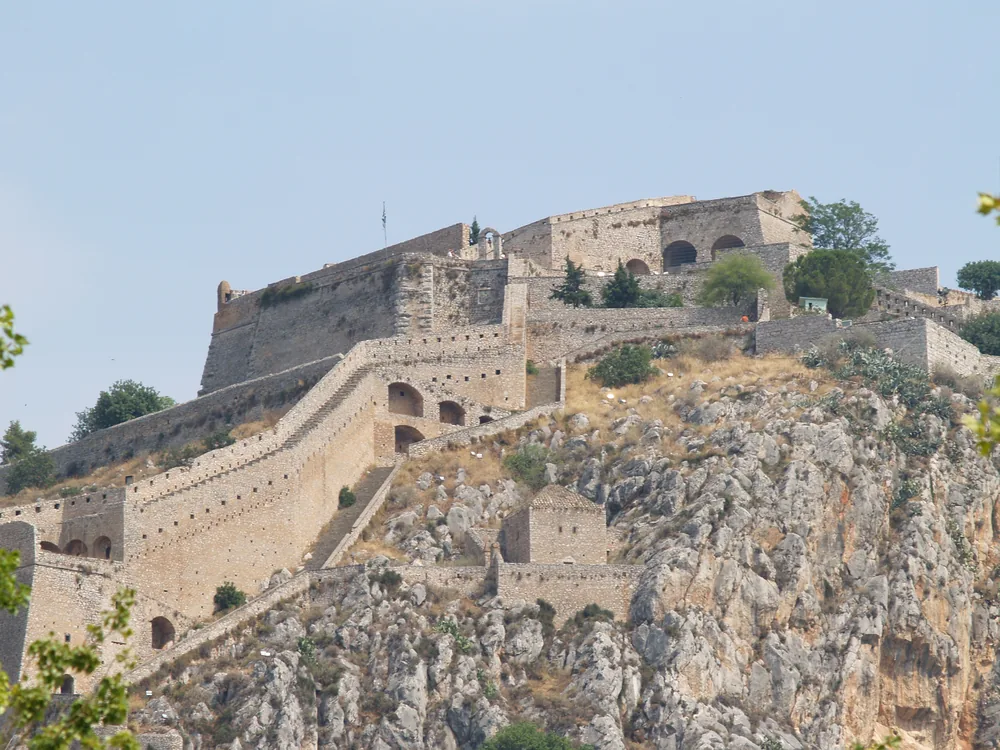
Elsewhere in the Peloponnese: [Palamidi Fortress](/castles/greece/palamidi-fortress), 75 kilometres northeast in Nafplio, is an 18th-century Venetian citadel overlooking the Gulf of Argolis — a fortification of a completely different era and character from Mystras but equally impressive in its hillside position. [Acrocorinth](/castles/greece/acrocorinth), at the northern edge of the Peloponnese 100 kilometres north, was the ancient and medieval acropolis of Corinth, fortified continuously from antiquity through the Ottoman period — the Peloponnese's longest-occupied strategic height.
History
Mystras's history begins with an act of military opportunism that rapidly became something much larger. William II of Villehardouin, Prince of Achaea, built a Frankish castle on the steep conical hill in 1249 to command the Eurotas valley below. Thirteen years later, captured by Byzantine forces at the Battle of Pelagonia, he ceded Mystras to Emperor Michael VIII Palaiologos as a condition of his release — and inadvertently set in motion the Byzantine reconquest of the Peloponnese. A town that had already begun growing on the slopes below the castle became, over the following decades, the capital of the Despotate of Morea and the most vital centre of late Byzantine civilisation in Greece.
The Palaiologos despots who ruled from Mystras through the 14th and 15th centuries commissioned an extraordinary programme of churches and monasteries — the Peribleptos, Pantanassa, and Metropolis of Saint Demetrios — whose fresco cycles represent Late Byzantine painting at its technical zenith. The city's intellectual life was equally remarkable. Around 1410, the philosopher George Gemistos Plethon settled at Mystras and developed the Neoplatonic teaching he would later bring to the Council of Florence in 1438, directly shaping the Florentine Renaissance through his influence on Cosimo de' Medici. Constantine Palaiologos, the last Byzantine Emperor, ruled as Despot of Morea here before his coronation; Plethon died at Mystras in 1452.
Constantinople fell in 1453. Mystras held out for seven more years before Despot Demetrios Palaiologos surrendered to Mehmed II in 1460 — the final Byzantine city on mainland Greece to fall. Ottoman and later Venetian-Ottoman rule brought gradual population decline. By the early 1830s, during the Greek War of Independence, the hillside city was abandoned as its residents relocated to newly built modern Sparta on the plain below. The ghost city received UNESCO inscription in 1989.
How to Visit
Getting there: Mystras is 8 km west of modern Sparta — about 2.5 hours from Athens by car via the E65/A7 motorway. By bus, KTEL services from Athens (Terminal B) run to Sparta regularly; from Sparta, taxis connect to the site (approximately €10). Enter from the upper gate to work downhill through the castle and palace before descending to the churches.
Tickets: Entry costs €12 for adults; children enter free. The GetYourGuide "From Athens: Ancient Sparta and Nemea Wine Country Day Trip" is a full private day trip covering Mystras, ancient Sparta, and Nemea wine country — the price covers the complete Athens-return private excursion, not the site entry alone.
Practical tips: Wear sturdy shoes with grip — the stone paths are consistently steep and uneven throughout. Carry water, as shade is limited outside the church interiors. The Pantanassa convent requires modest dress (shoulders and knees covered); a small community of nuns still lives here and welcomes respectful visitors.
Combine with: Chlemoutsi Castle, the best-preserved Frankish castle in Greece on the western Peloponnese coast, is the natural pairing — together they trace the Frankish and Byzantine sides of medieval Peloponnese history in a single Peloponnese itinerary.
Frequently Asked Questions
Mystras was inscribed in 1989 for two reasons: its exceptional preservation as a complete, abandoned medieval urban landscape — castle, palace, churches, monasteries, and residential streets surviving without the demolition or rebuilding that typically follows urban abandonment — and for its status as the finest surviving concentration of Late Byzantine fresco painting anywhere. The frescoes of the Peribleptos and Pantanassa monasteries are considered among the most accomplished examples of Byzantine art produced before the fall of Constantinople.
Location
Mystras Archaeological Site, 231 00 Mystras, Laconia, Greece
Nearby Castles
Tours & Tickets
Powered by GetYourGuide
From
€230/ person