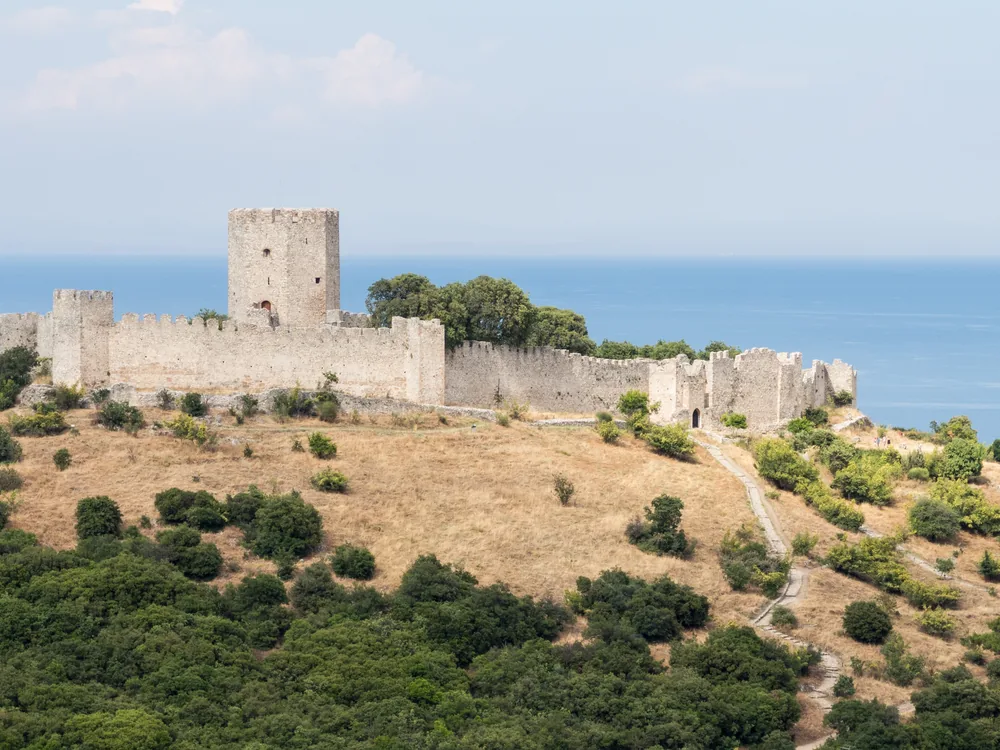
Platamon Castle
Κάστρο Πλαταμώνα
Greece · Central Macedonia (Pieria), foot of Mount Olympus · Near Katerini
Built 1204 · Crusader fortress with Byzantine and Ottoman modifications; cylindrical keep tower (28m), curtain walls on natural promontory, square entrance tower — characteristic of Lombard castle-building in post-Fourth Crusade Greece
This page is part of an independent travel guide and is not affiliated with, endorsed by, or operated by Platamon Castle.
© Castles & Palaces
Quick Facts
- Hours
- Daily 08:00–20:00
- Day trip from
- €78.3
- Duration
- 1–2 hours (castle walls, round keep, and coastal panorama); the GetYourGuide sunset tour is a 4-hour multi-site excursion
- Best time
- May to October
- Nearest city
- Katerini
Featured Tour
Pieria: the Olympus Sunset Tour with Platamon Castle Visit
Cancellation available · Instant confirmation
Highlights
- ✦Strategic position — Platamon controls the narrow coastal pass between Macedonia and Thessaly, where the Olympus foothills meet the Aegean; every power from ancient Macedon to the Ottomans held this point because whoever controlled Platamon controlled the road south
- ✦Crusader construction (1204–1222) — built by the Lombard knight Rolando Piska under Boniface of Montferrat after the Fourth Crusade, on the ruins of the ancient city of Heraklion; the cylindrical keep is the defining surviving element
- ✦Three-empire layering — Byzantine, Crusader, and Ottoman phases are all visible in the fabric; Byzantine recapture 1218, Ottoman from 1385, with a brief Venetian interruption in 1425
- ✦Mount Olympus panorama — the castle stands at the precise junction of the Aegean and the Olympus massif; the 2,917-metre summit is directly visible from the keep walls
- ✦Olympus Festival — the castle's interior courtyard hosts a celebrated annual summer festival of classical music and theatre, with the medieval walls and sea as the backdrop
- ✦Site of the first Central Macedonia entry on this site — Platamon is geographically distinct from the site's other Greek castles (Peloponnese, Rhodes, Corfu) and represents a different region of Greek history entirely
Tickets & tours
Book through GetYourGuide
Platamon Castle occupies a rock promontory on the Aegean coast of Pieria, at the point where the sea meets the foothills of the Olympus range, and controls one of the most strategically important passes in Greece: the narrow coastal corridor connecting Macedonia to Thessaly and the south, where the mountains come close enough to the water that any army moving between the two regions had to pass through this gap. Ancient geographers called the valley inland from here the Tempe — the Vale of Tempe, celebrated from antiquity as a place of exceptional beauty and as the pass through which the Persian army of Xerxes descended in 480 BC — and the military logic of the position was understood long before the castle was built.
The ancient city of Heraklion occupied this site from at least the 4th century BC. The city's remains — walls, foundations, ceramic evidence — survived beneath and around the medieval structure that replaced it. After the Fourth Crusade fractured the Byzantine Empire in 1204 and redistributed its provinces among the victorious Latin powers, the region of Thessaloniki was given as a kingdom to Boniface of Montferrat. It was under Boniface's authority that the Lombard knight Rolando Piska began construction of the Crusader castle at Platamon, built on the foundations of ancient Heraklion between 1204 and 1222. The castle used the characteristic techniques of Crusader military architecture: a round keep tower at the highest point of the promontory, curtain walls following the natural contours of the rock, and a square entrance tower at the main gate.
Crusader control of Platamon was brief. Byzantine noble Theodoros Komnenos Doukas, who was building his Epirus Despotate into a significant rival power in northwest Greece, captured Platamon in 1218 — less than fifteen years after it was built. Byzantine control meant the strategic imperative was maintained and reinforced: whoever held Platamon controlled the road between Macedonia and Thessaly. The castle changed hands again in 1385, when Ottoman forces under Murad I took the position as part of their systematic conquest of mainland Greece. The Venetians briefly seized it in 1425 but could not hold it; Platamon remained under Ottoman control for the better part of five centuries thereafter, maintained because every Ottoman administrator understood, as every power before them had, that this narrow coastal pass required a defensible fortification.
The castle's visible fabric today is primarily the product of the Crusader construction period, with modifications from the Byzantine and early Ottoman phases. The round keep — a 28-metre cylindrical tower at the highest point of the promontory — is the most dramatic surviving element and commands views across the Aegean coastline and back toward the Olympus massif. The curtain walls, partially collapsed in sections, trace the original perimeter of the Crusader fortress. The square entrance tower at the western gateway preserves its archway and portions of the mechanism recesses for the portcullis. Ottoman-era additions included a mosque — the foundation remains visible within the enclosure — and minor modifications to the gate complex.
What makes Platamon Castle visually extraordinary is not primarily its architecture but its setting. The castle stands at the precise junction of the Aegean and the Olympus range: looking east from the keep, the sea stretches to the horizon; looking west, Mount Olympus — at 2,917 metres the highest peak in Greece, its summit frequently above the cloud line — fills the skyline directly behind the castle walls. This juxtaposition of mythological mountain and medieval fortress, framed by the Aegean coastline and the Vale of Tempe to the south, gives the site an almost operatic quality that photographs do not fully convey.
Platamon has been managed as an archaeological site under the Greek Ministry of Culture since the mid-20th century and has been partially excavated over several decades. The site has also become known for its summer programme: the Olympus Festival, held annually within the castle's open-air enclosure, hosts classical music and theatrical performances using the medieval walls as a backdrop and the Aegean as a stage set. Festival periods can affect visitor access to portions of the site; checking the festival calendar before planning a visit is advisable.
The GetYourGuide sunset tour (4 hours) approaches Platamon Castle as one of several stops on a multi-site evening excursion departing from Litochoro. The tour also visits Leibethra — the mythological birthplace of Orpheus — and the hillside village of Paleos Panteleimonas. IMPORTANT: the tour is organized around the Olympus sunset panorama experience, not guaranteed interior castle access. At least one verified GetYourGuide reviewer noted that the castle was already closed for interior entry by their visit time and the tour focused on the exterior and views. Visitors wishing to access the castle interior, the excavated areas within the walls, and the keep tower should visit directly during morning hours on the standard archaeological site admission schedule.
Platamon Castle is located 80 kilometres south of Thessaloniki on the E75 motorway, at the Platamonas exit. The nearest significant town is Litochoro, the main gateway for Olympus trekking, 8 kilometres to the southwest. The castle is clearly signposted from the coastal road and has a small car park at the base of the approach path. The walk from the car park to the keep takes approximately 15 to 20 minutes along an uphill path with uneven stone sections. Platamon is the site's first entry in the Central Macedonia and Thessaly region — geographically distinct from the site's other Greek castle clusters in the Peloponnese, Rhodes, and Corfu.
History
Ancient city of Heraklion on site from 4th–3rd century BC. Crusader castle built 1204–1222 by Lombard knight Rolando Piska under Boniface of Montferrat, Kingdom of Thessaloniki, after the Fourth Crusade. Captured by Byzantine Theodoros Komnenos Doukas in 1218. Taken by Ottoman forces in 1385; brief Venetian occupation 1425; remained Ottoman for nearly five centuries. Managed as a Greek Ministry of Culture archaeological site since the mid-20th century.
How to Visit
Getting there: 80 km south of Thessaloniki on the E75/A1 motorway — exit at Platamonas and follow the coastal road to the small car park at the base. From the car park, the walk to the keep takes 15–20 minutes on an uphill path with uneven stone sections.
Tickets: Entry costs €4 (children €2). The GetYourGuide day trip is a 4-hour Olympus sunset excursion from Litochoro that includes a Platamon Castle stop, Leibethra, and the hillside village of Paleos Panteleimonas — note that interior castle access is not guaranteed on this evening tour.
Practical tips: For assured interior access to the castle and keep, visit during morning hours on the standard archaeological site schedule. The Olympus Festival hosts classical music and theatre within the castle walls each summer — check dates in advance as festival events can restrict access to portions of the site.
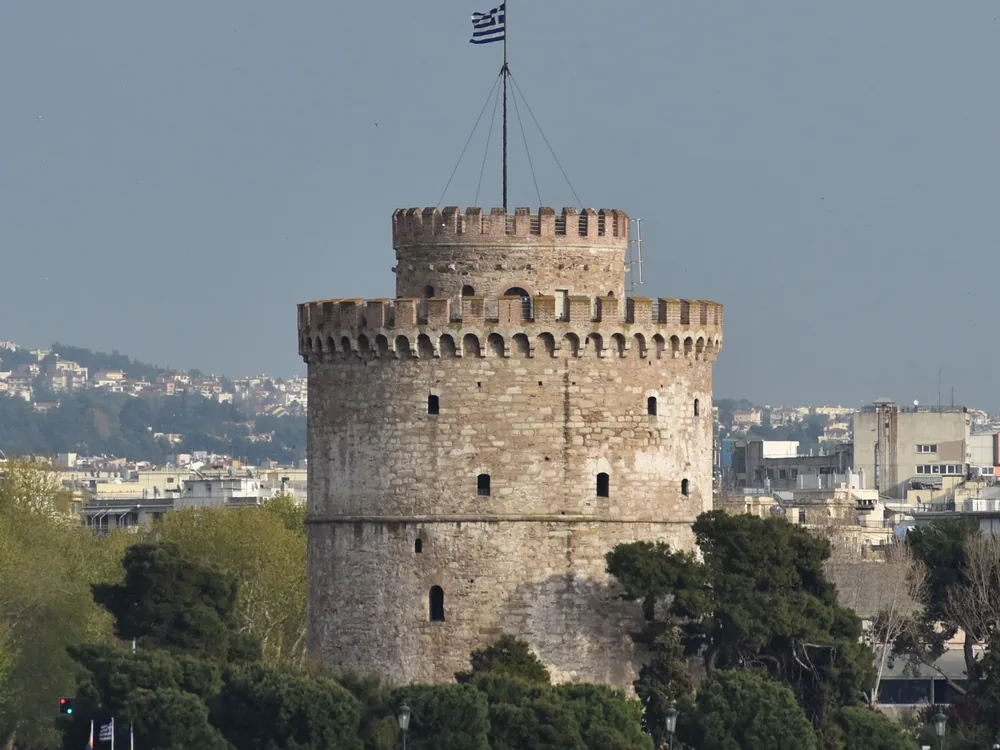
Combine with: White Tower of Thessaloniki 80 km north for a full day combining two of northern Greece's most significant medieval fortifications.
Frequently Asked Questions
The Vale of Tempe is the narrow river valley cut by the Peneios River between Mount Olympus and the Ossa range — one of only two natural passes between Macedonia and central Greece. In antiquity, any army moving between northern and southern Greece had to pass through it, making it one of the most strategically important geographic features in the Balkans. Xerxes' army used it in 480 BC; Philip II of Macedon fought for control of the Tempe approaches; the Roman legions marched through it repeatedly. The valley was also celebrated in ancient literature for its landscape beauty and its connection to the cult of Apollo.
Location
Platamonas, 600 65, Pieria, Greece
Nearby Castles
Tours & Tickets
Powered by GetYourGuide
From
€78.3/ person