
Ballynahinch Castle
Caisleán Baile na hInse
Ireland · Connemara, County Galway · Near Recess
Built 1756 · 18th-century Connemara estate house incorporating the site of a c.1546 O'Flaherty tower house built by Dónal Ó Flaithbheartaigh around his marriage to Grace O'Malley (Gráinne Mhaol); the present building is a castellated Georgian-era house built by the Martin family in 1756 on O'Flaherty land acquired during the Cromwellian settlement; the Martin family — one of the Fourteen Tribes of Galway, descendants of the Norman-Irish oligarchy that controlled the medieval city — held Ballynahinch for over two centuries; Richard 'Humanity Dick' Martin (1754–1834), creator of the first Irish animal welfare legislation and co-founder of what became the RSPCA, lived here; the estate passed through several owners in the 19th century before being purchased by H.H. Ranjitsinhji, the Indian cricket legend and ruler of the princely state of Nawanagar, in 1924 — who was drawn by Connemara's salmon fishing; converted to a hotel in the 1930s, now one of Connemara's most characterful luxury hotels; the castle grounds on the Owenmore river are among the most productive private salmon fisheries in Ireland
This page is part of an independent travel guide and is not affiliated with, endorsed by, or operated by Ballynahinch Castle.
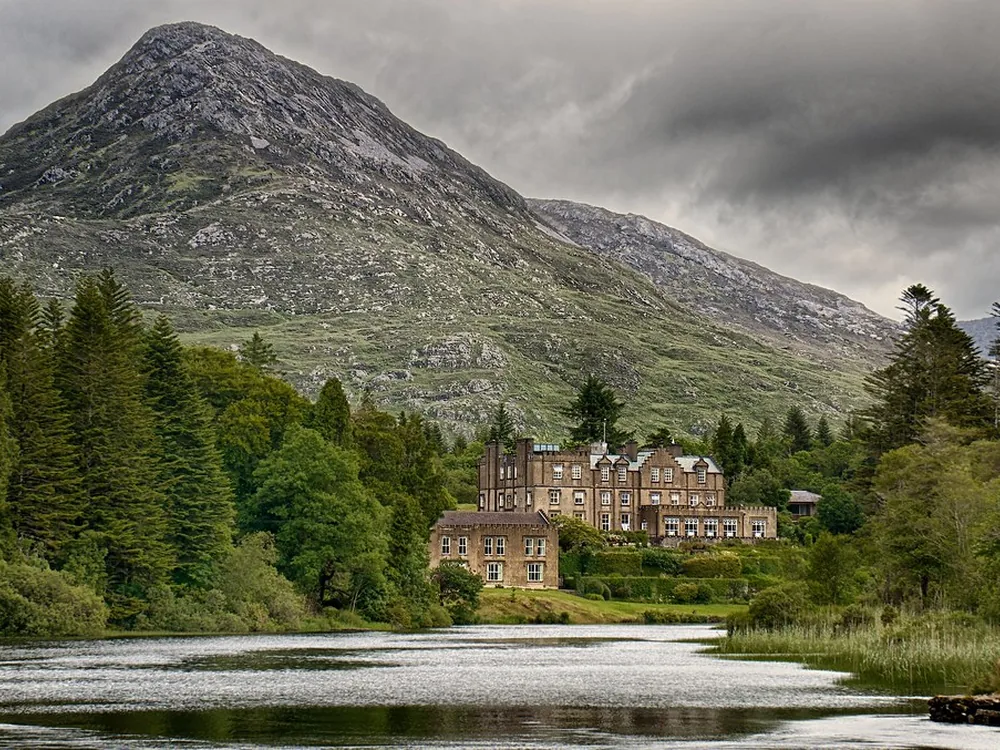
© Castles & Palaces
Quick Facts
- Hours
- Mon–Sun Open
- Day trip from
- €162
- Hotel rating
- ★★★★ 4-Star Hotel
- Duration
- 1–2 hours (grounds and bar/restaurant visit)
- Best time
- Year-round
- Nearest city
- Recess
Featured Tour
From Galway: Aughnanure, Kylemore & Ballynahinch Castles of Connemara
Cancellation available · Instant confirmation
Stay Here
Ballynahinch Castle Hotel
★★★★ 4-Star HotelRooms are split between the historic building and a newer wing
Booked via Booking.com · Free cancellation on most rates
Restaurant, bar and grounds open to non-residents (and to the GetYourGuide day-trip tour group); historic house bedrooms are guests-only
Highlights
- ✦The castle site's connection to Grace O'Malley (Gráinne Mhaol) — the 16th-century Connacht sea queen, pirate, and clan leader who negotiated in person with Queen Elizabeth I in 1593 — dates from c.1546, when the O'Flaherty lord Dónal Ó Flaithbheartaigh built a tower house here around the time of his marriage to O'Malley; the castle was therefore associated with one of early modern Ireland's most extraordinary women from its earliest documented phase
- ✦Richard Martin (1754–1834), known as 'Humanity Dick' — a nickname given him by King George IV — was the Liberal MP who introduced the 1822 Cruel Treatment of Cattle Act, the first animal welfare legislation in the world, and co-founded the Society for the Prevention of Cruelty to Animals in 1824 (later the RSPCA and, after Irish independence, the ISPCA); he lived at Ballynahinch and was known for personally pursuing animal abusers across Connemara on horseback, fighting duels in their prosecution
- ✦H.H. Ranjitsinhji — 'Ranji,' the Jam Sahib of Nawanagar, widely considered one of the two greatest batsmen of the Victorian cricket era (alongside W.G. Grace) and the first Indian to play Test cricket for England — purchased Ballynahinch Castle in 1924 primarily because he found the Connemara salmon fishing irresistible; he was a passionate angler and the Owenmore River below the castle was one of the most productive salmon rivers in Ireland; he died at Ballynahinch in 1933
- ✦The Owenmore River that runs through the castle estate is still one of the most productive private salmon fisheries in Ireland — the fishery is managed by the hotel and accessed primarily by hotel guests, continuing a tradition of sporting estate use that Ranjitsinhji would recognise; the presence of Atlantic salmon in the river depends on the health of the entire Connemara river system, making Ballynahinch part of the conservation effort for a species under significant pressure across its Atlantic range
- ✦The castle hotel experience — a working hotel in a genuine 18th-century Connemara castle on a salmon river, with non-guests welcome in the bar and restaurant — is one of the most authentically atmospheric places to have a pint of Guinness in the west of Ireland, combining the castle's specific history (O'Malley, Martin, Ranjitsinhji) with the simple pleasure of sitting beside the Owenmore in Connemara
Tickets & tours
Book through GetYourGuide
Ballynahinch Castle stands on the Owenmore River in central Connemara, at the edge of a salmon lough in the valley south of the Twelve Bens mountain range. The present building — a castellated Georgian-era house built in 1756 — is not the oldest structure on the site: c.1546, the O'Flaherty lord Dónal Ó Flaithbheartaigh built a tower house here around the time of his marriage to Grace O'Malley, the Connacht sea queen and clan leader. The O'Malley connection gives Ballynahinch one of the most specific and best-documented links to early modern Connemara history of any site in the region.
Grace O'Malley (Gráinne Mhaol) was the daughter of the O'Malley chieftain of Connacht — a clan with maritime power over the western approaches to Connacht and an extensive privateering operation that contemporary English administrators described variously as piracy and legitimate trade depending on their political mood. Her first marriage, to Dónal Ó Flaithbheartaigh of the O'Flaherty clan, brought her to Connemara, where the O'Flaherties held the territory west of Lough Corrib. Ballynahinch was associated with the clan from this period, though the tower house Dónal built c.1546 has not survived as a standing structure.
The Martin family acquired Ballynahinch through the Cromwellian land settlement that redistributed Catholic-held land in Connacht following the Confederate Wars of the 1640s. The Martins were one of the Fourteen Tribes of Galway — the Norman-Irish merchant families that had controlled the city since medieval times — and they built the present castellated house in 1756 on the O'Flaherty estate. The family held Ballynahinch for over two centuries, through the period of Irish Protestant Ascendancy and into the early 19th century.
Richard Martin (1754–1834) — 'Humanity Dick,' as King George IV called him — was the most remarkable member of the Martin family and one of the more remarkable individuals in Irish history. A Whig and then Liberal MP, a notorious duelist (fighting at least 100 duels by contemporary estimates), and a passionate advocate for animal welfare at a time when the concept had no legal recognition, Martin introduced the 1822 Cruel Treatment of Cattle Act to the British Parliament — the first piece of animal welfare legislation passed anywhere in the world. In 1824, he co-founded the Society for the Prevention of Cruelty to Animals (later the RSPCA, and in Ireland the ISPCA), establishing the institutional framework for animal welfare that remains in place today. He enforced his convictions personally, reportedly riding across Connemara to personally prosecute individuals he found mistreating animals, sometimes at the end of a pointed pistol.
The Martin estate was sold in the 19th century after the family's financial decline, and the castle passed through several owners before its most internationally famous resident. H.H. Ranjitsinhji — 'Ranji,' the Jam Sahib of Nawanagar, Sussex and England cricketer, and universally regarded as one of the two or three greatest batsmen of the Victorian era — purchased Ballynahinch Castle in 1924. Ranjitsinhji, who had been the first Indian to play Test cricket for England (representing England rather than India, as India had no national team in the 1890s), was by this time the ruler of the Indian princely state of Nawanagar and a figure of considerable international celebrity. He bought Ballynahinch for the salmon fishing: the Owenmore River below the castle was, and remains, one of the most productive private salmon fisheries in Ireland, and Ranjitsinhji was a serious angler who spent significant time at the castle in his later years. He died at Ballynahinch in 1933.
The castle became a hotel in the 1930s and has remained one since. The building is genuinely historic — the 1756 structure with later additions — and the setting on the Owenmore River, with the salmon lough visible from the castle grounds and the Twelve Bens on the horizon, is exactly the Connemara landscape that the castle's history of remarkable residents suggests. Non-guests are welcome in the hotel bar and restaurant, and the riverside grounds are accessible during daylight hours — making Ballynahinch one of the few Irish castle hotels where the heritage experience is available to non-guests without a room booking.
The GetYourGuide Connemara Castles Tour from Galway includes Ballynahinch alongside [Aughnanure Castle](/castles/ireland/aughnanure-castle) and [Kylemore Abbey](/castles/ireland/kylemore-abbey) — three completely different castle types in a single Connemara day.
History
Around 1546, the O'Flaherty lord Dónal Ó Flaithbheartaigh built a tower house at Ballynahinch — the construction associated with his marriage to Grace O'Malley (Gráinne Mhaol), the Connacht chieftain whose own career at sea and in the political crises of late-16th-century Ireland made her the most celebrated woman in Gaelic Ireland. The Cromwellian land settlement of 1651–52 redistributed O'Flaherty territory to Protestant settlers, ending their centuries-long control of central Connemara.
The Martin family built the present castellated house on the site in 1756, establishing the estate that would become associated with one of the more improbable figures in Irish history. Richard 'Humanity Dick' Martin — so nicknamed by King George IV — lived at Ballynahinch in the late 18th and early 19th centuries, introducing the 1822 Cruel Treatment of Cattle Act (one of the first animal welfare laws in the world) and co-founding what would become the SPCA in 1824. The Martin estate was sold in the 19th century and passed through several owners.
In 1924, H.H. Ranjitsinhji — the Jam Sahib of Nawanagar and one of the greatest cricketers of the Victorian era — purchased Ballynahinch for the salmon fishing in its lough and river. He died here in 1933. The castle was converted to a hotel in the 1930s and continues in that role today.
How to Visit
Getting there: Ballynahinch Castle is on the R341, 2 km west of Recess in central Connemara, 50 km from Galway city (1 hour by car). By bus: Bus Éireann serves Recess from Galway on the Clifden route, then 2 km walk or taxi to the castle.
Tickets: Entry is free — the grounds and riverside walks are accessible to all during daylight hours. Ballynahinch is a working hotel; non-guests are welcome in the bar and restaurant (open daily for lunch, dinner, and afternoon tea). The GetYourGuide day trip covers Ballynahinch alongside Aughnanure and Kylemore on a 9-hour Connemara circuit from Galway, with transport included.
Practical tips: A drink or meal in the hotel bar is the best way for non-guests to experience the building's interior and the riverside setting. The Owenmore River salmon fishery that drew H.H. Ranjitsinhji here in 1924 is still actively managed by the hotel.
Combine with: Kylemore Abbey 20 km north and Aughnanure Castle 35 km east — all three covered by the same GetYourGuide Connemara Castles Tour.
How to Stay
Getting there: Recess, Connemara, Co. Galway, on the road between Galway city and Clifden.
Rooms & rates: Classic Rooms are mainly in the original 1756 house, with three in a riverside wing; Superior Rooms overlooking the Owenmore river include two more in the original house. Two separate exclusive-use properties — Lettery Lodge and Owenmore Cottage — suit larger groups but are distinct buildings from the main house. From €235/night (see Stay Here above).
On-site: Restaurant and bar (both open to non-residents), one of Ireland's most productive private salmon fisheries on the Owenmore river, riverside grounds.
Good to know: There's no lift to the bedrooms — a genuine limitation for guests needing step-free access, worth confirming directly before booking.
Combine with: Visit by day on the GetYourGuide tour (Aughnanure, Kylemore & Ballynahinch Castles of Connemara — see Featured Tour above), then return to stay the night; or pair with Kylemore Abbey, 20 minutes away.
Frequently Asked Questions
Grace O'Malley (Gráinne Mhaol, c.1530–1603) was the daughter of the O'Malley chieftain of Connacht, one of the most powerful Gaelic sea-lords of western Ireland. She commanded her clan's maritime operations, which English administrators described as piracy and she apparently regarded as legitimate commerce. Her first marriage to Dónal Ó Flaithbheartaigh of the O'Flaherty clan connected her to Ballynahinch around 1546. She later negotiated in person with Queen Elizabeth I in London in 1593, an audience whose transcript survives. Her connection to Ballynahinch is one of the earliest documented associations of a named historical figure with this site.
Location
Ballynahinch, Recess, Connemara, Co. Galway, H91 CA70, Ireland
Nearby Castles
Tours & Tickets
Powered by GetYourGuide
From
€162/ person