
Clontarf Castle
Caisleán Chluain Tarbh
Ireland · Clontarf, Dublin · Near Dublin
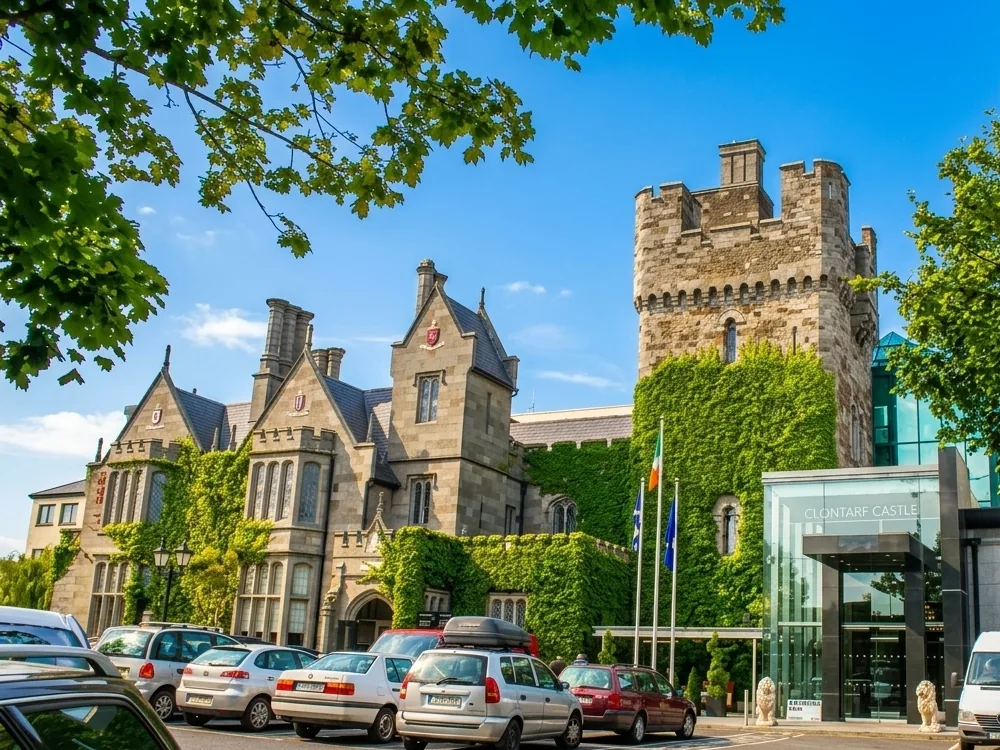
Built 1837 · Neo-Norman/Victorian castle, rebuilt in the late 19th and 20th centuries on a site first fortified in the 12th or 13th century by the Normans; a distinct building from the earlier structures on the site
This page is part of an independent travel guide and is not affiliated with, endorsed by, or operated by Clontarf Castle.
© Castles & Palaces
Quick Facts
- Rooms from
- €187 / night
- Hotel rating
- 4-Star Hotel
- Duration
- Overnight stay only — no day-visit access
- Best time
- Year-round
- Nearest city
- Dublin
Stay Here
Clontarf Castle Hotel
4-Star HotelBooked via Booking.com · Free cancellation on most rates
Open to day visitors without booking a room — see How to Visit below.
Highlights
- ✦The present castle was built two centuries after the Battle of Clontarf (1014, Brian Boru versus the Vikings and Leinster forces) — it shares the site's name and location with the battle, but is not the same building and was not built to commemorate it directly
- ✦The first castle on the site was erected around the 12th or 13th century by the Normans, at a strategic point defending Dublin
- ✦The current building, in a neo-Norman/Victorian style, is a reconstruction dating to the late 19th and 20th centuries, following successive fires and remodelling
- ✦Today a 4-star hotel just minutes from central Dublin, combining urban convenience with a genuinely historic and strategically significant location
- ✦Grounds and gardens are accessible to hotel guests; there is no museum-style entry ticket
Stay in the castle itself
Book a room via Booking.com
Clontarf Castle stands in the Dublin suburb of Clontarf, a location whose name is inseparable from one of the most famous events in Irish history: the Battle of Clontarf, fought in 1014, in which Brian Boru's forces defeated a coalition of Viking and Leinster forces in a battle that looms large in the Irish historical imagination. It is important to be precise, however, about what this connection actually means for the building standing on the site today: the present castle was constructed roughly two centuries after the battle was fought, and it is not the same building, nor a direct architectural descendant of any structure present at the site in 1014. Clontarf Castle shares its name and its location with the famous battle, but visitors should understand this as a connection of place rather than physical continuity — the castle does not date to, and was not built specifically to commemorate, the events of that year.
The first genuine fortification on this site was erected considerably later than the battle, around the 12th or 13th century, when the Normans built a castle here as part of their broader effort to secure and defend the approaches to Dublin, one of Ireland's most strategically important settlements following the Anglo-Norman invasion. This medieval Norman structure occupied a genuinely valuable defensive position, controlling access to Dublin from the north along the coast, a role that gave Clontarf ongoing military and strategic significance for centuries beyond its namesake battle.
The castle that stands on the site today, however, results from a much later building history. Following successive fires, remodelling and reconstruction across the following centuries, the present neo-Norman and Victorian-style building took shape during the late 19th and 20th centuries — meaning today's Clontarf Castle represents a considerably more recent chapter of construction layered onto a site with genuine medieval military origins, rather than a continuously occupied medieval building surviving intact from the Norman period. This pattern of successive rebuilding on a strategically valuable site is a common feature of many historic castles, and Clontarf's story is a clear example of how a location's deep historical significance does not always translate into physically ancient surviving fabric.
Today Clontarf Castle operates as a 4-star hotel, and its location gives it a genuinely distinctive advantage within Ireland's castle hotel landscape: it sits just minutes from central Dublin, offering visitors the atmosphere and architectural character of a castle stay combined with the practical convenience of true urban proximity, rather than requiring a longer drive out into the Irish countryside. This makes Clontarf a natural choice for visitors who want a castle hotel experience as part of a Dublin city stay, rather than as a separate countryside excursion.
The hotel's grounds and gardens are accessible to guests as part of a stay, though there is no museum-style entry ticket or independent day-visit product associated with Clontarf Castle — access runs through the hotel itself rather than through a separate paid historical attraction. Visitors specifically interested in the Battle of Clontarf's history and its genuine 1014 context are better served exploring Dublin's broader historical resources on the battle rather than expecting the castle building itself to serve as a physical monument to that event.
For visitors building a Dublin itinerary that includes an interest in Irish medieval history, Clontarf Castle offers a convenient and atmospheric base, situated directly within one of Irish history's most resonant place names, even as the building itself tells a considerably later and more layered architectural story than its famous namesake battle might initially suggest.
The wider Clontarf seafront and its promenade along Dublin Bay remain popular with local walkers and joggers today, and the neighbourhood retains a genuinely residential, unhurried character distinct from Dublin's busier central tourist districts, despite sitting only a short journey from the city centre by car, bus or the Dublin Bay coastal path. This combination of a quieter, more local Dublin neighbourhood with direct proximity to the city's main attractions gives guests at Clontarf Castle a genuinely different experience of Dublin than a hotel located within the busier Temple Bar or Grafton Street areas — a useful practical consideration for visitors weighing where to base themselves during a Dublin stay.
History
The first castle on the Clontarf site was erected around the 12th or 13th century by the Normans, at a strategic point defending Dublin's northern approaches. This was roughly two centuries after the Battle of Clontarf, fought in 1014 between Brian Boru's forces and a coalition of Viking and Leinster forces — the castle shares the site's name and location with that battle but is a separate, later structure, not a surviving building from the battle itself. Following successive fires and remodelling, the present neo-Norman/Victorian-style castle took its current form during the late 19th and 20th centuries. Today it operates as a 4-star hotel a few minutes from central Dublin.
Frequently Asked Questions
No. The present castle was built roughly two centuries after the Battle of Clontarf, and the first fortification on the site dates only to around the 12th or 13th century, built by the Normans. Clontarf Castle shares the site's name and location with the famous 1014 battle, but is not the same building and was not standing at the time of the battle.
Location
Castle Ave, Clontarf, Dublin 3, D03 K544, Ireland
Nearby Castles
Rooms from
€187/ night