
Howth Castle
Caisleán Beann Éadair
Ireland · County Dublin, Howth Peninsula · Near Dublin
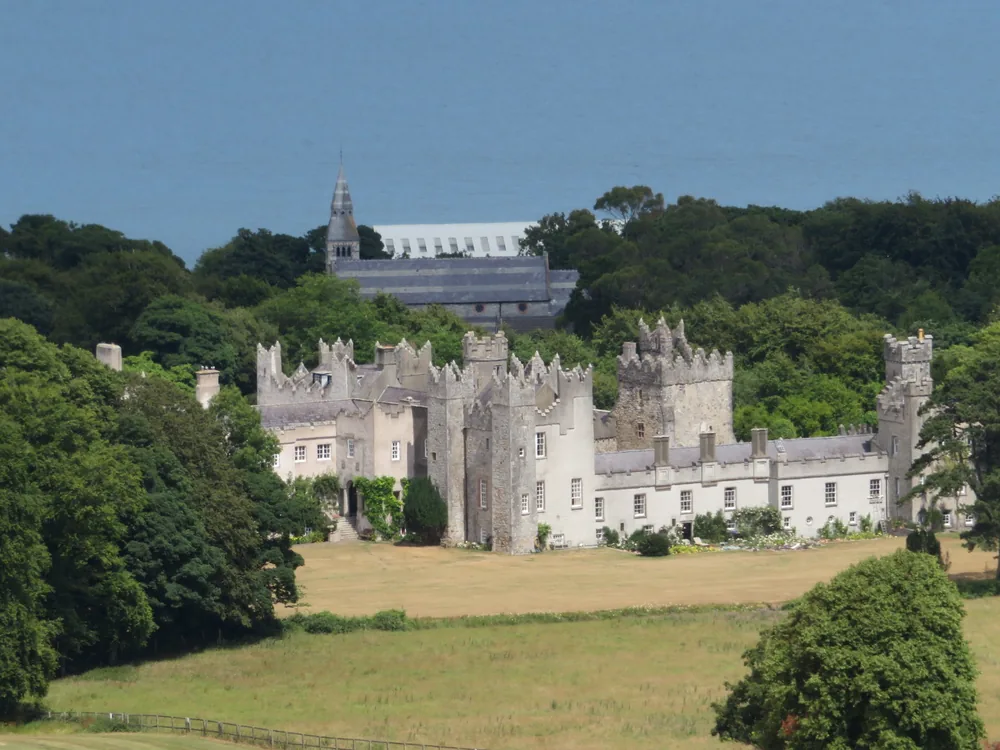
Built 1235 · Norman tower house and later medieval additions on the Howth Peninsula, north of Dublin Bay; founded c.1235 by Almeric Tristram following the Norman landing at Howth; rebuilt and extended repeatedly across the 13th–19th centuries, with the current structure largely dating from the 16th and 19th centuries; the castle remains a private family residence continuously occupied by the St Lawrence family (Earls of Howth) for over 800 years — one of the longest unbroken occupations of any castle by a single family in Ireland; the 19th-century additions include gothic revival elements added during the Victorian period; the estate grounds contain the ruins of a Norman-era church and a walled rhododendron garden; the castle exterior is visible from the estate path and from the village, but the interior is not open to public visitors; the GetYourGuide walking tour visits the grounds, the Howth fishing village harbour, and the estate gardens rather than the castle building itself
This page is part of an independent travel guide and is not affiliated with, endorsed by, or operated by Howth Castle.
© Castles & Palaces
Quick Facts
- Hours
- Mon–Sun Open (estate grounds)
- Guided tour from
- €30
- Duration
- 1.5–2.5 hours (estate grounds + village)
- Best time
- April to October
- Nearest city
- Dublin
Featured Tour
Explore Howth Castle Estate & Ancient Fishing Village Tour
Cancellation available · Instant confirmation
Highlights
- ✦James Joyce opens Finnegans Wake with the words that begin in the middle of a sentence — and those words lead directly here: the novel's circular first fragment ends with 'a long the riverrun, past Eve and Adam's' and opens again (if you close the loop from the end of the book) with 'riverrun, past Eve and Adam's, from swerve of shore to bend of bay, brings us back to Howth Castle and Environs.' That Howth Castle and its surrounding peninsula is the first specific named place in one of the most complex novels in the English language is not incidental — Joyce grew up knowing the view across Dublin Bay from the Hill of Howth, and he chose Howth as his novel's geographical anchor because it represented a fixed point of return in the circular structure he was building
- ✦The St Lawrence family have occupied Howth Castle continuously since Almeric Tristram built the original fortification c.1235 following the Norman landing at Howth — making this one of the few Norman castle families anywhere in Britain or Ireland still in occupation of their founding estate after more than 800 years; the family adopted the St Lawrence name from the feast day of their landing and have held the title Earls of Howth; the castle is still partly lived in today, which is why the interior is not accessible to visitors
- ✦The 40-acre estate rhododendron garden — planted over several centuries and containing over 2,000 varieties — is among the most spectacular spring-flowering gardens in Ireland, peak season May to June; the walled garden and the wider woodland planted around the Norman-era church ruin create a layered estate landscape that moves between cultivated formality and naturalistic overgrowth in a way characteristic of the great Irish demesne gardens
- ✦Grace O'Malley — Gráinne Mhaol, the pirate queen of Connacht, one of the most powerful figures in 16th-century Irish maritime history — is connected to Howth by one of the best stories in Irish legend: arriving at the castle and finding the gates shut (the family was at dinner), she reportedly kidnapped the heir and held him until the St Lawrence family promised to keep the gates open at mealtimes and to set an extra place at table for any passing visitor; the family is said to have kept this custom for generations, and an extra place at dinner is still set at the castle
- ✦The Howth Peninsula — the headland north of Dublin Bay, with the village, the harbour, the cliff walk, and the summit of the Hill of Howth — is one of the most complete half-day escapes from Dublin: the harbour has been a fishing port since the Viking age (Howth derives from the Old Norse hǫfuð, 'head'), the cliff walk around the peninsula takes 2–3 hours with views across Dublin Bay to the Wicklow Mountains, and the DART rail connection from Dublin city centre to Howth station takes 30 minutes
Skip the queue with a guided tour
Skip-the-line tickets & expert guides
Howth Castle stands on the northern headland of the Howth Peninsula, overlooking Dublin Bay from the north, approximately 15 kilometres northeast of Dublin city centre. The castle is not a museum or visitor attraction in any conventional sense: it is a private family residence, continuously occupied by the St Lawrence family — Earls of Howth — since Almeric Tristram built the original fortification c.1235 following the Norman landing at the peninsula. The interior is not open to the public. What the site offers instead is something rarer: the surrounding estate, its 800-year-old gardens, the ruins of a Norman-era church within the grounds, and a village and harbour whose layered Viking, Norman, and maritime history is precisely what James Joyce selected as the geographic anchor for Finnegans Wake.
Joyce's choice of Howth Castle and Environs was not arbitrary. The phrase opens the novel — more accurately, it completes the opening sentence, which begins at the novel's end and circles back to the beginning, requiring the reader to close the loop: 'riverrun, past Eve and Adam's, from swerve of shore to bend of bay, brings us back to Howth Castle and Environs.' That a novel structured on circular return should anchor itself to a specific headland on Dublin Bay, visible from the city and from the sea, reflects both Joyce's biographical attachment to the place — he knew it from childhood, and it appears in Ulysses as the location of Bloom and Molly's courtship on the Hill of Howth — and the peninsula's character as a fixed geographical point in a city that otherwise bleeds outward into suburb and sprawl. Howth is unmistakably itself. The castle is part of that identity.
Almeric Tristram, the progenitor of the St Lawrence line, built the original castle in 1235 on land granted following the Norman landing at Howth. The family adopted the St Lawrence name from the feast day on which they arrived, and they have held the title Earls of Howth through the subsequent centuries. The current castle structure is largely a product of the 16th and 19th centuries — Gothic revival additions overlaying the medieval core — and the building remains partly lived in today, which accounts for its status as a private residence rather than a heritage attraction. The tradition of family occupation is one of the longest unbroken noble occupancies of an original castle estate in Ireland.
The estate grounds contain two features of particular note for visitors. The rhododendron garden — 40 acres containing over 2,000 varieties, planted over several centuries — is among the most spectacular spring gardens in Ireland, peaking in May and June when the flowering creates a colour density unusual even by Irish demesne garden standards. Within the garden stands the ruin of a Norman-era church whose masonry predates the present castle structure, sitting in the kind of deliberate picturesque arrangement — ruined ecclesiastical structure in a formal garden — that the 18th and 19th centuries particularly favoured. The National Transport Museum of Ireland also occupies buildings on the estate grounds and operates with its own separate entry and hours.
The folklore attached to the castle is partly what makes Howth a village with an unusually dense narrative texture. Grace O'Malley — Gráinne Mhaol, the pirate queen of Connacht, the most powerful figure in 16th-century Irish maritime history outside the Dublin Pale — arrived at Howth Castle and found the gates shut, the family at dinner and not receiving visitors. Her response was to kidnap the heir. She agreed to release him on the condition that the St Lawrence family undertake to keep the gates open at mealtimes and set an extra place at table for any passing stranger. The family is said to have kept this custom for generations, with an extra place still set at dinner at the castle. Whether strictly historical or substantially legendary, the story has been told in Howth for four centuries.
The Howth Peninsula itself provides a walking context that most castle visits cannot offer: the cliff walk around the headland from the village takes 2–3 hours, with sustained views across Dublin Bay to the Wicklow Mountains to the south and to Ireland's Eye (an uninhabited island with its own ruined abbey) to the northeast. The village harbour, which has operated as a fishing port since Viking settlement — Howth derives from the Old Norse hǫfuð, meaning headland — has the fish-and-seafood market and restaurant cluster typical of an active working harbour. The DART rail connection from Dublin city centre to Howth station takes 30 minutes, making the peninsula one of the most convenient full half-days from the city.
The GetYourGuide walking tour covers the castle estate exterior, the gardens, the Howth harbour, and the peninsula's Viking, Norman, and literary history in a 2.5-hour guided walk — an estate and village experience rather than an interior castle visit. Independent visitors can walk the estate and village paths freely; the guided tour adds the historical framework that connects the Norman founding, the Grace O'Malley story, and Joyce's use of the peninsula into a single narrative.
History
Almeric Tristram built the original Norman castle at Howth around 1235, following the Norman conquest of the peninsula. He took the name St Lawrence from the feast day on which he won a decisive engagement — founding a family connection to the headland that has lasted nearly eight centuries. Through the 14th to 16th centuries the castle was rebuilt and extended, and the St Lawrence family was established as Earls of Howth. A famous episode from the 16th century — unverified in its precise details but persistent in the telling — has Grace O'Malley (Gráinne Mhaol), the Connacht chieftain, arriving at Howth to find the gates shut at dinnertime; offended at the breach of hospitality, she kidnapped the Howth heir and extracted a promise that the castle gates would always remain open at mealtimes. The practice, whether or not the story is precisely true, became part of the castle's identity.
Gothic Revival additions and further rebuilding in the 17th to 19th centuries gradually produced the present structure, with its estate gardens developed over the same period. Howth entered modern literature permanently in 1939, when James Joyce published Finnegans Wake, whose famously circular opening line — 'riverrun, past Eve and Adam's, from swerve of shore to bend of bay, brings us by a commodius vicus of recirculation back to Howth Castle and Environs' — made the headland a landmark of the literary imagination as well as the geographic one.
The castle remains a private St Lawrence family residence. The estate grounds, gardens, and the village of Howth are accessible to visitors.
How to Visit
Getting there: Howth is 15 km north of Dublin. By DART: 30 minutes from Dublin city centre to Howth station — the fastest option. By car: 30 minutes on the R105 coastal road; parking available in the village.
Tickets: Entry is free — the estate grounds and gardens are accessible on foot at all times. The castle interior is a private residence, not open to visitors. The GetYourGuide guided tour is a 2.5-hour walking tour of the castle estate, village harbour, and peninsula history — an estate and village experience, not an interior castle visit.
Practical tips: The rhododendron garden (over 2,000 varieties) peaks in May–June. The Howth cliff walk around the headland takes 2–3 hours with views across Dublin Bay to the Wicklow Mountains — combine it with the estate for a full half-day.
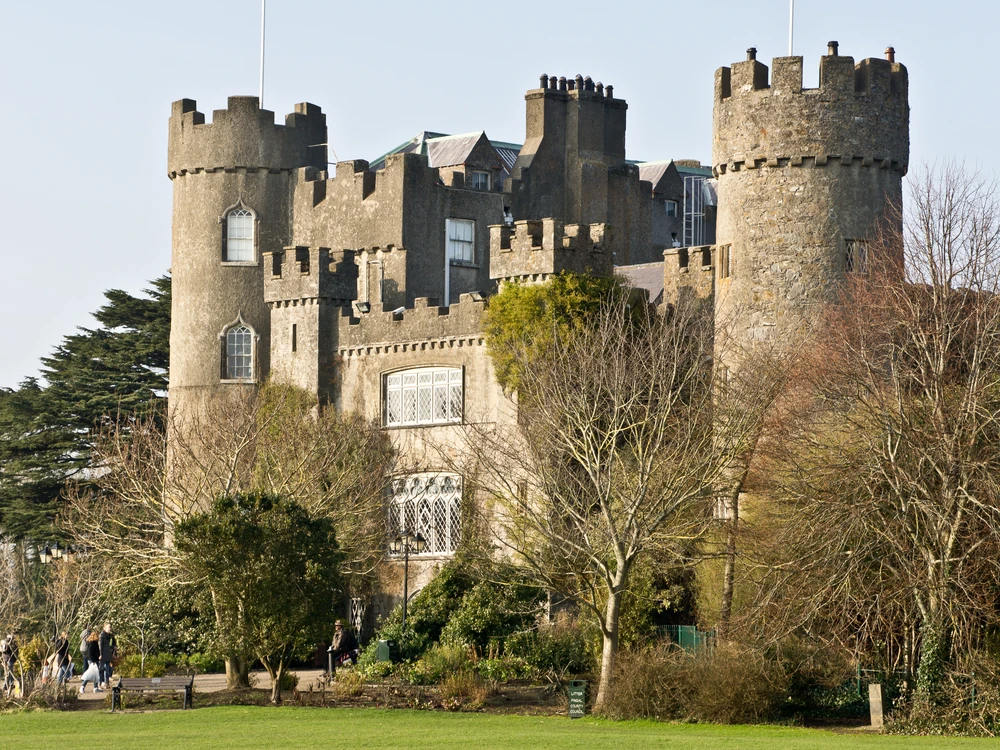
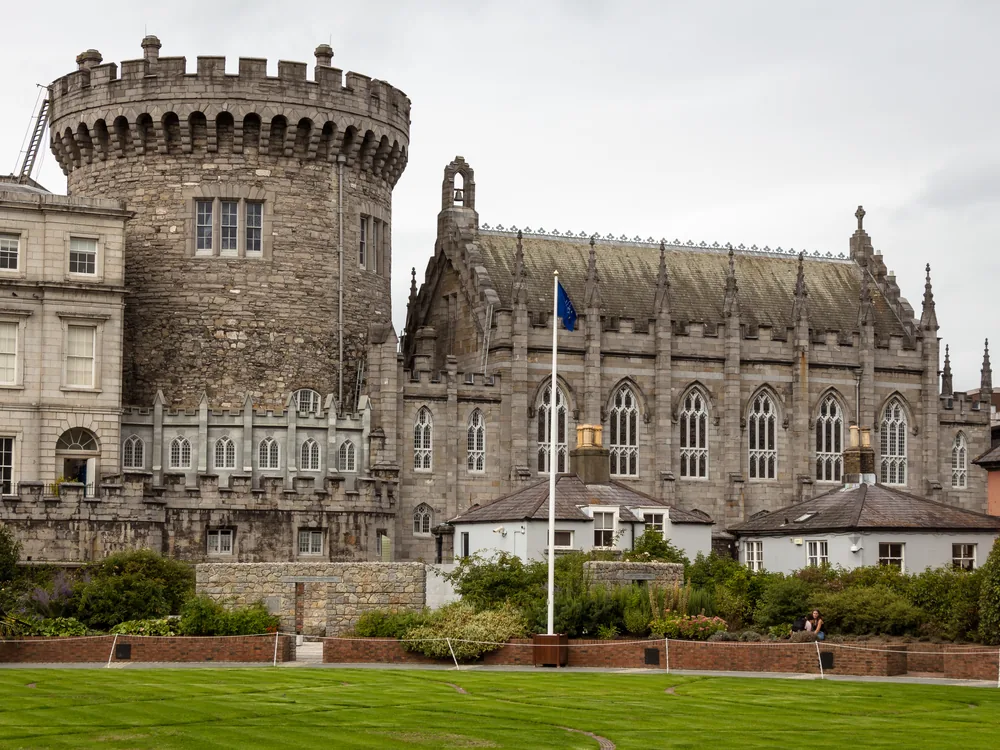
Combine with: Malahide Castle 6 km southwest or Dublin Castle 15 km southwest for a north Dublin day.
Frequently Asked Questions
No — Howth Castle is a private family residence continuously occupied by the St Lawrence family (Earls of Howth) since 1235, and the interior is not open to public visitors. The GetYourGuide guided tour covers the estate grounds, the rhododendron gardens, the Howth village, and the harbour over 2.5 hours — it is an estate and village experience rather than an interior castle tour.
Location
Howth Castle Estate, Howth, Co. Dublin, D13 W2P7, Ireland
Nearby Castles
Tours & Tickets
Powered by GetYourGuide
From
€30/ person