
Fitzpatrick Castle
Caisleán Uí Ghiollapádraig
Ireland · Killiney, County Dublin · Near Dublin
Built 1740 · 1740 two-storey-over-basement Georgian house, originally 'Mount Malpas,' enlarged and castellated in 1840 as 'Killiney Castle'
This page is part of an independent travel guide and is not affiliated with, endorsed by, or operated by Fitzpatrick Castle.
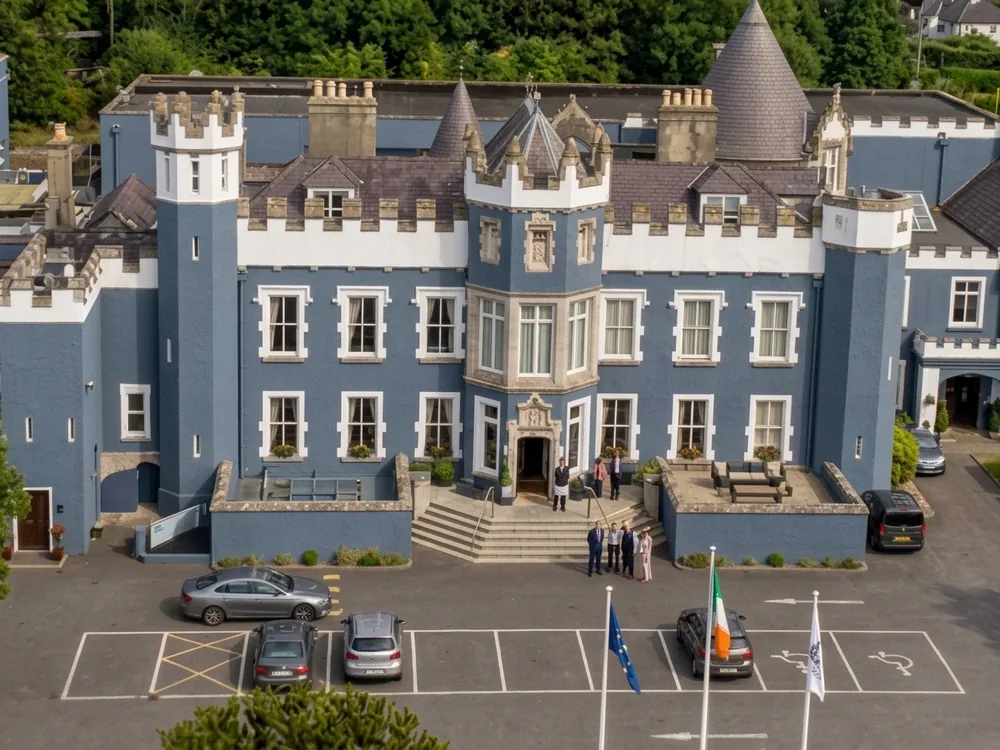
© Castles & Palaces
Quick Facts
- Rooms from
- €165 / night
- Hotel rating
- 4-Star Hotel
- Duration
- Overnight stay only — no day-visit access
- Best time
- Year-round
- Nearest city
- Dublin
Stay Here
Fitzpatrick Castle Hotel
4-Star HotelBooked via Booking.com · Free cancellation on most rates
Open to day visitors without booking a room — see How to Visit below.
Highlights
- ✦Originally 'Mount Malpas,' built in 1740 by Colonel John Malpas — a two-storey-over-basement Georgian house with a seven-bay facade; passed through several 18th-century owners, each enlarging the estate
- ✦Robert Warren enlarged the house in 1840 and renamed it 'Killiney Castle'
- ✦During the 20th century, the building was used by the Black and Tans, the IRA and Free State troops during the Irish Civil War, before being burned by Free State troops and later requisitioned by the government as a military barracks from 1939 to 1945
- ✦In the 1970s, Paddy and Eithne Fitzpatrick transformed the building into a first-class hotel, giving it its present name
- ✦Located 20 minutes from Dublin, with views over Killiney Bay
Stay in the castle itself
Book a room via Booking.com
Fitzpatrick Castle stands on Killiney Hill in County Dublin, and its story begins under a considerably more modest name and identity than the castellated building visitors encounter today. The house was originally called 'Mount Malpas,' built in 1740 by Colonel John Malpas as a two-storey-over-basement Georgian residence with a seven-bay facade — a substantial but architecturally conventional Georgian country house rather than anything resembling a fortified or castellated structure. Over the following decades, the property passed through the hands of several notable 18th-century owners, including Captain Maunsell, Colonel Loftus and Lord Clonmel, each of whom made their own enlargements and improvements to the estate, gradually expanding the property beyond its original Georgian footprint.
The transformation that gave the building its castle-like identity came in 1840, when Robert Warren undertook a substantial enlargement of the house and renamed it 'Killiney Castle' — a rebranding that reflected the more romantic, castellated architectural additions Warren introduced, in keeping with the broader 19th-century fashion for giving grand country houses a castle-like appearance regardless of their actual medieval or defensive origins.
The building's 20th-century history took a genuinely turbulent turn during one of the most volatile periods of modern Irish history. During the Irish War of Independence and the subsequent Irish Civil War, the building was used successively by the Black and Tans — the notorious auxiliary police force deployed by British forces during the conflict — by the IRA, and by republican forces, before ultimately being burned by Free State troops as part of the wider destruction of properties associated with various factions during this deeply divisive period of Irish state formation. Following this destructive episode, the building's troubles were not entirely over: it was requisitioned by the Irish government between 1939 and 1945, serving as a military barracks during the Second World War (known in Ireland as 'the Emergency'), a further institutional interruption to what had once been a private aristocratic residence.
The building's eventual transformation into the hotel it remains today came through the efforts of Paddy and Eithne Fitzpatrick, who in the 1970s took on the considerable task of converting the historically battered building into a first-class hotel, giving it the Fitzpatrick name it carries to this day. This transformation from a building that had witnessed occupation by opposing sides of a civil war and subsequent military requisition into a polished hospitality property represents one of the more dramatic turnarounds among the castle hotels found in this collection.
Today Fitzpatrick Castle's location gives it a genuinely distinctive appeal within the wider landscape of Irish castle hotels: situated just 20 minutes from central Dublin, with views extending over Killiney Bay, the property offers guests the atmosphere of a historic castle stay combined with straightforward proximity to Ireland's capital city. Killiney itself has long been associated with an affluent, scenic residential character, sometimes compared informally to the French Riviera for its bay views and elevated coastal setting, giving the area a genuinely attractive backdrop distinct from Dublin's more urban central districts.
For visitors seeking a castle hotel experience within easy reach of Dublin, rather than requiring a longer journey into the Irish countryside, Fitzpatrick Castle offers a genuinely convenient option — a building whose own turbulent 20th-century history, spanning use by opposing forces during Ireland's revolutionary period through wartime military requisition, now sits comfortably behind its identity as a polished, bay-view hotel just a short drive from the capital.
The wider Killiney Hill area, part of which is preserved as public parkland, offers walking trails with panoramic views over Killiney Bay, Dalkey Island and, on clear days, as far as the Wicklow Mountains further south — a genuinely rewarding outdoor complement to a stay at the hotel itself. This combination of accessible woodland walks, coastal views and straightforward Dublin proximity gives Fitzpatrick Castle a rounded appeal for visitors who want both an easy city connection and a genuine sense of coastal Irish scenery without travelling far from either.
History
Fitzpatrick Castle was originally 'Mount Malpas,' a Georgian house built in 1740 by Colonel John Malpas, passing through several 18th-century owners who each enlarged the estate. Robert Warren enlarged the house in 1840 and renamed it 'Killiney Castle.' During the 20th century, the building was used by the Black and Tans, the IRA and republican forces during the Irish Civil War, before being burned by Free State troops and later requisitioned as a military barracks from 1939 to 1945. In the 1970s, Paddy and Eithne Fitzpatrick transformed the building into a first-class hotel, giving it its present name.
Frequently Asked Questions
The building was originally called 'Mount Malpas,' built in 1740 by Colonel John Malpas as a Georgian house. It was enlarged and renamed 'Killiney Castle' in 1840 by Robert Warren, before taking its present name after Paddy and Eithne Fitzpatrick converted it into a hotel in the 1970s.
Location
Killiney Hill Road, Killiney, Co. Dublin, A96 D5C9, Ireland
Nearby Castles
Rooms from
€165/ night