Govone Castle
Castello di Govone
Italy · Piedmont · Near Alba
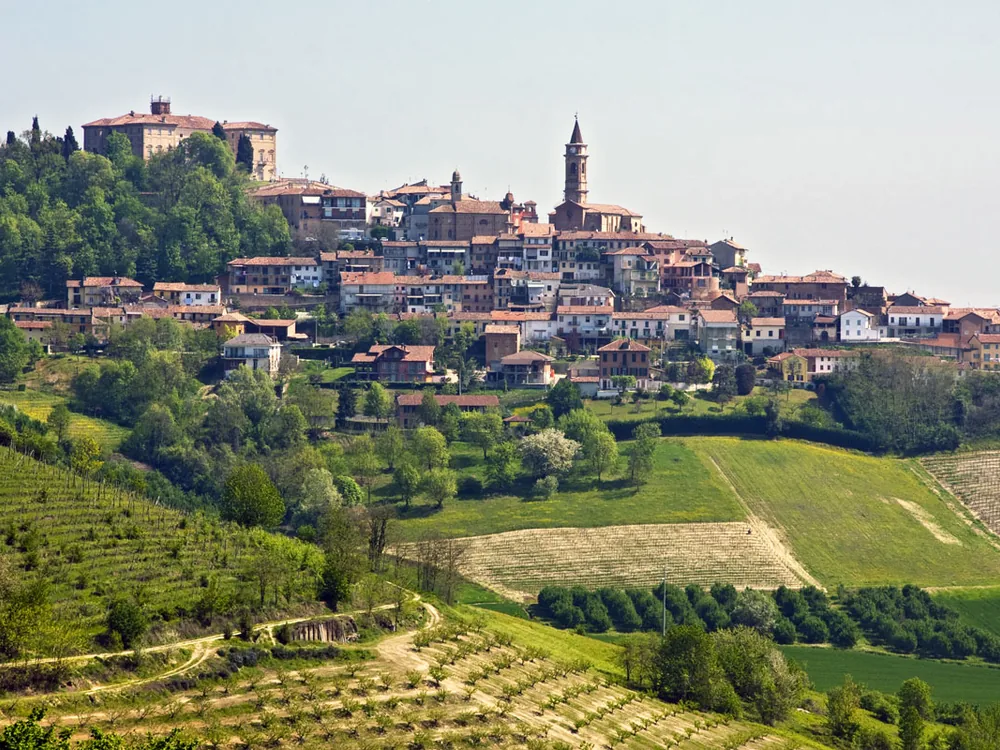
Built 1710 · Early 18th-century Piedmontese Baroque castle on a hilltop in the Roero wine country, Cuneo province; built 1710–1730 for the Grimaldi di Monaco family by unknown architects working in the idiom established by Filippo Juvara and Bernardo Vittone for Piedmontese aristocratic building of the period; acquired by Carlo Felice, Duke of Savoy and later King of Sardinia, in 1820 — who spent the summer months here and used the castle as an informal retreat from the Turin court; the interior was redesigned under Carlo Felice to the taste of the early Neoclassical period, with state rooms decorated in the Empire style fashionable in Italy after the Napoleonic campaigns; the castle occupies the highest point of the Govone hill, commanding panoramic views over the Tanaro valley to the south and the Langhe vineyards beyond; it is in the municipality of Govone and owned by the municipality, which has managed it since the royal era; inscribed in the UNESCO World Heritage List in 1997 as part of the Residences of the Royal House of Savoy (inscription 823)
This page is part of an independent travel guide and is not affiliated with, endorsed by, or operated by Govone Castle.
© Castles & Palaces
Quick Facts
- Hours
- Sat & Sun 10:00–13:00. Closed Mon–Fri
- Guided tour from
- €59
- Duration
- 1.5–2 hours
- Best time
- April to October
- Nearest city
- Alba
Featured Tour
Royal Tales: Royal Gardens & Villages, Govone to Pollenzo
Cancellation available · Instant confirmation
Highlights
- ✦Govone Castle is part of the UNESCO Residences of the Royal House of Savoy (1997, inscription 823) — the same group inscription that covers Venaria Reale, Castello di Rivoli, the Palazzo Reale in Turin, and [Racconigi Castle](/castles/italy/racconigi-castle); Govone is the most easterly of the inscribed UNESCO castles, closest to the Langhe wine country and the core DOCG zones of Barolo, Barbaresco, and Moscato d'Asti
- ✦Carlo Felice — King of Sardinia from 1821 to 1831, the Savoy ruler who preceded Carlo Alberto and who has been somewhat overshadowed in Italian historical memory by his predecessor and successor — acquired Govone in 1820 and used it as his principal private retreat; unlike the ceremonial grandeur of the Venaria Reale or Palazzo Reale, Govone was the castle a king came to when he wanted to be away from the state occasions that defined his public life; the interior Empire-style decoration he commissioned reflects the personal taste of a man who had lived through the Napoleonic reorganisation of Italy
- ✦The castle's position on the Govone hill gives it views over the Tanaro valley and, on clear days, southeast toward the Maritime Alps — a panorama that encompasses the Langhe wine landscape in its most cinematic form; the vineyards visible from the castle ramparts produce Barbera d'Asti, Roero Arneis, and Favorita — varieties that are the everyday wine of this landscape rather than the grand crus of the Langhe DOCG zones, but that define the local table
- ✦Govone's Natale — the Christmas market and castle decoration event held on weekends in December — is one of the most attended seasonal events in Piedmont and the reason many visitors from Turin and beyond first encounter the castle; the rooms that are otherwise seen by a few thousand heritage visitors per year are filled by tens of thousands of visitors across the Advent weekends, with decorative installations that use the UNESCO state rooms as theatrical staging; the event has been running for over 20 years and is now considered among the best Christmas markets in northern Italy
- ✦The castle is unusual among the Savoy UNESCO properties in being owned and managed by the municipality of Govone rather than the Italian state — a consequence of the property's passage from royal to local government hands after the monarchy's abolition, without the subsequent transfer to state cultural agencies; this means the castle's operation reflects the priorities and resources of a small Piedmontese municipality, which has produced a visitor experience more intimate and less institutionalised than the major state-managed Savoy sites
Skip the queue with a guided tour
Skip-the-line tickets & expert guides
Govone Castle stands at the highest point of the hilltop town of Govone in the Roero hills, Cuneo province, with views south over the Tanaro valley and east toward the Langhe wine landscape. It is one of the easternmost and most intimate of the 19 properties inscribed together on the UNESCO World Heritage List in 1997 as the Residences of the Royal House of Savoy — a group that includes the Venaria Reale and Castello di Rivoli near Turin, the royal palaces within the city, Castello di Agliè north of Turin, and [Racconigi Castle](/castles/italy/racconigi-castle) on the Cuneo plain to the southwest.
The castle was built between 1710 and 1730 for the Grimaldi di Monaco family — a branch of the same dynasty that still rules the Principality of Monaco — on the site of an earlier medieval fortification whose position on the Govone hilltop had controlled the Tanaro valley approach since at least the 12th century. The 18th-century building replaced the medieval structure with a formal Piedmontese Baroque palace in the idiom established by Filippo Juvara and his contemporaries for aristocratic and royal building in the region: restrained exterior, piano nobile state rooms with painted ceilings and formal furnishings, a position on high ground that combined symbolic dominance with practical views.
The castle passed through several owners before its most historically significant acquisition. In 1820, Carlo Felice, Duke of Savoy — who would become King of Sardinia in 1821 following the abdication of his brother Vittorio Emanuele I — purchased Govone as his private summer residence. Carlo Felice is one of the less celebrated Savoy rulers: his reign (1821–1831) was sandwiched between Vittorio Emanuele I's reactionary restoration and Carlo Alberto's liberalising constitutionalism, and he has been characterised by subsequent Italian historiography as a conservative figure of limited political imagination. At Govone, however, he was not a historical actor but a man on holiday. He spent his summers above the Langhe vineyards, commissioned the redecoration of the interior state rooms in the Empire style fashionable across Italy in the post-Napoleonic period, and used the castle as the retreat from the protocol-saturated life of the Turin court that the Savoy kings regularly sought in their various out-of-city properties.
The Empire-style interiors are the primary focus of the interior visit: painted and gilded rooms with the characteristic vocabulary of the Napoleonic aesthetic — classical motifs, Egyptian references, heroic medallions, dark wood against gilded bronze — applied to a Piedmontese hilltop castle that had been built a century earlier for an entirely different political context. The state rooms are well-preserved and give an accurate picture of how a Savoy royal would have furnished a private retreat in the 1820s.
The castle passed to the Italian state after the monarchy's abolition in 1946 and eventually to the municipality of Govone, which manages it today with resources that reflect its small-town ownership rather than the institutional budgets of the major state museums. The visitor experience is consequently more intimate and less systematised than the main Savoy UNESCO sites in Turin — guided visits are recommended, the interpretation is personal, and the castle presents itself as a working piece of community heritage rather than a polished state museum.
The event that brings the largest number of visitors to Govone is the Christmas market — held on Advent weekends in December, when the UNESCO state rooms are decorated with elaborate seasonal installations and the small hilltop town fills with visitors from across Piedmont and beyond. Govone's Natale has been running for over 20 years and is now recognised as one of the finest Christmas market experiences in northern Italy. During these weekends the rooms that receive a few thousand visitors per year in the heritage season are seen by tens of thousands of Christmas visitors, making December the most visited month in the castle's calendar.
A GetYourGuide guided day tour ("Royal Tales: Royal Gardens & Villages") visits Govone and the nearby town of Pollenzo, while the multi-day Turin Royal Pass covers Govone alongside [Racconigi Castle](/castles/italy/racconigi-castle) and several other Savoy residences for visitors wanting a broader ticket. The proximity to the Langhe wine country (Barolo is 25 km to the south, Alba 12 km to the southeast) makes Govone a natural addition to a wine-and-heritage Piedmont itinerary.
History
A medieval fortification controlled the Govone hilltop and the Tanaro valley below before the building that stands today was conceived. The Grimaldi di Monaco family built the current castle in Piedmontese Baroque style between 1710 and 1730, establishing an aristocratic residence suited to the agrarian wealth of the Roero hills.
Carlo Felice, Duke of Savoy — later King of Sardinia from 1821 to 1831 — purchased the castle in 1820 and redecorated the interior state rooms in Empire style during the 1820s, giving the building the French-inflected Savoyard character it retains. He died in 1831, and the castle passed through his successors. The abolition of the Italian monarchy in 1946 transferred the property first to the Italian state and subsequently to the municipality of Govone, which now manages it.
Govone was inscribed as part of the UNESCO World Heritage Site covering the Residences of the Royal House of Savoy in 1997 — one of 19 properties included in that designation across Piedmont. The castle is open Saturdays and Sundays from April to November, and hosts an extensive Christmas market in December.
How to Visit
Getting there: Govone is 12 km northeast of Alba in the Roero hills. By train: Govone station on the Turin–Alba line (approximately 1 hour from Turin Porta Nuova; local services from Alba, ~15 minutes) — the castle is a 5-minute walk uphill from the station. By car: 1 hour from Turin via the A21 autostrada to Asti, then regional roads south; car parks in the village.
Tickets: Walk-up entry €6 adult, €3 child. The GetYourGuide guided day tour (new listing, 8 hours) visits Govone and Pollenzo with transport and a guide included; the multi-site Turin Royal Pass covers Govone and Racconigi together over 4 days for those wanting a broader Savoy-residences pass — book in advance.
Practical tips: Open Saturday and Sunday only, 10:00–13:00, April to mid-November; additional Sunday afternoons (15:00–18:00) in peak summer. In December the castle opens daily for the Christmas market weekends (Govone's Natale) — one of the best seasonal events in Piedmont, with the state rooms elaborately decorated. Guided visits are recommended as self-guided interpretation is limited; the piano nobile is accessible by lift.
Combine with: Racconigi Castle — 45 km west, the other UNESCO Savoy castle in Cuneo province — and Moncalieri Castle near Turin, both part of the same UNESCO residences group.
Frequently Asked Questions
Govone Castle is inscribed as part of the Residences of the Royal House of Savoy (UNESCO inscription 823, 1997) — a group of 19 Savoy properties in Piedmont recognised together as an outstanding example of royal dynastic architecture in Europe. The inscription acknowledges the Savoy dynasty's consistent building programme from the 14th century to the early 20th and the quality of the individual residences. Govone is inscribed as a royal summer residence used by King Carlo Felice (1821–1831) and for its well-preserved Empire-style interior.
Location
Piazza Giovanni Marconi 1, 12040 Govone CN, Italy
Nearby Castles
Tours & Tickets
Powered by GetYourGuide
From
€59/ person