
Milazzo Castle
Castello di Milazzo
Italy · Sicily — Messina Province, Milazzo peninsula, north coast of Sicily · Near Messina
Built 1240 · Multi-period stratified fortification: Greek acropolis (5th century BCE), Arab castle on Greek foundations (9th century), Norman keep (11th century), Frederick II Hohenstaufen royal castle expansion (13th century), Spanish Aragonese outer defensive circuit (15th–16th century), and 17th-century Cathedral of the Immaculate Conception within the Medieval Citadel walls; the complex encompasses three distinct defensive perimeters visible from the lower town
This page is part of an independent travel guide and is not affiliated with, endorsed by, or operated by Milazzo Castle.
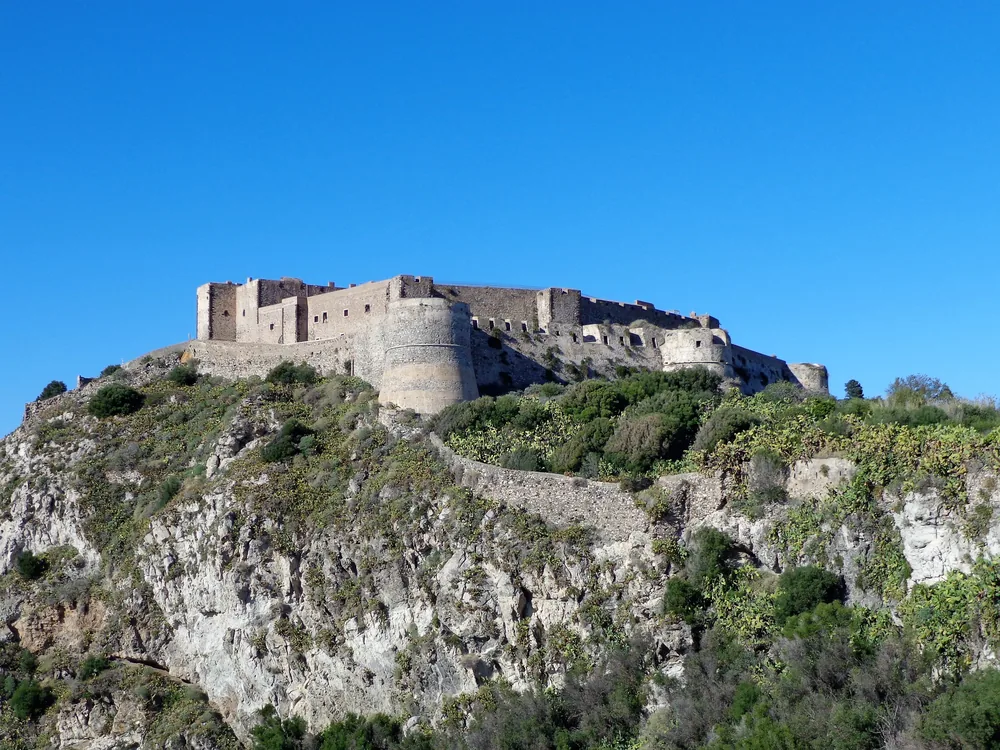
© Castles & Palaces
Quick Facts
- Hours
- Tue–Sun 09:00–18:00. Closed Mon
- Guided tour from
- €135
- Duration
- 2–2.5 hours (guided walking tour of citadel and town centre)
- Best time
- April to June and September to October
- Nearest city
- Messina
Featured Tour
Milazzo: Walking Tour of the Fortified Citadel and the Town Center
Cancellation available · Instant confirmation
Highlights
- ✦Five civilisations in one complex — Greek acropolis walls, Arab fortress foundations, Norman keep, Frederick II Hohenstaufen royal castle (1240s), Spanish Aragonese outer circuit, and a 17th-century cathedral all survive within the same fortification, making Milazzo the most historically stratified castle complex in northeastern Sicily
- ✦Frederick II of Hohenstaufen's royal tower — the Holy Roman Emperor who made Sicily the intellectual centre of 13th-century Europe left his architectural mark on Milazzo with the great tower and cisterns characteristic of his Sicilian building programme at Castel del Monte and Syracuse
- ✦The Cathedral of the Immaculate Conception inside the castle walls — a fully consecrated 17th-century Spanish Baroque church within the Medieval Citadel, still functioning as a place of worship; no other Sicilian castle contains a working cathedral within its fortifications
- ✦Three legible defensive perimeters visible on the ascent from the lower town — the Aragonese outer wall enclosing the Borgo Antico, the Norman-Hohenstaufen citadel gate above, and the Greek acropolis foundations at the summit; the GetYourGuide guided tour makes the military logic of each successive addition legible
- ✦Gateway to the Aeolian Islands — ferries to Lipari, Stromboli, Vulcano, and Salina depart from Milazzo port below the castle, making the fortification a natural first-morning stop before the UNESCO volcanic archipelago; castle and islands together form one of the most logistically rewarding itineraries in northeastern Sicily
Skip the queue with a guided tour
Skip-the-line tickets & expert guides
Milazzo Castle is one of the most architecturally and historically stratified fortifications in Sicily, accumulating successive layers of defensive construction across more than two millennia of continuous occupation. The promontory on which it stands was first fortified by Greek colonists in the 5th century BCE; Arab rulers built a castle on the Greek acropolis; the Normans constructed a stone keep; Frederick II of Hohenstaufen — Holy Roman Emperor and the most architecturally ambitious ruler of the 13th century — expanded the Norman fortress into a major royal castle in the 1240s; the Aragonese extended the circuit with a new outer wall; and the Spanish built a cathedral within the walls in the 17th century. Nowhere else in Sicily is the complete sequence of Mediterranean powers — Greek, Arab, Norman, Hohenstaufen, Aragonese, Spanish — so legibly written into a single complex.
The Medieval Citadel enclosed within the castle walls is the principal area for visitors: a self-contained fortified town of Norman and later construction, entered through an impressive gateway and containing the remains of Frederick II's royal tower, the Spanish-era Cathedral of the Immaculate Conception (still consecrated and functioning), the ruins of the Aragonese administrative buildings, and the Greek acropolis walls incorporated into later construction. The GetYourGuide guided walking tour (2–2.5 hours) provides interpretation of these multiple layers in a structured sequence; a guide inside the Citadel is genuinely valuable given the complexity of what survives. Note that the Citadel's on-site admission fee (approximately €5 adult, €3 child) is paid at the gate — the GetYourGuide price covers the guided tour, not the site admission.
The approach to the Medieval Citadel from Milazzo's lower town takes visitors through the Borgo Antico — itself enclosed within the Aragonese outer defensive circuit — before reaching the Norman gate to the Citadel proper. The layering of three distinct defensive perimeters (Greek acropolis, Norman/Hohenstaufen Citadel, Aragonese outer circuit) is visible as you ascend, and the walking tour makes the military logic of each addition legible as you move through the successive gates.
Milazzo is also the principal departure point for ferries to the Aeolian Islands — the UNESCO-listed volcanic archipelago (Lipari, Stromboli, Vulcano, Salina, and others) that lies 1–2 hours offshore from the port below the castle. This geographic circumstance gives Milazzo Castle a practical significance beyond its intrinsic historical interest: visitors using Milazzo as a staging post for the Aeolian Islands can visit the castle in the morning, take the ferry to Lipari in the afternoon, and continue to Stromboli or Salina the following day. The combination of Sicily's most stratified fortress with the most dramatic volcanic landscape in the Mediterranean makes Milazzo one of the most logistically useful and historically rewarding bases in northeastern Sicily.
The Milazzo peninsula's strategic position — a narrow promontory projecting into the Tyrrhenian Sea with commanding views over the Aeolian Islands — made it one of the most contested sites on Sicily's north coast throughout the ancient and medieval periods. The castle's current role as an open-air heritage site, with the Citadel serving as both museum and active place of worship, gives it an unusual quality: the working cathedral inside the walls means Milazzo Castle has never entirely ceased to function as a living place.
History
The promontory at Milazzo has attracted settlers and defenders for over two millennia. Greek colonists from Zancle (modern Messina) fortified the position in the 5th century BCE, exploiting a rocky headland with commanding views over the Tyrrhenian approaches and the Aeolian Islands; Arab rulers who conquered Sicily in the 9th century adapted the Greek acropolis into a fortified stronghold; and the Normans, who completed their conquest of Sicily by 1091, built a stone keep on the ancient foundations. Each successive occupation added to what the previous one had built, creating a fortification with an unusually legible architectural biography spanning twelve centuries.
Frederick II of Hohenstaufen — Holy Roman Emperor, King of Sicily, and the most ambitious builder of the 13th century — expanded Milazzo Castle into a major royal fortress in the 1240s, adding the great tower and cisterns that characterise his Sicilian building programme. Aragonese rulers subsequently extended the complex with a new outer defensive circuit, creating the Borgo Antico between the inner and outer walls and giving the fortification its current three-perimeter structure. The Spanish period produced the castle's most unexpected feature: the Cathedral of the Immaculate Conception, consecrated within the Citadel walls in the 17th century and still functioning as a place of active worship today. Military use of the outer defences continued into the 19th century before the complex was gradually adapted as an open-air heritage site, with the Medieval Citadel serving as its centrepiece.
How to Visit
Getting there: Milazzo is 40 kilometres west of Messina on Sicily's north coast. By car, take the A20 motorway to the Milazzo exit and follow signs to the Borgo Antico and Castello. By public transport, regional trains run from Messina to Milazzo station (approximately 40 minutes), from which the castle is a 15-minute walk uphill through the Borgo Antico. From Palermo, Milazzo is reachable by train via Messina (approximately 3.5 hours). The port for Aeolian Islands ferries is directly below the castle.
Tickets: On-site admission to the Medieval Citadel is approximately €5 adult and €3 child, paid at the gate. The GetYourGuide guided walking tour includes a licensed guide inside the Medieval Citadel and covers the town centre — but the citadel's on-site admission fee is paid separately at the gate; the price covers the guided tour only, not site admission. Walk-up entry to the citadel is available during opening hours for independent visitors. The tour booking link is available for those who want structured interpretation of the complex multi-period layers.
Practical tips: The five-layer archaeological biography of this castle makes a guide significantly more valuable here than at most Sicilian sites — the visual differences between Greek acropolis walls, Norman masonry, Frederick II construction, and Aragonese defensive circuits are not always self-evident without interpretation. Allow 2–2.5 hours for the full Citadel tour. If combining with an Aeolian Islands ferry, morning visits suit best — most departures to Lipari and Stromboli are from mid-morning onward, leaving time for the castle before boarding.
Combine with: The Aeolian Islands (ferries depart from Milazzo port, 1–2 hours to Lipari or Stromboli) — Milazzo is the main gateway to the UNESCO-listed Aeolian archipelago, making the castle a natural first stop before embarking for the islands.
Frequently Asked Questions
No — the GetYourGuide guided walking tour covers the cost of the guide inside the Medieval Citadel and the town centre walk, but the Citadel's on-site admission fee (approximately €5 adult, €3 child) is paid separately at the gate. The GetYourGuide price is for the guided tour only, not site admission. If you visit independently without a guide, you pay only the on-site admission fee of approximately €5 adult.
Location
Salita Castello, 98057 Milazzo ME, Sicily, Italy
Nearby Castles
Tours & Tickets
Powered by GetYourGuide
From
€135/ person