
Taormina Castle
Castello Saraceno di Taormina (Castelmola)
Italy · Sicily — Messina Province, Monte Tauro above the coastal town of Taormina · Near Taormina
Built 902 · Arab-Norman fortified watchtower and ruined defensive walls; Byzantine-era foundations from before the Arab conquest of 902 CE; successively adapted by Arab Aghlabid rulers and the Norman conquerors of Sicily in the 11th century; surviving fabric consists primarily of ruined walls, a gate, and watchtower remnants on the Monte Tauro summit at 390 metres above Taormina
This page is part of an independent travel guide and is not affiliated with, endorsed by, or operated by Taormina Castle.
© Castles & Palaces
Quick Facts
- Hours
- Daily 09:00–19:00
- Entry via GetYourGuide
- €10
- Duration
- 45 minutes–1 hour (ruins + panoramic viewpoint)
- Best time
- March to June and September to November
- Nearest city
- Taormina
Featured Tour
Taormina Castle Tour
Cancellation available · Instant confirmation
Highlights
- ✦The panoramic view from Monte Tauro at 390 metres — on clear days the position encompasses the Straits of Messina, the Calabrian coastline of mainland Italy beyond, and the vast smoking cone of Etna rising from the volcanic plain; a viewpoint of genuine magnificence that is the castle's primary reward
- ✦The layered Arab-Norman military archaeology — Byzantine foundations adapted by Arab Aghlabid rulers after the conquest of 902 CE, then reworked by the Normans in the 11th century; the site preserves three distinct layers of medieval Mediterranean military occupation at a single summit
- ✦The strategic logic of the Messina Strait — Monte Tauro commands the narrowest and most strategically vital maritime passage in the central Mediterranean; the military reason for fortifying this specific summit is instantly legible from any direction, and the audio guide contextualises the site's role in Byzantine, Arab, and Norman Sicily
- ✦The audio-guided archaeological circuit — the ruined walls, gateway, and watchtower remnants are modest in scale but authentic; the audio guide draws the military and historical context that the physical remains alone cannot communicate
- ✦The Taormina combination — castle and Greek Theatre in one afternoon: from Monte Tauro's Arab-Norman battlements to the Teatro Greco's stone cavea framing Etna, Taormina's two great elevated vantage points are covered in a natural uphill-to-downhill sequence
Skip the queue with a guided tour
Skip-the-line tickets & expert guides
The Castello Saraceno crowns Monte Tauro at 390 metres above Taormina, with one of the most commanding panoramic positions in all of Sicily. On clear days — which are common from spring through autumn — the view from the ruins encompasses the Straits of Messina to the northeast, the Calabrian coast of mainland Italy beyond, and the vast smoking cone of Etna rising from the volcanic plain to the southwest. It is a viewpoint of genuine magnificence, and it is the primary reason to make the steep climb from the town below.
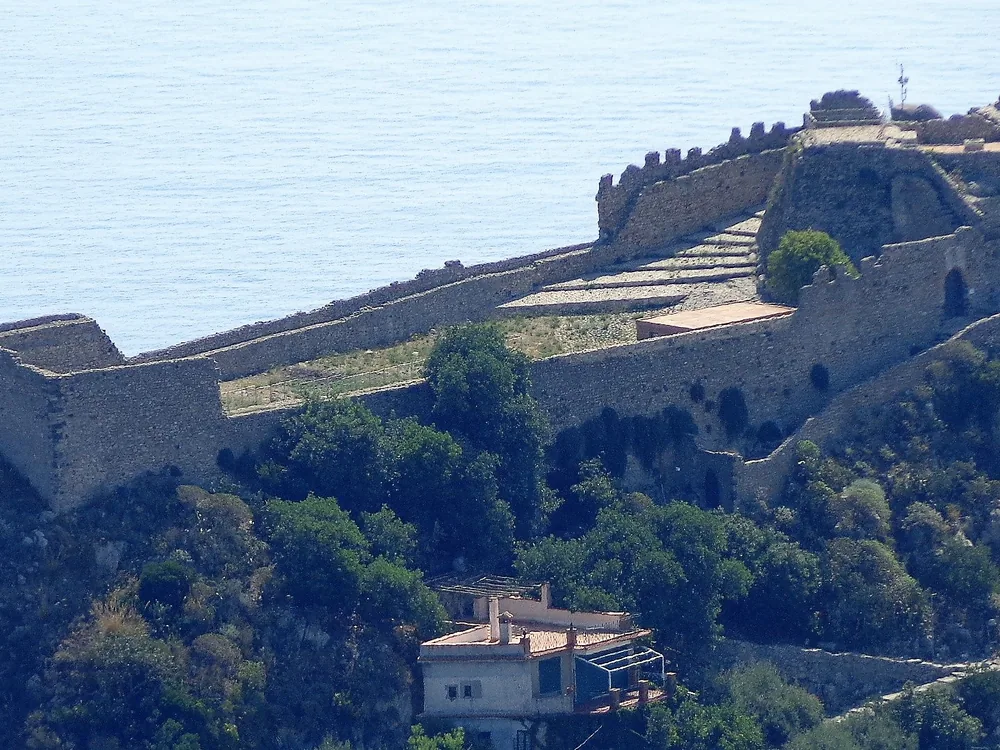
Visitors should arrive with calibrated expectations about the physical remains. The Castello Saraceno is a site of genuine archaeological and historical interest — layered Byzantine, Arab, and Norman occupation across several centuries of strategic importance — but what survives today is limited: ruined walls, the remnants of towers, a gateway, and the general outline of a fortification rather than any substantial standing structure. The archaeological remains are authentic and the audio guide contextualises them well, but this is emphatically not a castle in the tradition of preserving an intact medieval interior. Visitors who come primarily for the view and the layered history of the Messina Strait will leave satisfied; those expecting a well-preserved medieval castle will be disappointed.
The historical significance of the position is real and substantial. Monte Tauro was successively occupied by Byzantine forces for whom it was a key watchtower in the defence of the strait, Arab Aghlabid rulers who took Taormina in 902 CE in the final phase of their conquest of Sicily, and then the Normans who consolidated control of the island in the 11th and 12th centuries. Each phase of occupation adapted and extended the fortifications on the summit, using the natural topography to control the Messina Strait — one of the most strategically vital maritime passages in the medieval Mediterranean, connecting the Tyrrhenian and Ionian seas and separating Sicily from the Italian mainland by only a few kilometres.
The site is best understood as part of a Taormina itinerary that also includes the Teatro Greco immediately below in the town — the Greek Theatre, still in use for summer performances, frames Etna through its stone cavea in what is arguably the most memorable theatrical setting in the ancient world. Together, the Greek Theatre and the castle cover Taormina's two great elevation points and two great historical layers: Greek antiquity and medieval military occupation. The combination of panoramic view, multi-period archaeological site, and the famous Greek Theatre below makes a Taormina afternoon one of the most condensed culture experiences available anywhere in Sicily.
The entry ticket (€10 adult, €5 child) is paid at the gate, and the audio guide is included. The GetYourGuide entry ticket is available online with 1-day validity for those who prefer to book ahead.
History
Monte Tauro above Taormina has been a fortified position since the Byzantine period, when the site served as a strategic watchtower controlling the Messina Strait between Sicily and the Italian mainland. Byzantine forces who occupied Sicily for over three centuries used the summit's commanding position to monitor maritime movement through the narrowest point of the central Mediterranean, and the walls they built formed the first substantial fortification of the rocky peak.
Those fortifications were taken by Arab Aghlabid forces in 902 CE, completing the Arab conquest of Sicily that had been in progress since the 820s; the fall of Taormina effectively ended the Byzantine presence on the island. Arab rulers adapted the existing walls and maintained the site as a watchtower in the broader defensive network of Arab Sicily, exploiting the topographic logic that the Byzantines had identified.
The Normans, who began their conquest of Sicily under Roger I in 1061 and completed it by 1091, took Monte Tauro and its fortifications as part of their systematic reduction of Arab strongholds. Norman military occupation incorporated the surviving Arab walls into a new fortified system, giving the site its characteristic layered fabric of Byzantine foundations, Arab construction, and Norman adaptation. The castle functioned primarily as a watchtower and signal station rather than a major residential centre; Taormina's civic life was conducted in the town below. Gradual abandonment followed as the Messina Strait ceased to be an active military front line, and the ruins visible today preserve the earliest and most durable fabric of the site's long occupation.
How to Visit
Getting there: The Castello Saraceno is on Monte Tauro, directly above Taormina town. From Taormina's main street (Corso Umberto I), follow the signed path uphill — the climb takes approximately 20–30 minutes on foot from the town centre and is steep in places. Taormina itself is reached from Messina (50 km) or Catania (55 km) by car or regional bus; from the A18 motorway, exit at Taormina-Giardini. No car access to the castle summit.
Tickets: Walk-up entry is €10 adult and €5 child, paid at the gate — no advance booking required. The entry price includes the audio guide. The GetYourGuide entry ticket is available online with 1-day validity for those who prefer to book ahead; the price is identical to walk-up entry and the mixed GetYourGuide reception is discussed in Practical tips below.
Practical tips: Arrive early — in summer, the path to Monte Tauro is steep, sun-exposed, and hot from mid-morning; a morning start before 09:30 makes the climb far more comfortable. Wear sturdy footwear regardless of season, as the summit paths are rocky and uneven. Be candid with yourself about expectations: GetYourGuide reviews are mixed, largely reflecting visitors who expected more architectural substance from the physical remains. The castle's primary reward is the panoramic position and the views over Etna and the Straits of Messina — the ruins themselves are sparse. If the view on a clear day is what you came for, the visit delivers; if you want a well-preserved medieval castle, Milazzo, Syracuse, or Caccamo offer more substantial fabric.
Combine with: The Teatro Greco (Greek Theatre) of Taormina, immediately below the castle in the town — one of the most dramatically sited ancient theatres in the world, with Etna framed in the stone cavea; between the Greek Theatre and the castle, Taormina's two great vantage points are covered in a single afternoon moving from the ancient theatre up to the medieval ruins.
Frequently Asked Questions
Honestly, it depends on what you're looking for. If you are coming for one of Sicily's finest panoramic views — Etna to the southwest, the Straits of Messina to the northeast, Calabria beyond — and for the experience of standing on a site with three distinct layers of medieval occupation (Byzantine, Arab, Norman), then yes, €10 is reasonable. If you are expecting a well-preserved castle with substantial standing architecture and furnished interiors, the Castello Saraceno will disappoint — the surviving fabric is limited to ruined walls, a gateway, and tower remnants. GetYourGuide reviews are mixed, which reflects exactly this mismatch. Come for the view and the history of the position; set expectations accordingly.
Location
Monte Tauro, 98039 Taormina ME, Sicily, Italy
Nearby Castles
Tours & Tickets
Powered by GetYourGuide
From
€10/ person