
Palazzo Vecchio
Palazzo della Signoria
Italy · Tuscany · Near Florence
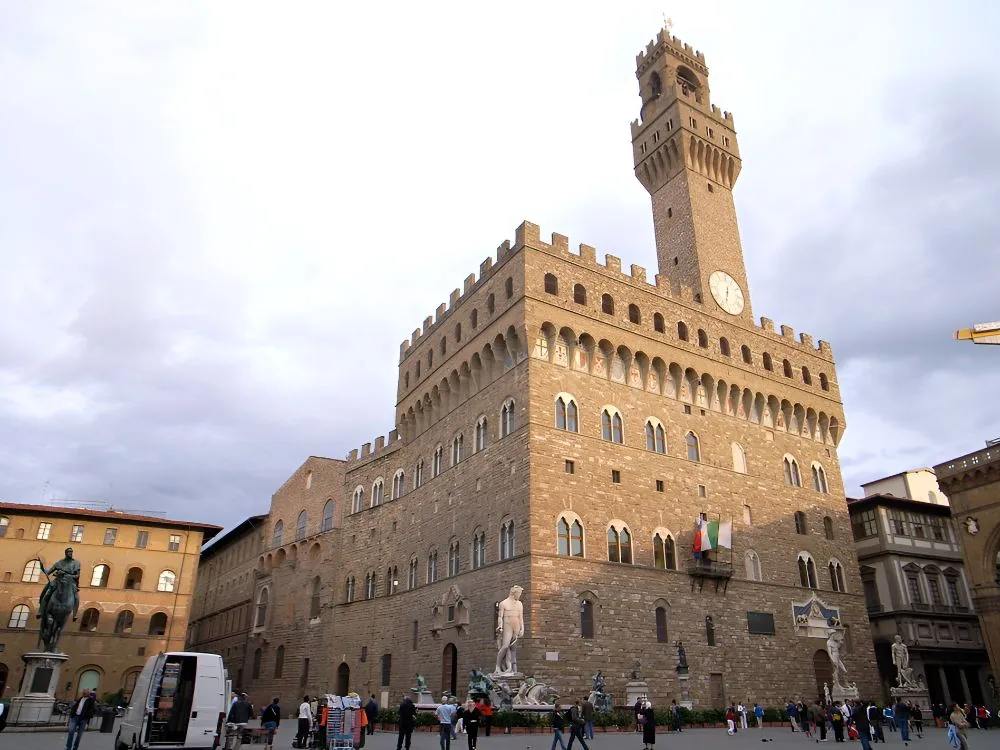
Built 1299 · Gothic civic architecture — built 1299–1314 as the centre of Florence's republican government, designed to embody the city's political independence from the Guelph bishops and the Ghibelline nobility; the facade is deliberately asymmetric (the Torre di Arnolfo is off-centre, built to avoid standing over the land of a condemned traitor); 19th-century neo-Gothic rusticated stonework additions complement the medieval original; later 16th-century interior transformation into a Medici ducal palace by Giorgio Vasari under Cosimo I de' Medici
This page is part of an independent travel guide and is not affiliated with, endorsed by, or operated by Palazzo Vecchio.
© Castles & Palaces
Quick Facts
- Hours
- Mon–Thu 09:00–19:00. Fri & Sat 09:00–23:00. Sun 09:00–19:00
- Entry via GetYourGuide
- €32
- Duration
- 1.5–2 hours (main palace); 30 minutes additional for the Torre di Arnolfo tower climb (separate ticket, limited access)
- Best time
- October to March
- Nearest city
- Florence
Featured Tour
Florence: Palazzo Vecchio Entry Ticket with Audioguide
Cancellation available · Instant confirmation
Highlights
- ✦The Salone dei Cinquecento (Hall of the Five Hundred) — the largest room in the palace, commissioned by Savonarola in 1494 for the newly restored republic's Great Council; Vasari's painted ceiling (begun 1563, 39 panels depicting Florentine military and civic history) and the vast wall frescoes overwhelm the room's 54×23m interior; this is where Cosimo I held court as Duke of Tuscany
- ✦The Torre di Arnolfo — the 94-metre tower (optional, separate ticket, limited capacity) offers panoramic views over Florence and the Arno valley; the tower's deliberate off-centre positioning on the palace facade — one of the most visible examples of medieval urban political symbolism — relates to a building code stipulating that public structures could not stand over the condemned family's razed house
- ✦The Studiolo of Francesco I — a tiny private study of Francesco I de' Medici (1570s), decorated floor-to-ceiling by Vasari and Bronzino with allegories of earth, air, fire, and water over 34 panels; one of the most complete surviving examples of Mannerist interior decoration, hidden away on the first floor as Francesco intended — a cabinet of curiosities that only privileged visitors could enter
- ✦Michelangelo's David (copy) and the Judith — the piazza outside the main entrance features a copy of Michelangelo's David (the original is in the Accademia); inside the palace, Donatello's original bronze Judith and Holofernes (1460s) stands in the Sala dei Gigli — one of the defining works of Florentine Renaissance sculpture
- ✦The Hall of Maps (Sala delle Carte Geografiche) — Cosimo I's studiolo of the world, with 53 painted wardrobe panels depicting maps of the known world as of the 1560s, plus a terrestrial globe 2.5 metres in diameter; a monument to the Medici vision of cosmopolitan power
- ✦First Florence/Tuscany entry on this site — the Palazzo Vecchio is the civic and artistic heart of the Florentine Republic and later the Medici Duchy; it is the single most historically concentrated building in Florence after the Cathedral complex
Skip the queue with a guided tour
Skip-the-line tickets & expert guides
The Palazzo Vecchio is the building around which Florentine public life has revolved for more than 700 years. It is still the seat of Florence's city government — the mayor's office is inside — while simultaneously housing one of the most significant museum collections in the city and dominating the Piazza della Signoria, which is itself essentially an outdoor gallery of copies of major Florentine Renaissance sculpture. The building manages to be, simultaneously, a working municipal building, a major Renaissance and Gothic monument, a museum of extraordinary importance, and the backdrop for the piazza where the most violent moments of Florentine political history played out: the burning of Savonarola, the execution of the Pazzi conspirators, the proclamation of various short-lived republics and restorations.
The palace was commissioned in 1299 by the Priors of Florence (the governing council of the Florentine Republic) as a secure seat of government — literally a fortress in which the priors could deliberate without being subject to the violent pressure of factional politics. The design, attributed to Arnolfo di Cambio, is a massive, crenellated rectangle of rustic ashlar with an imposing vertical emphasis created by the 94-metre Torre di Arnolfo projecting from one corner. The tower's deliberate off-centre positioning on the facade — which gives the building its characteristically asymmetric appearance — is explained by a medieval building code that forbade erecting public structures over the razed site of a condemned traitor's house: the land under the tower's natural geometric centre had belonged to a family whose treason required that nothing be built there. The asymmetry that 21st-century visitors admire as dramatically medieval was, at the time, a legal constraint.
The building's character shifted radically in the 1560s, when Cosimo I de' Medici, having consolidated his position as Duke of Tuscany, commissioned Giorgio Vasari (the artist, architect, and first art historian) to transform the medieval republican palace into a ducal residence and display space. Vasari's programme was thorough and astonishing in scale: the Salone dei Cinquecento, the vast room originally built by Savonarola for the Great Council of the restored republic, was raised by several metres and its ceiling covered with 39 painted panels depicting the history of Florentine military and civic glory. The walls were frescoed with battle scenes. The room, 54 metres long and 23 metres wide, became the largest and most overtly propagandistic room in Renaissance Florence — a statement of Medici power framed in the vocabulary of republican history.
The Studiolo of Francesco I, hidden on the first floor, is the intimate counterpoint to the Salone's theatrical bombast. This tiny windowless room — essentially a private cabinet of curiosities — was designed by Vasari and decorated by Bronzino, Alessandro Allori, and dozens of other artists in the 1570s, its every surface covered with allegories of earth, air, fire, and water, painted over storage niches that once held Francesco's collection of precious natural specimens, tools, and curiosities. It is one of the most completely preserved examples of Mannerist interior design in existence, and one of the most quietly extraordinary rooms in a city full of extraordinary rooms.
The GetYourGuide-listed experience (approximately 2 hours) covers the main palace with audioguide. The Torre di Arnolfo tower climb (separate ticket, limited daily capacity) is bookable independently through the city museums website. The palace is a 2-minute walk from the Uffizi Gallery and 5 minutes from the Duomo — allow a full day if combining all three.
History
Arnolfo di Cambio built the Palazzo della Signoria — the seat of Florence's republican government — between 1299 and 1314, producing a civic building of such authoritative mass that it has dominated Piazza della Signoria for seven centuries. The tower's asymmetric position above the main block reflects a peculiarity of medieval Florentine building law: the site occupied by a condemned traitor could not be incorporated into a public building, forcing the tower placement off-centre in a way that became, paradoxically, one of the building's most distinctive features.
The palazzo served as Florence's civic centre through the political upheavals of the following two centuries. Savonarola — the Dominican friar who briefly governed Florence in a puritanical theocracy in the 1490s — was burned at the stake in the piazza in 1498. Cosimo I de' Medici, having consolidated Medici power over Florence, transformed the interior from 1540 onward with the comprehensive decorative programme overseen by Giorgio Vasari: the Salone dei Cinquecento and the apartments were refrescoed with subjects glorifying Medici rule and Florentine history. When the Medici moved their residence to the Pitti Palace across the Arno in 1549, the Signoria building acquired the popular name Palazzo Vecchio — the Old Palace — that it has carried ever since.
The building remains Florence's city hall today, with the mayor's office inside, while museum sections covering the medieval and Medici apartments are managed by Musei Civici Fiorentini.
How to Visit
Getting there: Palazzo Vecchio stands on Piazza della Signoria in Florence's historic centre — 5 minutes' walk from the Duomo and 2 minutes from the Uffizi Gallery. Florence's ZTL (restricted traffic zone) prohibits private cars; arrive by train to Santa Maria Novella station (~15 minutes' walk) or by tram (T1 line, Unità stop is closest). Taxis drop off at Piazza della Repubblica.
Tickets: Walk-up entry €12 adult, €5 child. The GetYourGuide entry ticket with audioguide covers the main palace rooms for approximately 2 hours. The Torre di Arnolfo tower climb is a separate ticket with limited daily capacity — book it through museicivicifiorentini.comune.fi.it.
Practical tips: October to March is the least crowded season; in summer, Thursday–Saturday evening openings until 23:00 offer a quieter alternative to daytime visits. Book at least 3 days ahead for guaranteed morning entry. Allow 1.5–2 hours for the main palace; add 30 minutes if climbing the tower.
Combine with: Castel di Poggio is a short drive into the Chianti hills outside Florence — a complementary Florentine castle experience in the Tuscan countryside.
Frequently Asked Questions
The 'Vecchio' (old) name came into use after 1549, when Cosimo I de' Medici moved the ducal residence from this palace to the newly acquired Pitti Palace across the Arno. The government palace in Piazza della Signoria became the 'old palace' relative to the Medici's new Pitti residence — an informal label that stuck. It had previously been called the Palazzo della Signoria (after the governing body of the republic) or simply Palazzo dei Priori.
Location
Piazza della Signoria, 50122 Firenze FI, Italy
Nearby Castles
Tours & Tickets
Powered by GetYourGuide
From
€32/ person