
Palazzo Venezia
Palazzo Venezia
Italy · Lazio — Rome, Piazza Venezia, at the foot of the Capitoline Hill · Near Rome
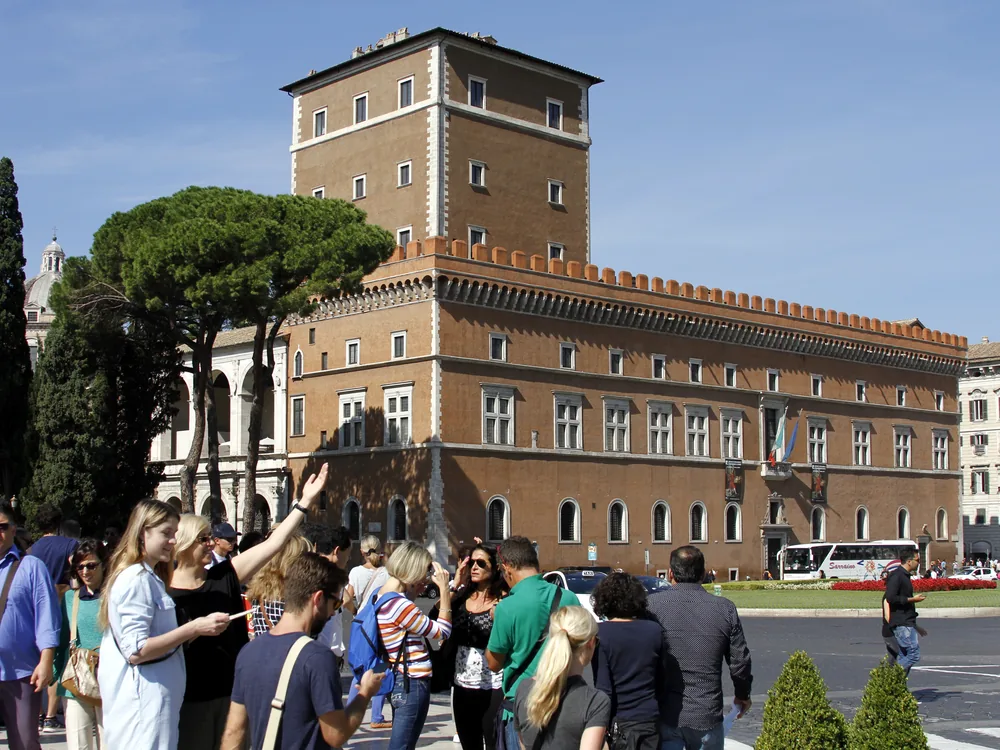
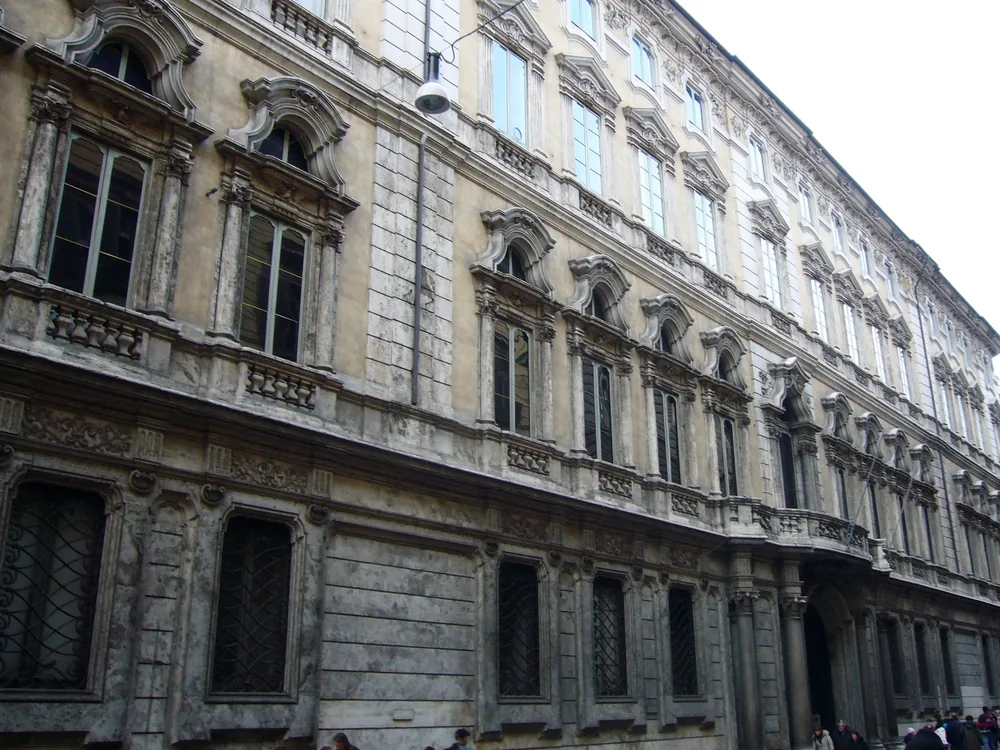
Built 1455 · Early Renaissance civic palace and one of the first major Renaissance buildings in Rome — built from 1455 for Cardinal Pietro Barbo (who became Pope Paul II in 1464); the building combines a medieval fortress-like mass with Renaissance decorative elements including the distinctive rusticated stone base, the refined biforate (two-light) windows, the crenellated parapet, and the interior courtyards; the architecture reflects the transitional moment between the Gothic-Romanesque tradition of Roman medieval civic building and the new classicising vocabulary of the 15th-century Renaissance; the palazzo's position on Piazza Venezia — the traffic hub at the foot of the Capitoline Hill, adjacent to the Vittoriano Monument (Altare della Patria) — gives it one of the most prominent addresses in Rome despite being physically overshadowed by the white marble mass of the Vittoriano; the Sala del Mappamondo, on the piano nobile, is the most historically charged room in the building: a large barrel-vaulted hall that served as Mussolini's personal office from 1929 to 1943, the room in which the Fascist dictator received state visitors and conducted government business
This page is part of an independent travel guide and is not affiliated with, endorsed by, or operated by Palazzo Venezia.
© Castles & Palaces
Quick Facts
- Hours
- Tue–Sun 10:00–18:00. Closed Mon
- Guided tour from
- €33
- Duration
- 1–1.5 hours (Palazzo Venezia museum alone); 3 hours for the full GetYourGuide bundle including Vittoriano elevator and Museum of the Risorgimento
- Best time
- Year-round
- Nearest city
- Rome
Featured Tour
Rome: Palazzo Venezia Reserved Entrance + Vittoriano Elevator + Museum of the Risorgimento (audio guide, 3h)
Cancellation available · Instant confirmation
Highlights
- ✦The Sala del Mappamondo — Mussolini's personal office from 1929 to 1943: a large barrel-vaulted Renaissance hall from which the Fascist dictator conducted the business of government and received foreign dignitaries; the room's historical association gives it a gravity disproportionate to its architectural character; the name ('Hall of the World Map') comes from a late medieval map that once hung in the room; it is the most charged space in the building
- ✦The balcony on Piazza Venezia — the Loggia delle Benedizioni (Loggia of Blessings) projecting over Piazza Venezia was used by Mussolini as the staging point for his public speeches to assembled crowds; from this balcony he announced the declaration of war on France and Britain in June 1940; the balcony's position over the piazza — Rome's central traffic hub — made the mass rally below it one of the most visible exercises of fascist crowd politics in the city; the association remains the primary reason the palazzo is internationally known
- ✦Palazzo Venezia museum — the museum collections occupy the piano nobile rooms of the palace: decorative arts, armour, medieval and Renaissance ivories, ceramics, tapestries, bronzes, and panel paintings; the collection is broader than it is deep and lacks the single iconic work that draws specialists, but the setting — Renaissance palace rooms, some with original painted or gilded ceilings — makes the visit architecturally rewarding independently of any single object
- ✦Museum of the Risorgimento — the Museum of Italian Unification (Risorgimento) adjacent to the palazzo covers the history of Italian political unification in the 19th century, from the Napoleonic disruption of the old order through the campaigns of Garibaldi and Cavour to the establishment of the Kingdom of Italy in 1861; Roman connection: the Papal States, whose seat was in Rome, resisted Italian unification until 1870 and the pope did not officially acknowledge the Italian state until the Lateran Treaty of 1929 — the same year Mussolini moved into the palazzo
- ✦Vittoriano Monument panoramic elevator — the GetYourGuide bundle includes the panoramic terrace elevator of the Vittoriano Monument (Altare della Patria), the enormous white marble national monument adjacent to the palazzo; from the upper terrace at 70 metres, the view over the Roman Forum, the Palatine Hill, the Capitoline Hill (with the Piazza del Campidoglio), the roofline of the Centro Storico, and the distant dome of St Peter's is one of the most comprehensive overviews of ancient and modern Rome available from any single point
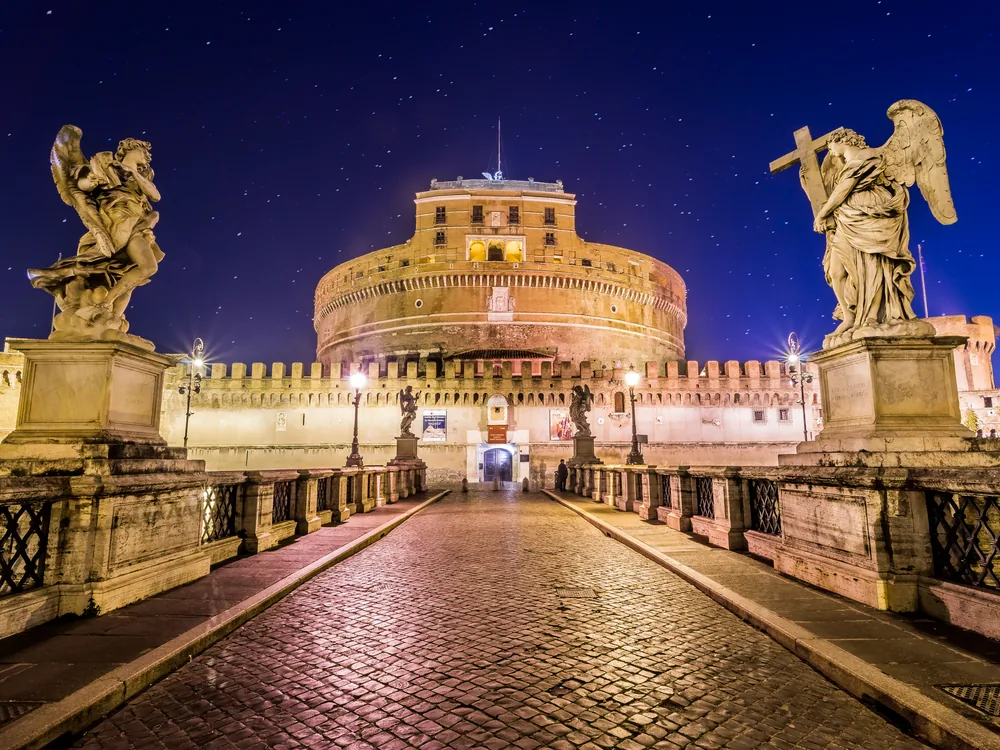
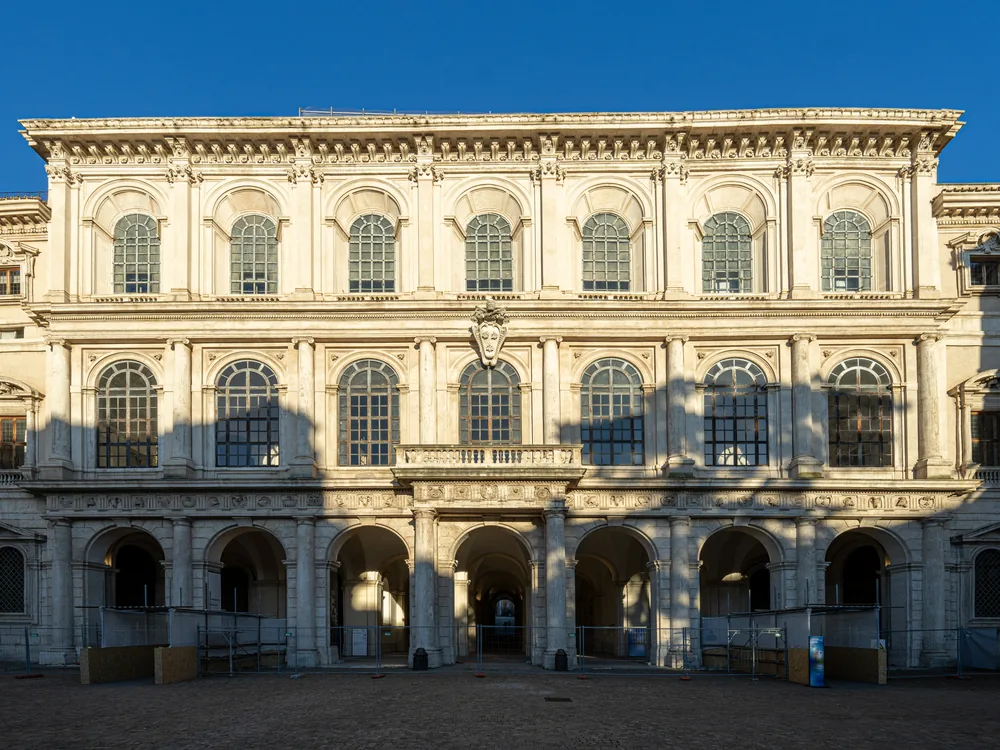
- ✦Rome cluster: Castel Sant'Angelo and Palazzo Barberini — [Castel Sant'Angelo](/castles/italy/castel-santangelo), the Hadrianic mausoleum and papal fortress on the Tiber, is approximately 1.8 kilometres northwest; [Palazzo Barberini](/castles/italy/palazzo-barberini), the Baroque palace by Bernini and Borromini with Caravaggio and Raphael, is approximately 1.5 kilometres northeast; the three form the site's Rome palace cluster covering fourteen centuries of Roman palace history
Skip the queue with a guided tour
Skip-the-line tickets & expert guides
Palazzo Venezia stands on Piazza Venezia — the traffic roundabout at the geographical centre of Rome — its Renaissance rusticated stone facade dwarfed by the enormous white marble mass of the Vittoriano Monument immediately adjacent. The palazzo's physical scale has been obscured by its neighbour since the Vittoriano was built in the late 19th century; its historical significance has, for the past century, been defined by the events of 1929–1943, when Benito Mussolini chose it as the seat of his government.
The palace was built from 1455 for Cardinal Pietro Barbo, who became Pope Paul II in 1464. The building is one of the first significant Renaissance structures in Rome — built at the transitional moment when the classicising architectural vocabulary of the Florentine Renaissance was beginning to influence Roman civic building. The facade combines a medieval fortress-like mass with Renaissance decorative elements: rusticated stone, biforate (two-light) windows, and a crenellated parapet that reads simultaneously as fortification and architectural ornament. The interior courtyards — particularly the Cortile del Palazzetto, which now faces the Vittoriano — preserve 15th-century loggia arcading of considerable architectural quality.
The building's subsequent history traces the complications of Roman political geography. After Barbo's death, the palazzo served as a papal residence for Leo X, Paul III, and Clement VII; then as the embassy of the Republic of Venice in Rome (hence the name: the Venetian ambassador occupied it from 1564). When Venice fell to Napoleon in 1797 and the Republic was dissolved, the palazzo passed to the Austrian Empire (which had absorbed the former Venetian territories); Austria held it until 1916, when Italy, at war with Austria-Hungary, seized the building as state property.
In 1929, Mussolini — who had become head of the Italian government through the March on Rome in 1922 and secured absolute power through the Fascist consolidation of the late 1920s — moved his office to the Sala del Mappamondo on the palazzo's piano nobile. The Sala del Mappamondo was a large barrel-vaulted Renaissance hall; its scale and central position on the piano nobile made it an effective setting for the theatrical statecraft that Fascism required. Mussolini received foreign dignitaries in the room with the lights arranged so that his desk was at the far end of a long empty space — the walk from the door to the desk was a calculated exercise in psychological subordination.
The palazzo's balcony — the Loggia delle Benedizioni projecting over Piazza Venezia — became the staging point for Mussolini's public speeches to crowds assembled in the piazza below. From this balcony he announced the invasion of Abyssinia in 1935, the proclamation of the Italian Empire in 1936, and Italy's declaration of war on France and Britain in June 1940. The piazza's function as Rome's main traffic hub gave the rallies a geography of maximum visibility; the palazzo provided the vertical separation between leader and crowd that Fascist political spectacle required.
Since 1944, when the Allies occupied Rome and Mussolini fled north, the palazzo has functioned as a museum. The Palazzo Venezia museum occupies the piano nobile rooms with a collection of medieval and Renaissance decorative arts: arms and armour, ivories, ceramics, bronzes, tapestries, and panel paintings. The collection is institutional rather than spectacular — it lacks the single iconic work that defines a collection — but the rooms themselves, some with original 15th-century ceilings, provide an architectural framework that rewards the visit independently of any specific object.
The GetYourGuide bundle covers the Palazzo Venezia museum, the Museum of the Risorgimento, the Vittoriano Monument's panoramic elevator (at 70 metres, one of the best viewpoints in Rome over the Forum and Palatine Hill), and a 25-minute multimedia video. The pricing note from the brief and visitor reviews is important: the bundle is priced significantly above what a visitor can pay at the official box office for just the Palazzo Venezia museum (~€8 estimated). If you only want the museum, buying directly at the box office is economical. If you want the Vittoriano elevator and the Risorgimento museum included, the bundle makes the combination more practical.
[Castel Sant'Angelo](/castles/italy/castel-santangelo) and [Palazzo Barberini](/castles/italy/palazzo-barberini) complete the site's Rome palace cluster: three buildings spanning fourteen centuries of Roman palace history from the Hadrianic mausoleum to the Baroque to the Renaissance-turned-Fascist-headquarters.
History
Cardinal Pietro Barbo began construction of the palazzo in 1455, and when Barbo was elected Pope Paul II in 1464, it became a papal residence — one of the first Renaissance palaces in Rome, a building whose rusticated stone facade and severe proportions set a precedent for Roman palace architecture that persisted for a century. The building served various papal uses through the 15th and 16th centuries, with Leo X, Clement VII, and Paul III among those who resided or used it.
In 1564 the Republic of Venice took possession, and the palazzo became the Venetian embassy in Rome — giving it the name it carries today. This arrangement lasted until 1797, when Napoleon dissolved the Republic of Venice; the Austrian Empire inherited the Venetian territories and with them the palazzo. Italy seized the building from Austria-Hungary in 1916 as wartime enemy property.
The palazzo's most politically charged chapter came in 1929, when Mussolini moved his office to the Sala del Mappamondo and made the building the operational centre of the Fascist government. From the Loggia delle Benedizioni overlooking Piazza Venezia, he delivered the speeches that were amplified to the crowds below — including the declaration of war on France and Britain on 10 June 1940. Mussolini fled north following his arrest in 1943; the Allies occupied Rome in 1944. The Museo del Palazzo Venezia was established in the building after the war and is open Tuesday to Sunday.
How to Visit
Getting there: Palazzo Venezia is on Piazza Venezia, Rome's central traffic hub at the foot of the Capitoline Hill. Bus lines 40, 62, 64, and 70 stop here directly. The nearest metro station is Colosseo (Line B), a 12-minute walk east. From Castel Sant'Angelo it is a 20-minute walk southeast along Corso Vittorio Emanuele II.
Tickets: Walk-up entry ~€8 adult, free for under-18s; confirm current prices at polomusealelazio.cultura.gov.it. The GetYourGuide bundle includes the Palazzo Venezia museum, the Museum of the Risorgimento, the Vittoriano Monument panoramic elevator, and a 25-minute multimedia video with audioguide — worth the premium if you plan to visit the Vittoriano terrace; buy directly at the box office if you only want the museum.
Practical tips: The museum is closed Mondays; open Tuesday–Sunday 10:00–18:00; no advance booking required. Allow 1–1.5 hours for the museum alone, or 3 hours for the full bundle. Year-round visiting is fine — the interior is unaffected by weather, and the Vittoriano panoramic terrace is best in clear conditions for views over the Forum.
Combine with: Castel Sant'Angelo is 20 minutes' walk northwest along the Tiber; Palazzo Barberini is 1.5 km northeast — a Baroque palace by Bernini and Borromini with Caravaggio and Raphael.
Frequently Asked Questions
At least one reviewer specifically noted that buying directly at the official box office cost roughly half the GetYourGuide price for the same museum entry. The GetYourGuide bundle is worth the premium if you want the Vittoriano Monument's panoramic elevator (which gives one of the best elevated views of the Roman Forum and ancient city) and the Museum of the Risorgimento included — those additions justify part of the price difference. If you only want to see the Palazzo Venezia museum and Sala del Mappamondo, the box-office standalone ticket is significantly more economical.
Location
Via del Plebiscito 118, 00186 Roma RM, Italy
Nearby Castles
Tours & Tickets
Powered by GetYourGuide
From
€33/ person