
Sacra di San Michele
Sacra di San Michele
Italy · Piedmont, Val di Susa — summit of Mount Pirchiriano, ~40km west of Turin · Near Avigliana / Sant'Ambrogio di Torino
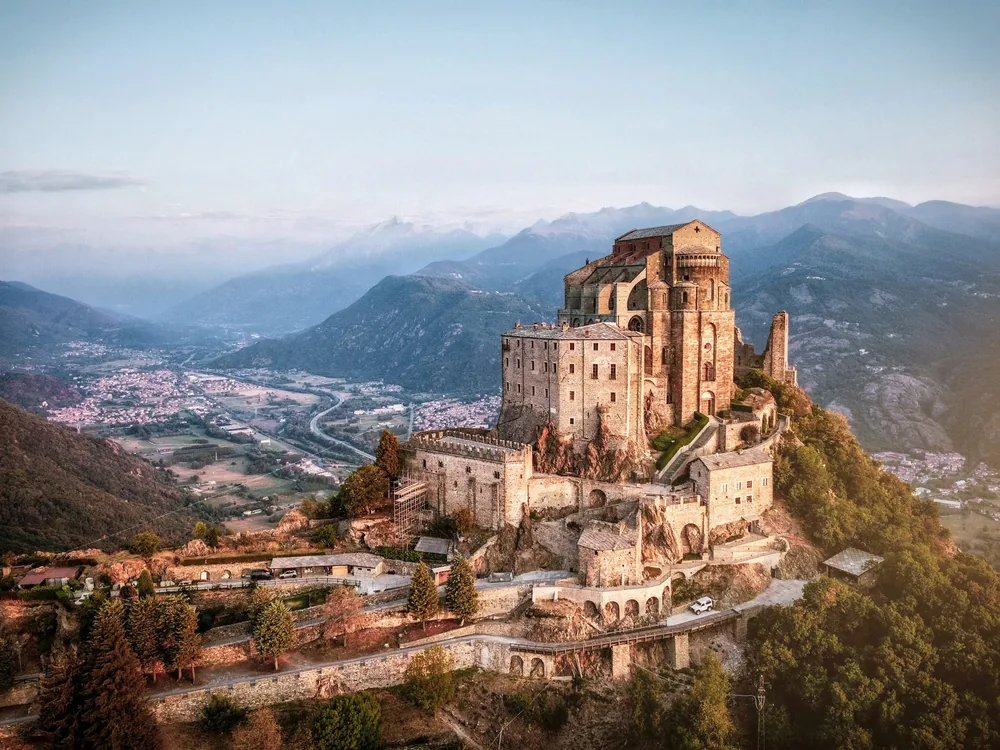
Built 983 · Romanesque abbey-fortress on a mountain summit — founded c.983–987 on the summit of Mount Pirchiriano (962m) where the walls appear to grow directly from the living rock; the lower structures, including the Iron Gate and the base of the Staircase of the Dead, are incorporated into the rock itself; the main church is Romanesque in structure, built over a pre-existing underground chapel; the famous Doorway of the Zodiac (early 12th century, attributed to workshop of Niccolò) is carved with the signs of the zodiac, northern-hemisphere constellations, and playful human figures; later Gothic chapels and Baroque decorative additions integrate within the Romanesque fabric; the Rosminian Fathers' 19th-century restoration preserved the essential medieval character while consolidating the heavily deteriorated structure; the abbey's defensive position — a near-vertical drop on all sides, with the summit accessible only via the single staircase route — makes it functionally a fortress as well as a religious house
This page is part of an independent travel guide and is not affiliated with, endorsed by, or operated by Sacra di San Michele.
© Castles & Palaces
Quick Facts
- Hours
- Tue–Sat 09:30–12:30 / 14:30–18:00. Sun 09:30–12:00 / 14:30–18:00. Closed Mon
- Guided tour from
- €60
- Duration
- 1.5–2 hours (abbey interior and staircase); 4–5 hours (GetYourGuide half-day tour from Turin including travel)
- Best time
- April to October
- Nearest city
- Avigliana / Sant'Ambrogio di Torino
Featured Tour
From Turin: Half-Day Medieval Sacra di San Michele Tour
Cancellation available · Instant confirmation
Highlights
- ✦The Doorway of the Zodiac — one of the most unusual Romanesque portals in Italy; carved in the early 12th century with the twelve signs of the zodiac, the northern-hemisphere constellations, and pairs of human figures pulling each other's hair in what scholars have interpreted as an allegory of human folly; the door is the formal entrance to the abbey church and the one element that visitors consistently describe as the visual signature of the place
- ✦The Staircase of the Dead — 243 steps cut through and alongside the living rock of the mountain, named for the monks' tombs once displayed in the niches along the walls; the climb is the only way to reach the abbey and takes approximately 20 minutes; the physical effort of the ascent was a deliberate feature of the pilgrimage experience — you arrive at the summit having earned it
- ✦Umberto Eco's The Name of the Rose — Eco acknowledged the Sacra di San Michele as a key visual inspiration for the monastery setting of his 1980 novel; the 1986 film adaptation starring Sean Connery reproduced its brooding hilltop silhouette and labyrinthine atmosphere; the connection made the abbey internationally known far beyond its normal pilgrimage circuit and is still the most common reason non-religious visitors seek it out
- ✦The Via Francigena pilgrim route — the Sacra sits directly on the ancient pilgrimage road from Canterbury to Rome; medieval pilgrims walking the Via Francigena would see the abbey's silhouette from the Val di Susa valley below and make the climb as a devotional act; the abbey's elevation and visibility made it simultaneously a pilgrimage goal and a navigational landmark for centuries of cross-Alpine travellers
- ✦The walls grow from the rock — the lower portions of the abbey, including the Iron Gate and the foundations of the Staircase, are built directly into and upon the living rock of the summit; the transition between carved stone and natural cliff face is gradual enough in several places that the human construction and the mountain seem to continue each other rather than interrupt
- ✦GetYourGuide half-day private tour from Turin (4–5 hours, entrance fees included) — coach from Turin, guided abbey visit; the €60 covers transport + guide + entry
Skip the queue with a guided tour
Skip-the-line tickets & expert guides
Before you can visit the Sacra di San Michele, you have to climb to it. The car park sits at the base of Mount Pirchiriano, and from there the only approach is the Iron Gate, a medieval portal cut through the rock at the mountain's base, and then 243 stone steps — the Staircase of the Dead — ascending through the mountain itself before emerging at the abbey's main entrance and the Doorway of the Zodiac. This is not incidental. The medieval designers of the route understood the pilgrimage approach as part of the experience: the effort of the climb, the darkness of the enclosed staircase, the surprise of the portal emerging from the cliff face, all calibrated to produce a particular state of mind at the moment of arrival.
The founding of the abbey is attributed to Hugh of Montboissier, a Burgundian noble, who around 983–987 established a monastic community on the summit of the rocky peak that commands the Val di Susa — the principal Alpine crossing between Piedmont and France. The site's strategic position on the Via Francigena, the pilgrim and merchant road from Canterbury to Rome via the Mont Cenis pass, gave the new foundation immediate relevance: pilgrims walking from northern Europe to Rome would see the abbey's silhouette rising above the valley and make the climb as a devotional act, transforming a mountain summit into one of the fixed points on the great medieval pilgrim itinerary.
The Benedictines who established themselves at the site built the abbey's core structures in the Romanesque style of 11th and 12th-century Piedmont: heavy walls incorporating and emerging from the natural rock of the summit, a main church built over an earlier underground chapel dedicated to the archangel Michael, and the defensive position that made the summit simultaneously a religious house and an impregnable fortress — no conventional military approach was possible on three sides. The abbey became wealthy through donations from the Marquesses of Turin, the Savoy dynasty's predecessors in the region, and later from the Savoy rulers themselves, who regarded the Sacra as a dynastic sanctuary.
The building's most celebrated single element is the Doorway of the Zodiac, the carved portal at the top of the Staircase of the Dead leading into the abbey church. Carved in the early 12th century by a sculptor working in the tradition of Niccolò — the northern Italian Romanesque carver responsible for portals at Piacenza and Ferrara — the doorway carries the twelve signs of the zodiac in roundels around the arch, flanked by the constellations of the northern hemisphere; below the zodiac signs are paired human figures engaged in what appears to be mutual hair-pulling, which scholars have interpreted as representing the vices and human folly that must be passed through to reach the sacred interior. The portal is remarkable in Italian Romanesque sculpture for the combination of astronomical precision — the constellations are accurately placed relative to the zodiac — and playful figurative invention.
The abbey's power and relevance declined from the 14th century onward, as the Via Francigena's importance diminished and the Savoy court shifted its patronage elsewhere. By the 18th century the community had largely abandoned the complex; the Napoleonic period brought formal suppression, and decades of neglect followed during which parts of the structure deteriorated seriously and some sections were demolished. The Rosminian Fathers — the religious order founded by Antonio Rosmini — began restoration in 1836 and have managed the abbey since, consolidating the surviving medieval fabric and making the site accessible to pilgrims and visitors without replacing the original character.
The Sacra's association with Umberto Eco's The Name of the Rose requires some qualification. Eco did not set his novel at the Sacra di San Michele specifically — the fictional 'unnamed Italian Benedictine monastery' in the novel is a composite, drawing on various sources. But Eco explicitly acknowledged the Sacra as one of the visual and atmospheric inspirations for the setting, and the 1986 film adaptation by Jean-Jacques Annaud, starring Sean Connery as Brother William of Baskerville, reproduced the abbey's mountaintop silhouette and labyrinthine interior logic closely enough that visitors who arrive having read the novel or seen the film recognize what Eco and Annaud were responding to. The connection brought international attention to a site that had been largely a regional pilgrimage destination and helped establish its current status as one of Piedmont's most-visited historic monuments.
The legend of Bell'Alda, a local story about a shepherd girl who fell or jumped from the mountain — in different versions either saved by an angel or killed by a second fall after she bragged about surviving the first — is one of several locally-maintained medieval legends attached to the site; it circulates on guided tours and in the abbey's own literature as an example of the moral tales that accumulated around major pilgrimage sites in the medieval period.
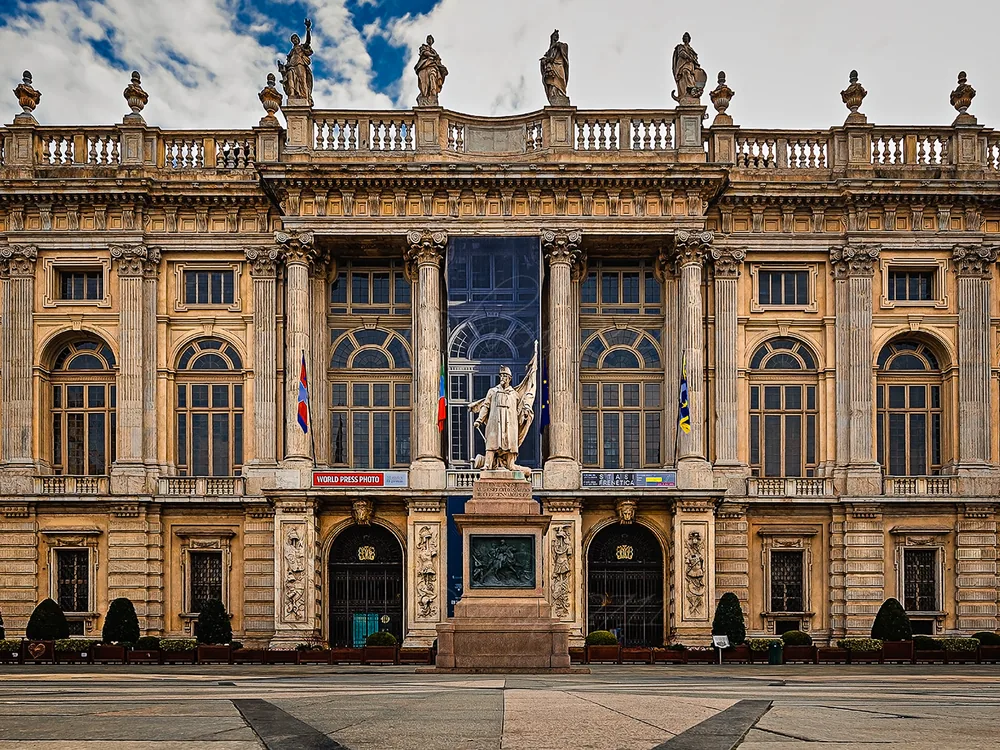
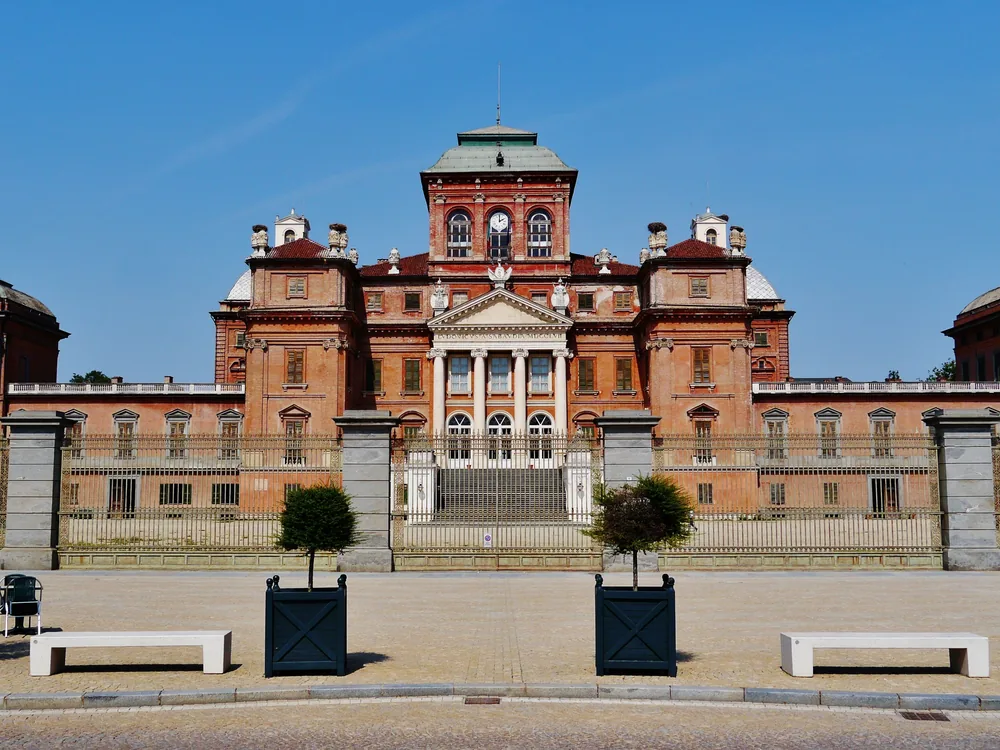
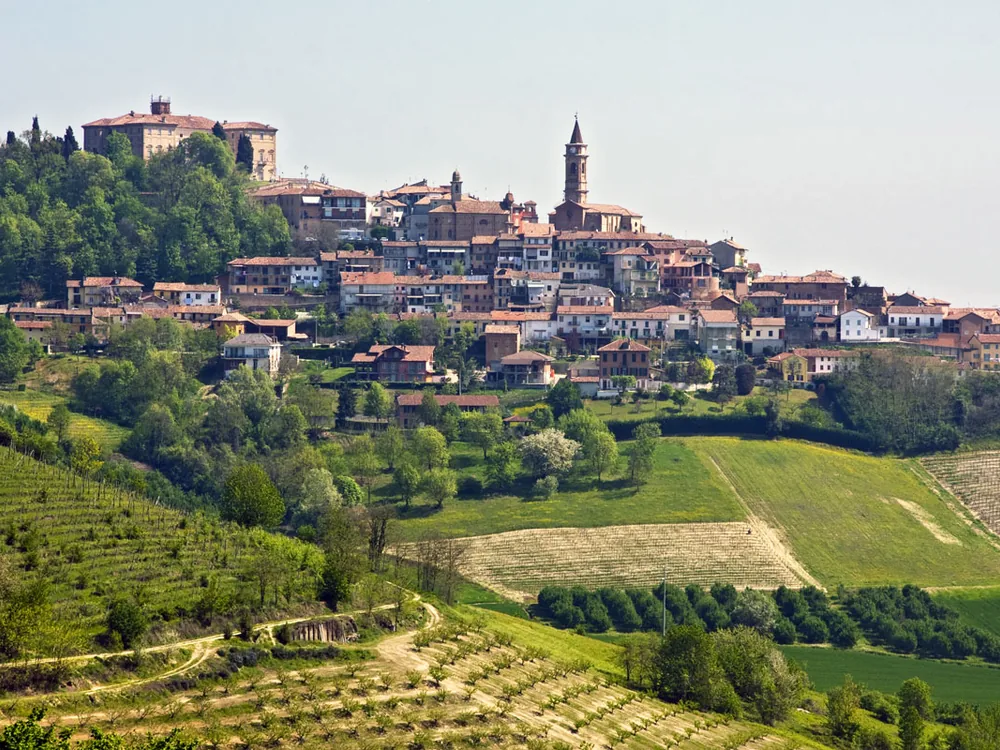
[Palazzo Madama in Turin](/castles/italy/palazzo-madama), 40 kilometres east in the centre of the city, is the Roman-gate-turned-medieval-castle-turned-Baroque-palace that served as the seat of successive Savoy rulers — the dynasty whose patronage supported the Sacra di San Michele across several centuries. [Racconigi Castle](/castles/italy/racconigi-castle) and [Govone Castle](/castles/italy/govone-castle), further east in the Piedmont flatlands, complete the Savoy royal residential landscape that the Sacra di San Michele's mountain silhouette presided over from the west.
History
Hugh of Montboissier founded the abbey on the summit of Mount Pirchiriano around 983 to 987, commanding the Val di Susa at the point where the route from France descended into Piedmont — one of the most important pilgrimage and trade corridors in medieval Italy. A Benedictine community built the main Romanesque church over an earlier underground chapel in the 11th century, and the abbey grew wealthy through donations from the Marquesses of Turin and the House of Savoy, whose patronage made the Sacra one of the most significant religious establishments in northwest Italy. The Doorway of the Zodiac, carved in the early 12th century, is the most celebrated piece of Romanesque sculpture in Piedmont — a portal whose carved signs of the zodiac, constellations, and figures from classical mythology frame the threshold between the secular world and the sacred interior with a vocabulary that is as much learned as it is devotional.
The abbey reached its height in the 12th and 13th centuries, positioned on the Via Francigena and sustained by Savoy dynastic patronage. The 14th to 17th centuries brought decline, a reduced community, and partial neglect of the fabric. Napoleonic suppression in the 18th century allowed parts of the structure to deteriorate severely. The Rosminian Fathers began restoration in 1836 and took over management of the abbey, which has remained in their care since.
Umberto Eco acknowledged the Sacra as a visual inspiration for the fictional monastic setting of The Name of the Rose (1980), and Jean-Jacques Annaud's 1986 film adaptation, starring Sean Connery, brought the abbey to wide international attention. It remains an active religious house, open to visitors Tuesday to Sunday.
How to Visit
Getting there: By car: ~40 km west of Turin via the A32 or SS25 to Sant'Ambrogio di Torino, then follow signs to the abbey car park at the base of Mount Pirchiriano (~40 minutes from Turin). By public transport: train from Turin Porta Susa to Avigliana (~30 min, Trenitalia), then taxi or seasonal shuttle bus to the abbey car park (~5 km). From the car park, climb 243 stone steps of the Staircase of the Dead (~20 minutes) to reach the abbey entrance.
Tickets: Walk-up entry €7 adult. The GetYourGuide half-day tour from Turin includes return coach transport from Turin, abbey entrance fees, and a guided visit — 4–5 hours total; the most practical option for visitors without a car. No advance booking required for independent walk-up entry.
Practical tips: April to October offers the best conditions — Val di Susa and Alpine views are clearest in spring and autumn, and the access road is reliably passable. Closed Mondays year-round; open Tuesday–Sunday in split sessions (09:30–12:30 and 14:30–18:00); confirm current hours at sacradisanmichele.com. Wear comfortable footwear — the staircase climb is the only access route and is not accessible for visitors with limited mobility.
Combine with: Palazzo Madama in Turin city centre is 40 km east — the Savoy seat whose dynasty patronised the Sacra for centuries; Racconigi Castle is the principal Savoy summer residence, 75 km southeast on the Po plain.
Frequently Asked Questions
The Doorway of the Zodiac is the carved Romanesque portal at the top of the Staircase of the Dead, carved in the early 12th century by a sculptor in the tradition of Niccolò — the leading Romanesque carver of northern Italy whose portals survive at Piacenza and Ferrara. The door carries the twelve zodiac signs in roundels around the arch and the northern-hemisphere constellations in their correct seasonal positions, making it an accurate astronomical record as well as a decorative program. Below the zodiac figures are pairs of humans pulling each other's hair or wrestling — variously interpreted as the Months, the Labors of the calendar, or allegories of human vices and folly that the pilgrim must symbolically pass through to reach the sacred interior. It is among the most iconographically complex and technically accomplished pieces of Romanesque sculpture in Piedmont.
Location
Sacra di San Michele, Via alla Sacra 14, 10057 Sant'Ambrogio di Torino TO, Italy
Nearby Castles
Tours & Tickets
Powered by GetYourGuide
From
€60/ person