
Dollarbeg Castle
Scotland · Clackmannanshire — Dollar · Near Stirling
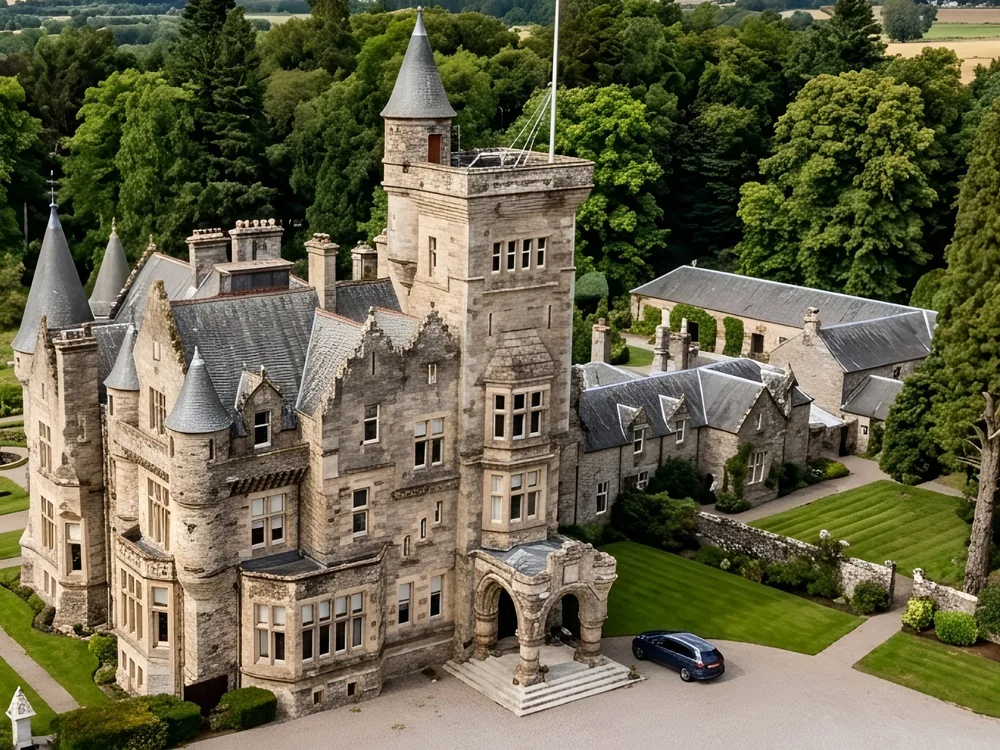
Built 1887 · Victorian Gothic Baronial mansion, built 1887–1889 by architect Ebenezer Simpson of Stirling — described as the last building of its kind constructed in this style
This page is part of an independent travel guide and is not affiliated with, endorsed by, or operated by Dollarbeg Castle.
© Castles & Palaces
Quick Facts
- Rooms from
- £482 / night
- Duration
- Self-catering stay only — no public visiting
- Best time
- Year-round
- Nearest city
- Stirling
Stay Here
Dollarbeg Castle - The Tower
Rooms are within the historic castle building itself
Booked via Booking.com · Cancellation terms vary by rate
No day-visitor access — exclusive-use self-catering apartments, not a conventional hotel
Highlights
- ✦The land was granted by Alexander II to the monks of Dunfermline Abbey in 1236; the Scotland family later divided the estate into Easter and Wester Dollarbeg
- ✦The estate passed to the 4th Duke of Atholl in 1785
- ✦William Henry Dobie, a Victorian railway magnate with business interests in Canada, bought the estate in the 1880s, demolished the old Easter Dollarbeg manor house, and built the current mansion between 1887 and 1889
- ✦Designed by Stirling architect Ebenezer Simpson in Victorian Gothic Baronial style — described as the last building of this type ever constructed
- ✦Hosted social gatherings in its Great Hall in the 1930s; served as an RAF radar control station during the Second World War; converted into 10 apartments in 2004
Stay in the castle itself
Book a room via Booking.com
Dollarbeg Castle stands in the small Clackmannanshire town of Dollar, and its documented history reaches back further than the imposing Victorian mansion that dominates the site today. The land was granted by King Alexander II to the monks of Dunfermline Abbey in 1236, part of the extensive medieval landholdings that Scottish religious houses accumulated across the country in this period. Ownership eventually passed to the Scotland family, who divided the estate into two separate holdings, Easter and Wester Dollarbeg, and in 1785 the property came into the hands of the 4th Duke of Atholl, connecting Dollarbeg to one of Scotland's most prominent aristocratic families for a period.
The building that gives Dollarbeg Castle its current identity, however, is a considerably later construction. In the 1880s, the estate was purchased by William Henry Dobie, a Victorian railway magnate whose business interests extended to Canada — one of many Scottish fortunes of the period built through the era's rapid expansion of railway infrastructure across the British Empire and beyond. Dobie demolished the older manor house that had stood at Easter Dollarbeg and commissioned an entirely new mansion, built between 1887 and 1889 to a design by Ebenezer Simpson, an architect based in nearby Stirling. Simpson's design, executed in a Victorian Gothic Baronial style, is genuinely notable within Scottish architectural history: it is described as the last building of this particular type ever constructed, marking something of an end point for a style of grand historicist Scottish mansion-building that had flourished for much of the preceding century.
Dollarbeg's 20th-century history moved through some genuinely varied uses. In the 1930s, the mansion's Great Hall hosted social gatherings, functioning as a venue for the kind of formal entertaining typical of substantial country houses in this period. The Second World War brought a far more utilitarian role: the estate served as an RAF radar control station, part of the wider air defence network protecting Britain's skies, a role shared by numerous large country properties requisitioned for military use during the conflict. By the early 2000s, Dollarbeg had been converted for residential and holiday use, split into 10 separate apartments in 2004.
Today Dollarbeg's accommodation model follows the same exclusive-use pattern seen elsewhere on this site at properties like Aikwood Tower and Faside Estate: rather than booking a single hotel room, guests reserve entire self-contained units within the historic building. The best-known of these is 'The Tower at Dollarbeg Castle,' a luxury three-bedroom apartment spread across the mansion's tower, complete with its own dedicated cinema room and a private rooftop terrace offering panoramic views over the surrounding Ochil Hills countryside; the Great Hall itself is also listed separately as its own distinct retreat. There is no public visiting arrangement of any kind at Dollarbeg — anyone wishing to experience the building needs to book one of these self-contained units as an overnight stay.
Set in Scotland's smallest county, within easy reach of Stirling and the wider central Scotland castle and battlefield landscape, Dollarbeg offers a genuinely unusual combination for visitors seeking self-catering accommodation: the scale and drama of a full Victorian Gothic mansion, broken down into private, self-contained apartments rather than experienced as a single shared hotel.
Dollar itself is best known for Dollar Academy, one of Scotland's most prominent independent schools, and for Castle Campbell, a genuinely medieval fortress perched dramatically in the hills immediately above the town — a striking contrast to Dollarbeg's own Victorian Gothic reinvention of the castle form, and a reminder that this small Clackmannanshire town holds two very different kinds of 'castle' experience within walking distance of each other, from Castle Campbell's genuine 15th-century ruin to Dollarbeg's late-Victorian architectural fantasy.
History
The land at Dollarbeg was granted by Alexander II to the monks of Dunfermline Abbey in 1236. The Scotland family later divided the estate into Easter and Wester Dollarbeg, and in 1785 the property passed to the 4th Duke of Atholl. William Henry Dobie, a Victorian railway magnate with business interests in Canada, bought the estate in the 1880s, demolished the old Easter Dollarbeg manor house, and built the current mansion between 1887 and 1889 to a design by Stirling architect Ebenezer Simpson, in a Victorian Gothic Baronial style described as the last building of its kind ever constructed. The mansion's Great Hall hosted social gatherings in the 1930s, and the estate served as an RAF radar control station during the Second World War. Dollarbeg was converted into 10 apartments in 2004, and today operates on an exclusive-use, self-catering basis.
How to Stay
Getting there: near Dollar, Clackmannanshire.
Rooms & rates: 10 luxury self-catering apartments, all converted from spaces within the historic 1887-89 castle building itself — including The Great Hall (the former ballroom, later WWII RAF radar control) and The Tower (with its own rooftop terrace).
On-site: Self-catering kitchens throughout; estate grounds.
Good to know: Since each apartment is a conversion of a genuinely historic room within the castle, ask specifically which apartment corresponds to which part of the building if that history interests you.
Combine with: Castle Campbell in nearby Dollar Glen, a short drive away.
Frequently Asked Questions
No. Dollarbeg operates on an exclusive-use, self-catering basis — guests book entire self-contained units within the historic mansion, such as 'The Tower at Dollarbeg Castle,' a three-bedroom apartment with its own cinema room, rather than a single hotel room. There is no public visiting arrangement; the building can only be experienced by booking one of these units as an overnight stay.
Location
Dollar, Clackmannanshire FK14 7NW, Scotland
Nearby Castles
Rooms from
£482/ night