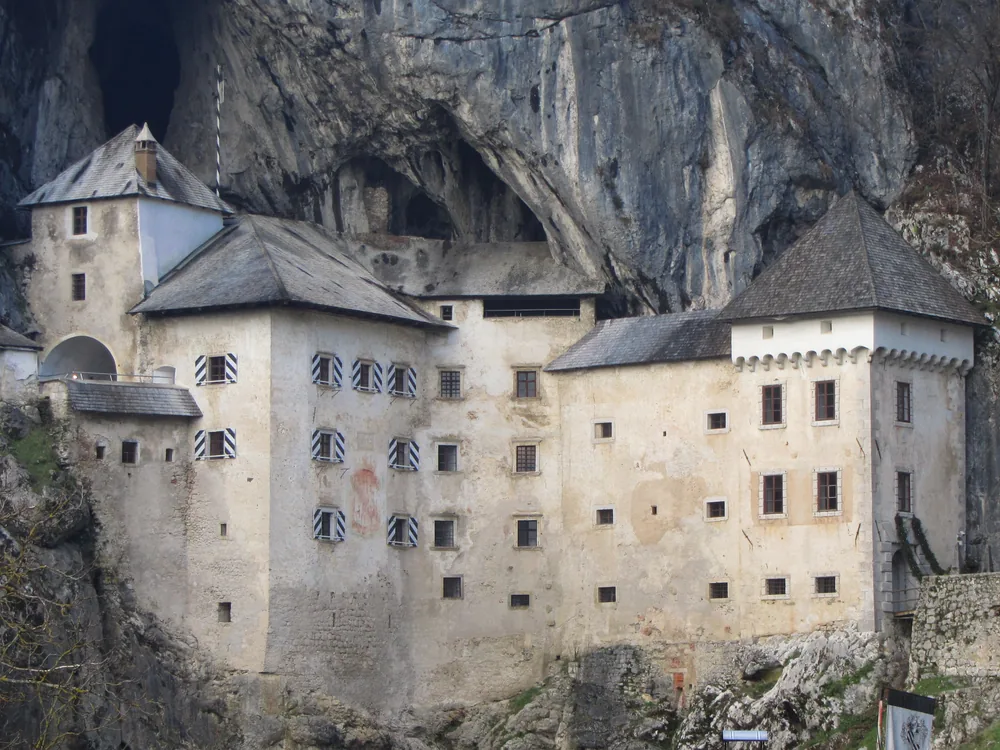
Predjama Castle
Predjamski Grad
Slovenia · Littoral · Near Postojna
Built 1274 · Medieval cave castle — built into the mouth of a limestone cave, Gothic and Renaissance elements
This page is part of an independent travel guide and is not affiliated with, endorsed by, or operated by Predjama Castle.
© Castles & Palaces
Quick Facts
- Hours
- Daily 10:00–18:00
- Guided tour from
- €69
- Duration
- 1–2 hours
- Best time
- May to September
- Nearest city
- Postojna
Featured Tour
Ljubljana: Postojna Cave and Predjama Castle Tour
Cancellation available · Instant confirmation
Highlights
- ✦The setting — 16 floors of castle built seamlessly into the mouth of a 123-metre limestone cave, seemingly defying gravity
- ✦The cave passages behind the castle — a network of natural tunnels that allowed the castle's defenders to receive supplies even under siege
- ✦The Knight's Hall — the main room of the castle with original painted wooden ceilings and a fireplace carved into the rock
- ✦The legend of Erasmus of Lueg — the outlaw knight who held the castle for over a year under Habsburg siege using the cave passages
- ✦Postojna Cave (10km away) — the world's most visited cave system, easily combined with Predjama
Skip the queue with a guided tour
Skip-the-line tickets & expert guides
Predjama Castle is perhaps the most extraordinary castle site in Europe: a Gothic and Renaissance fortress built directly into the gaping mouth of a 123-metre limestone cave in the Karst plateau of Slovenia. The castle does not simply stand in front of a cave — it is integrated with it, so that the upper floors of the castle give way to natural rock chambers above, and a network of natural passages behind the walls allowed the castle's defenders to move, receive supplies and escape even when the entrance was completely blockaded by besieging forces.
The castle is most associated with Erasmus of Lueg (c. 1400–1484), a knight who became a folk hero and symbol of Slovenian resistance to Habsburg authority. After killing the imperial marshal in Vienna, Erasmus retreated to Predjama and held it for over a year against a Habsburg siege — using the cave passages to receive fresh food, including cherries, which he reportedly threw down to the besieging soldiers to taunt them. He was eventually killed, according to legend, when a servant signalled to the attackers that Erasmus was in the privy, and a cannonball struck the latrine tower.
The castle interior preserves the Knight's Hall with its painted wooden ceiling, a well cut into the cave floor, and the dark passages that wind back into the mountain. The cave system behind the castle extends for kilometres and connects to the Postojna Cave system 10 kilometres away.
History
The first written record of the castle dates to 1274, though a fortification on the site is likely earlier. The cave location made it virtually impregnable — the entrance could be covered by defenders above, and the passage network allowed almost indefinite supply. The castle passed through various noble families before being associated most strongly with Erasmus of Lueg in the 15th century.
After Erasmus's death, the castle was rebuilt in its current Renaissance form in the 16th century. It remained inhabited and strategically useful through the Uskok wars of the early 17th century, when Croatian-Slavonian soldiers of fortune used the Karst plateau to raid Ottoman and Venetian territory. The castle gradually fell into disuse and partial ruin in the 18th century, and a major restoration was undertaken in the 20th century. It is now managed by the Postojna Cave company and visited by around 150,000 people a year.
How to Visit
Getting there: Predjama is 9 km from Postojna — 50 km south of Ljubljana (45 minutes by car or regular bus to Postojna, then a local taxi or seasonal shuttle from the cave to the castle). A car is the most practical option for the final stretch.
Tickets: Walk-up entry €16 adult, €9 child. A discounted combined ticket for Postojna Cave and Predjama Castle is available at the Postojna Cave ticket desk and strongly recommended — the cave is one of Europe's great natural spectacles and adds roughly 1.5 hours to the day. The GetYourGuide tour — a 5.5-hour Ljubljana day trip combining Postojna Cave and Predjama Castle with transport and entry included — book in advance.
Practical tips: The castle interior requires climbing stairs and ducking through low rock passages — wear sturdy footwear. Look for the latrine tower where Erasmus of Lueg was allegedly killed by a cannonball in 1484; the cave passages behind the castle are included in the visit and extend surprisingly deep into the mountain. May to September gives the best light on the cave mouth facade.
Combine with: Bled Castle is 55 km north — Slovenia's most iconic sight above Lake Bled, ideal on a Ljubljana–Bled–Predjama loop. Ljubljana Castle is 50 km northeast in the Slovenian capital, pairing naturally as the start or end of a Predjama day trip.
Frequently Asked Questions
The castle is built into the mouth of a natural limestone cave in the Karst plateau. The rock face above provides the 'roof' of the upper floors, and the natural cave continues behind the castle into the mountain for several kilometres. Medieval builders used the cave's natural features as structural elements — the rock face serves as walls, and the natural passages were incorporated as escape routes and supply lines. The result is a building that appears to grow from the cliff face rather than being constructed against it.
Location
Predjama 1, 6230 Postojna, Slovenia
Nearby Castles
Tours & Tickets
Powered by GetYourGuide
From
€69/ person