
Alcazaba de Málaga
Alcazaba de Málaga
Spain · Andalusia, Málaga · Near Málaga
Built 1057 · Moorish palatial fortress — built by the Hammudid dynasty in the 11th century during the Taifa period and expanded by the Nasrids in the 13th–14th centuries; the complex comprises three successive walled enclosures rising from the lower slope of Mount Gibralfaro, with an innermost palatial precinct in the established Nasrid tradition: garden courtyards with central water features, stucco panel decoration, geometric tilework, muqarnas ceilings, and carved stone inscriptions; the architectural vocabulary closely parallels the Alhambra in Granada, though on a smaller, more domestic scale; the coracha — a fortified corridor — connects the Alcazaba to Castillo de Gibralfaro on the summit above
This page is part of an independent travel guide and is not affiliated with, endorsed by, or operated by Alcazaba de Málaga.
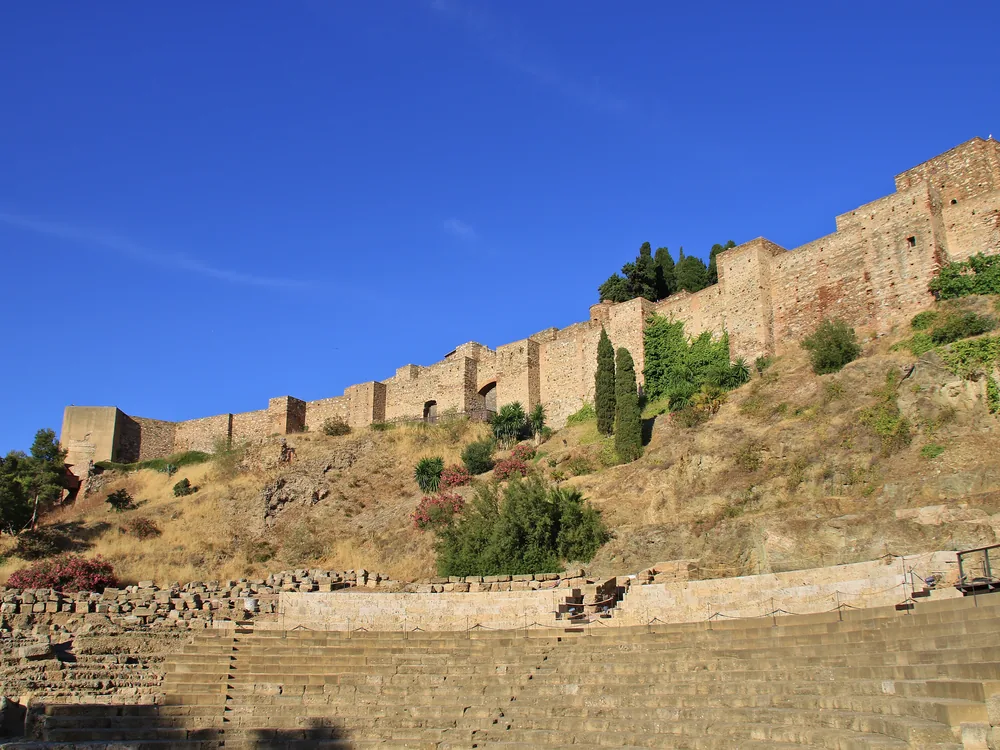
© Castles & Palaces
Quick Facts
- Hours
- Daily 09:00–20:00
- Guided tour from
- €13
- Duration
- 1–1.5 hours (Alcazaba alone); 2.5–3 hours combining with Castillo de Gibralfaro above
- Best time
- October to April
- Nearest city
- Málaga
Featured Tour
Málaga: Alcazaba and Roman Theatre Guided Tour With Entry
Cancellation available · Instant confirmation
Highlights
- ✦Free entry on Sundays — the Alcazaba is free to visit every Sunday; the €3.50 weekday ticket is already one of the lowest entry prices among major Andalusian Moorish sites; this is a genuine budget-travel advantage in a city where most major monuments charge significantly more
- ✦Nasrid garden courtyards — the innermost palatial precinct contains two main garden courtyards with central water channels, ornamental tile dados, carved stucco panels, and muqarnas in the same architectural vocabulary as the Alhambra; the Alcazaba predates the Alhambra's great palatial construction by a century and represents the earlier phase of the same decorative tradition in Nasrid Andalusia
- ✦The coracha — the fortified walled corridor that runs up the hillside from the Alcazaba's upper enclosure to connect with [Castillo de Gibralfaro](/castles/spain/castillo-de-gibralfaro) on the summit; the two sites were designed and operated as a single defensive system, with the Alcazaba serving as the palatial and administrative base and Gibralfaro as the purely military citadel above
- ✦Roman Theatre at the base — the Teatro Romano de Málaga (1st century BC–1st century AD), discovered in 1951 during excavations for a new building at the foot of the Alcazaba hill; now an open-air archaeological site with free access, visible from the Alcazaba entrance ramp and providing a layering of civilisations on the same hillside
- ✦11th-century Hammudid origins — built during the Taifa period, when the Caliphate of Córdoba had fragmented into competing Muslim city-states; the Alcazaba was constructed as both a palace and a fortress for the Hammudid rulers of Málaga more than 200 years before the Alhambra's great palace buildings were begun in Granada
- ✦Intimate scale versus the Alhambra — the Alcazaba receives a fraction of Granada's 2.7 million annual visitors despite offering comparable Nasrid garden courtyards and decorative detail; practical consequence: no timed-entry booking is typically required, and the site can be explored at an unhurried pace unavailable at the Alhambra
Skip the queue with a guided tour
Skip-the-line tickets & expert guides
The Alcazaba de Málaga sits on the lower slope of Mount Gibralfaro — the hill that dominates Málaga's city centre — at a physical position that explains precisely what it was built to be: a palatial residence and administrative centre within a fortified shell, protected above by the purely military [Castillo de Gibralfaro](/castles/spain/castillo-de-gibralfaro) and connected to it by the coracha, the walled corridor that runs between the two sites up the hillside. Where Gibralfaro is blunt military architecture — towers, battlements, ramparts for artillery — the Alcazaba is something else: a series of garden courtyards, water channels, stucco panels, and tiled dados in the Nasrid palatial tradition, enclosed within defensive walls but ordered around the aesthetics of aristocratic residence rather than the practicalities of military occupation.
The site was built in the 11th century by the Hammudid rulers of Málaga, during the Taifa period — the decades following the fragmentation of the Caliphate of Córdoba in 1031, when Andalusia dissolved into competing Muslim city-states. The Hammudids were an Arab dynasty of Idrisid origin from the Maghreb, who had seized the caliphal throne briefly at Córdoba in the early 11th century before establishing themselves at Málaga as the rulers of their own taifa kingdom. They built the Alcazaba between approximately 1040 and 1065 on a site that had been occupied since at least the Roman period — the Teatro Romano de Málaga, a first-century BC Roman theatre discovered in 1951 at the foot of the same hill, confirms continuous habitation from antiquity. The Hammudids used stone from the Roman theatre's own fabric in the Alcazaba's construction, a common practice of reuse that characterises much early Taifa building.
The complex is organised as three successive walled enclosures that rise from the lower slope to the upper palatial precinct. The outermost enclosure is primarily defensive: towers, wall walks, and the main gate sequence that forces a series of right-angle turns before admitting entry, preventing a charging assault from building momentum through the gateway. The middle enclosure is transitional — administrative buildings, guard quarters, and the access routes between lower and upper sections. The innermost enclosure is the palace: the two main garden courtyards where the Hammudid and later Nasrid rulers of Málaga received visitors, administered their city, and lived.
Málaga came under the control of the Nasrid Emirate of Granada in the mid-13th century, and the Nasrids undertook significant reconstruction and expansion of the innermost palatial precinct in the 13th and 14th centuries. The decorative programme they applied is immediately recognisable to anyone who has visited the Alhambra in Granada — the same geometric tilework at dado height, the same carved stucco panels with vegetal and calligraphic ornament above, the same muqarnas in the transition from wall to arch, the same central water feature in the courtyard linking ornament and sound. The Alcazaba's palatial rooms are smaller and less elaborately decorated than the great halls of the Alhambra, but they are the work of the same dynasty, the same craftsmen's tradition, and the same aesthetic philosophy: the garden courtyard as a representation of paradise, water as both practical resource and symbolic element, geometric precision as a reflection of divine order.
The Nasrid Emirate held Málaga until 1487, when the Catholic Monarchs Ferdinand and Isabella captured the city after a three-month siege. The military story of the siege belongs primarily to Gibralfaro above — the garrison there held out far longer than the lower city, making the siege one of the most prolonged of the Reconquista campaign in Andalusia. After the city's surrender on 18 August 1487, the Alcazaba was converted to serve as the residence of the Christian alcaides appointed to govern Málaga. The garden courtyards were maintained under the new administration but without the sustained investment that had kept the palatial fabric in good repair; over subsequent centuries, the complex fell into increasing disrepair.
By the 19th century, a prison had been constructed within the Alcazaba's walls. The demolition of this prison and the beginning of systematic restoration were undertaken from the 1930s onward, work that continued through the mid-20th century and involved the reconstruction of the main garden courtyards, the restoration of the water channels and fountain features, and the replanting of the gardens with species appropriate to a Nasrid palatial setting. The result is a site that reads as more complete than it is — the gardens and water features are largely modern reconstructions — but where the surviving medieval fabric (the defensive towers, the gate sequences, the wall fabric of the three enclosures, and significant sections of the innermost palace rooms) is substantial enough to carry the site's historical argument.
The Alcazaba's most visited feature is the combined route through the three enclosures and the Cuartos de Granada — the rooms named for the Granada-based Nasrid rulers who rebuilt them — finishing at the upper terrace with views over the Málaga port and the Costa del Sol. The route takes 60–90 minutes at an unhurried pace. A small archaeological museum within the complex displays objects from the excavations including Roman, Phoenician, and Islamic-period material from the hill.
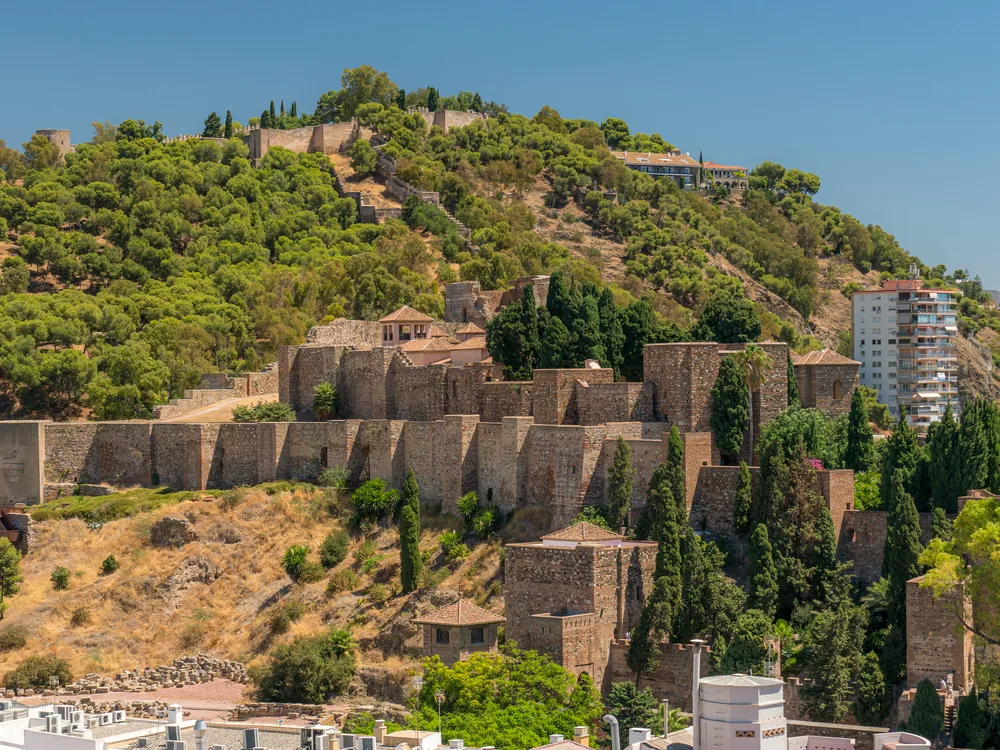
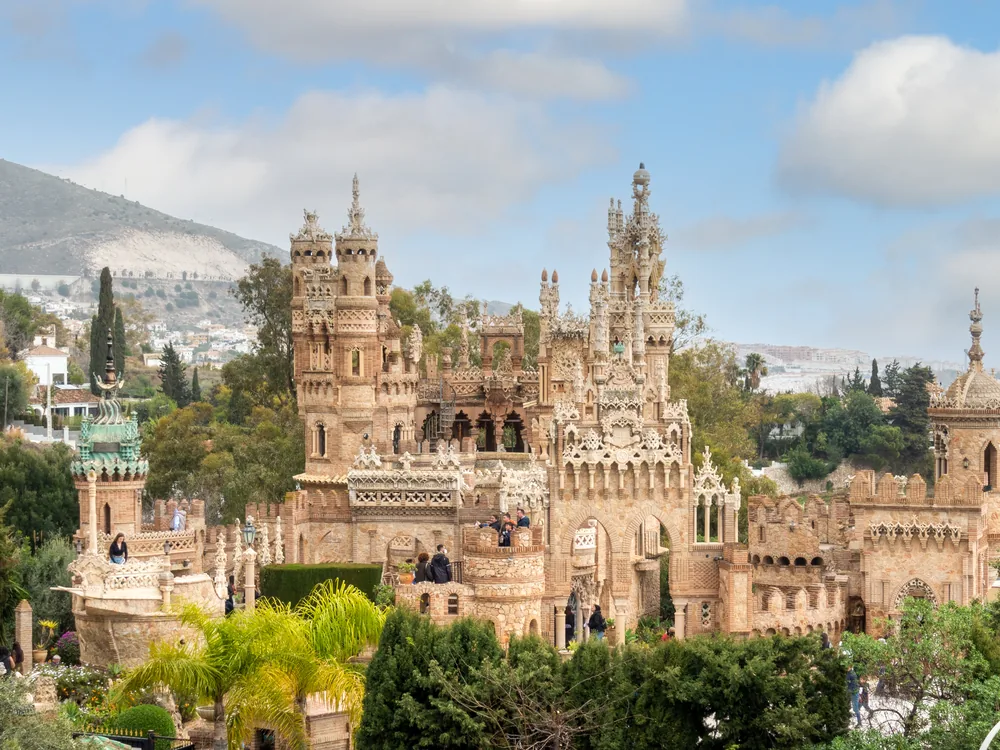
[Castillo de Gibralfaro](/castles/spain/castillo-de-gibralfaro) is the natural companion visit — the military counterpart directly above, connected by the coracha, and best visited as the second stop after the Alcazaba since the path builds from intimate palatial architecture toward open military panorama. The combined official ticket (€5.50) covers both sites. Elsewhere on the Costa del Sol, [Colomares Castle](/castles/spain/colomares-castle) in Benalmádena (~30km west) is a 20th-century romantic castle monument of a different kind entirely — worth knowing but a very different experience.
History
Phoenician and Roman settlement on Monte Gibralfaro hillside. Roman theatre (Teatro Romano) constructed 1st century BC. Taifa period: Hammudid dynasty builds the Alcazaba c.1040–1065, incorporating stone from the Roman theatre. Nasrid takeover mid-13th century; major reconstruction and decorative programme in the 13th–14th centuries. Three-month siege of Málaga; city surrenders to Ferdinand and Isabella, 18 August 1487. Post-Reconquista: used as residence of Christian alcaides; gradual decay. 19th century: prison built within the complex. Restoration begins 1930s (architect Francisco Prieto-Moreno); garden courtyards and water features reconstructed through mid-20th century. Teatro Romano discovered 1951 during construction at the base of the hill. Site open to visitors as a municipal monument of the Ayuntamiento de Málaga.
How to Visit
Getting there: The Alcazaba entrance is on Calle Alcazabilla, a 5-minute walk from Málaga's historic centre. From Málaga María Zambrano train station, it is approximately 20 minutes on foot through the city centre, or take the metro to Centro Alameda and walk 10 minutes. A lift at the Teatro Romano viewpoint connects the lower city to the first enclosure — useful for visitors with mobility needs. City-centre car parks are available; driving to the entrance is not practical.
Tickets: Walk-up entry €3.50 adult; children under 14 free. Free every Sunday. Combined official ticket (Alcazaba + Gibralfaro): €5.50; no advance booking required. The GetYourGuide tour — a 1.5-hour guided tour of the Alcazaba and Roman Theatre with entry included — is worth booking in advance at peak season.
Practical tips: Visit October–April to avoid summer heat (33–38°C) on the exposed hillside. Allow 1–1.5 hours for the Alcazaba alone, or 2.5–3 hours combining with Gibralfaro above. Sunday mornings before 11:00 are the quietest time to benefit from free entry and avoid cruise-ship groups.
Combine with: Castillo de Gibralfaro directly above — the military counterpart connected by the coracha walkway, best visited as the second stop. Colomares Castle lies 30 km west in Benalmádena on the Costa del Sol.
Frequently Asked Questions
Yes — the Ayuntamiento de Málaga offers free entry to the Alcazaba every Sunday. This applies to both the standalone Alcazaba ticket (normally €3.50) and the combined Alcazaba + Gibralfaro ticket (normally €5.50). The free entry applies to the official Ayuntamiento ticket; third-party GetYourGuide combined tickets have different pricing. Sunday mornings before 11:00 are the quietest time to use the free entry benefit.
Location
Calle Alcazabilla, 29015 Málaga, Spain
Nearby Castles
Tours & Tickets
Powered by GetYourGuide
From
€13/ person