
Aljafería Palace
Palacio de la Aljafería
Spain · Aragon — Zaragoza, capital of Aragon · Near Zaragoza
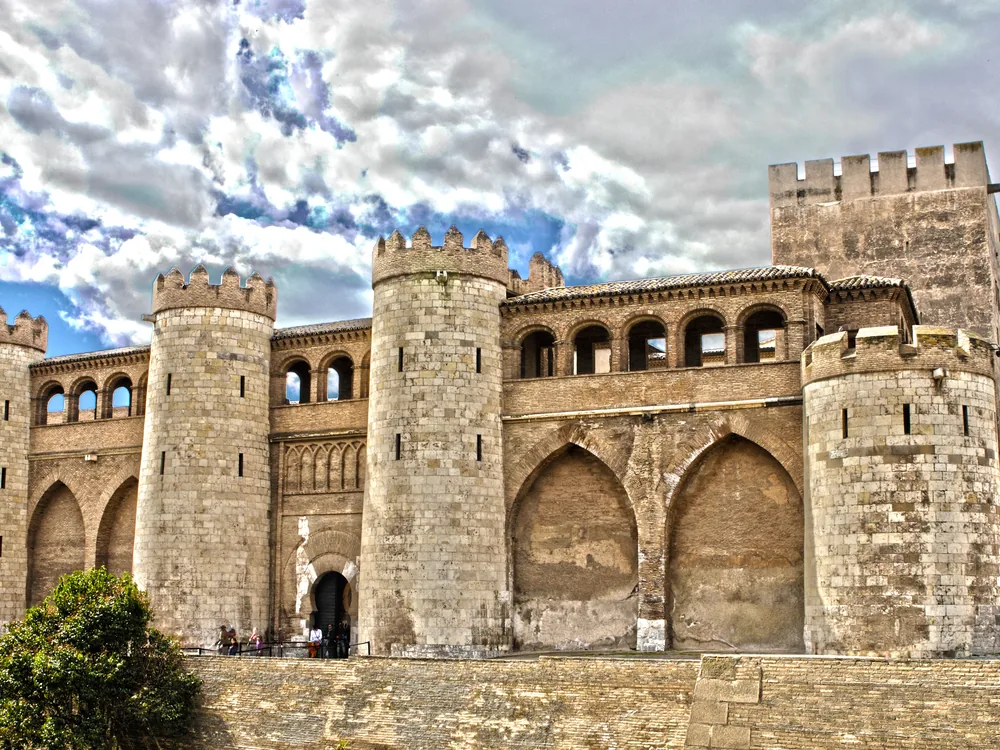
Built 1065 · An exceptional multi-period palatial complex — begun by Al-Muqtadir in 1065 as a Taifa Muslim palace and later transformed by the Christian kings of Aragon into a Gothic royal palace; the building contains three architecturally distinct and chronologically separate palatial environments in the same structure: the 11th-century Taifa Islamic rooms (the small mosque, the throne room, the golden chamber with its intricate interlaced arch decoration), the 14th–15th century Christian Gothic addition by the kings of Aragon (the staircase of honour, the throne room of the Catholic Monarchs, the coffered ceiling), and the 16th-century Aragonese Inquisition period modifications; the 9th-century Torre del Trovador (Troubadour Tower), which predates the palace and was incorporated into the Almohad-era defensive perimeter, is the oldest element of the current complex; the surviving Taifa rooms represent the northernmost example of high Islamic palatial architecture from the period of the Taifa kingdoms
This page is part of an independent travel guide and is not affiliated with, endorsed by, or operated by Aljafería Palace.
© Castles & Palaces
Quick Facts
- Hours
- Mon 10:00–14:00. Tue–Sat 10:00–14:00, 16:00–18:30. Sun 10:00–14:00
- Guided tour from
- €22
- Duration
- 1.5–2 hours (complete circuit: Taifa Islamic rooms + Torre del Trovador + Catholic Monarchs' royal suite + courtyard)
- Best time
- Year-round
- Nearest city
- Zaragoza
Featured Tour
Zaragoza: Aljafería Palace Official Guided Visit + Entry Ticket (2 hours, skip-the-line)
Cancellation available · Instant confirmation
Highlights
- ✦The northernmost Taifa palace in Europe — built in 1065 by Al-Muqtadir ibn Hud, king of the Taifa of Zaragoza, as the 'Palace of Joy' (Qasr al-Surur), the Aljafería represents the farthest north that high Islamic palatial architecture was established in the Iberian Peninsula and in Europe; there is no surviving palatial building from the Taifa period further north on the continent
- ✦The interlaced arch decoration — the principal Islamic throne room of the Aljafería is decorated with a system of interlaced polylobed arches that overlap and intersect in a geometric pattern of exceptional technical complexity; this arch system, created in the 11th century, predates and directly influenced the later development of Mudéjar architecture in Spain — the Aljafería's throne room is the earliest surviving example of the interlaced arch form that became the defining motif of Aragonese Mudéjar craftsmanship
- ✦The Catholic Monarchs' throne room and coffered ceiling — after the Aljafería became the seat of the Aragonese royal court in the 14th century, Ferdinand II of Aragon and Isabella I of Castile (the 'Catholic Monarchs' who unified Spain and commissioned Columbus's voyage) used the palace as their Aragonese court residence; the rooms added for them in the late 15th century include a coffered ceiling of gilded wood of exceptional quality, painted with the combined arms of Aragon and Castile, created at the moment of the Spanish state's formation
- ✦Torre del Trovador (Troubadour Tower) — the 9th-century tower within the palace precinct, which predates Al-Muqtadir's palace by two centuries, was incorporated into the defensive perimeter of the complex and is the oldest structural element of the site; the tower is associated (romantically rather than historically) with the troubadour tradition of the Aragonese court — the same troubadour culture that influenced Provençal poetry across medieval Europe
- ✦Three successive power systems in one building — visiting the Aljafería in sequence is a lesson in what buildings survive and what values successive powers choose to preserve or transform; the Taifa Islamic rooms were preserved (with modifications) by the Christian kings of Aragon because they were admirable; the Aragonese Gothic rooms were preserved through the Inquisition period because they were royal; the military barracks modifications of the 18th–19th century did the most damage and the most restoration work has focused on reversing them; the current building shows all three periods simultaneously
- ✦Current seat of the Cortes de Aragón — one wing of the Aljafería Palace is currently occupied by the Cortes de Aragón (Aragon's regional parliament), making it one of the very few medieval palaces in Europe that simultaneously functions as a functioning democratic legislature and a public heritage monument with guided tours in the adjacent sections
Skip the queue with a guided tour
Skip-the-line tickets & expert guides
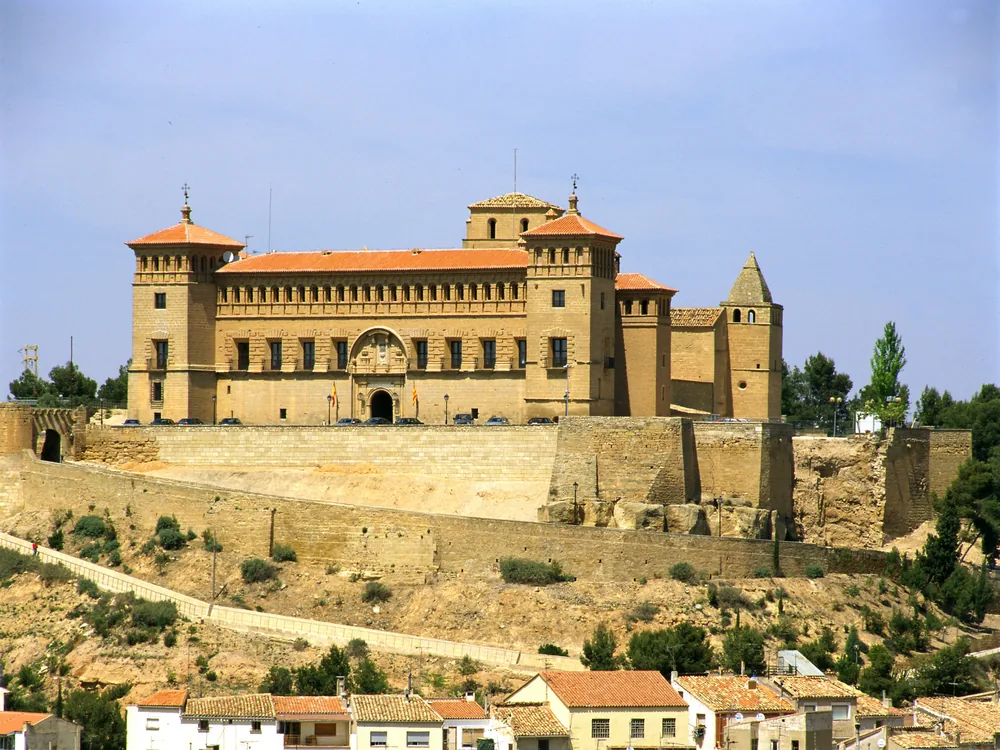
The Aljafería Palace stands in the western quarter of Zaragoza, a 15-minute walk from the Basílica de Nuestra Señora del Pilar and the Ebro River waterfront. Its exterior — a rectangular fortress of 9th-century origin, with round towers at the corners and a later Renaissance gatehouse — does not prepare a visitor for what the interior contains. The Aljafería is not a single building in any coherent architectural sense; it is three separate palatial environments from three completely different cultural and political systems, stacked inside the same defensive perimeter across a span of five centuries.
The first and oldest palatial layer is the Taifa Islamic complex built by Al-Muqtadir ibn Hud in 1065. Al-Muqtadir was the king of the Taifa of Zaragoza — one of the independent Muslim principalities that fragmented al-Andalus after the collapse of the Córdoba Caliphate in 1031 — and a cultivated ruler who maintained one of the more sophisticated courts of the Taifa period, patronising philosophy, science, and architecture. His palace, which he called Qasr al-Surur (the Palace of Joy), was designed as the northernmost Islamic palatial complex in the Iberian Peninsula and in Europe. The Aljafería was built approximately 200 kilometres north of the boundary of Muslim-controlled territory at the time of construction; no Islamic ruler built a palace this far north before or after.
The surviving Taifa rooms — the small oratory (mosque), the throne room, the Golden Chamber — are where the palace's extraordinary reputation rests. The throne room is decorated with a system of interlaced polylobed arches: arches that overlap and intersect with each other in a geometric mesh of exceptional technical precision, creating a visual effect of infinite complexity from a small number of repeating elements. This interlaced arch system, invented at the Aljafería in the 11th century, became the founding vocabulary of Mudéjar architecture — the Spanish Christian-period architectural style that continued using Islamic geometric ornament after the Reconquista, producing the remarkable decorated ceilings and tile work of the 12th–15th century Aragonese buildings. The Aljafería's throne room is the source.
The second palatial layer is the Christian Aragonese addition of the 14th and 15th centuries. After the Reconquista of Zaragoza in 1118 by Alfonso I of Aragon, the Aljafería became the principal royal residence of the kings of Aragon — the growing medieval power that controlled, at its peak, not only Aragon but Catalonia, Valencia, Sardinia, Sicily, and the Kingdom of Naples. The Christian kings of Aragon expanded the palace, adding Gothic rooms and the ceremonial spaces appropriate to the seat of a Mediterranean empire. Ferdinand II of Aragon — who together with his wife Isabella I of Castile unified the Spanish crown, completed the Reconquista of Granada (1492), expelled the Jews from Spain (1492), and authorised Columbus's voyage to the Americas (also 1492) — used the Aljafería as his Aragonese court palace. The throne room and the gilded coffered ceiling created for the Catholic Monarchs in the late 15th century represent the moment when the Aragonese Gothic and the emerging Spanish Renaissance met in a single ceiling above the unified monarchs' throne.
The third layer is the darkest: from 1485, the Aljafería served as the headquarters of the Aragonese Inquisition. The trials, imprisonments, and executions of the Spanish Inquisition's Aragonese branch were administered from these rooms. Goya — born in Fuendetodos, 50 kilometres south of Zaragoza — depicted Inquisition scenes set in buildings of exactly this type; whether the connection is direct or biographical is uncertain, but the visual grammar of the Inquisition proceedings belongs to the Aljafería's period of darkest use.
The GetYourGuide guided visit (2 hours) includes an official Aragon tour guide, audio equipment, and skip-the-line access. Reviews confirm that English commentary was provided alongside Spanish. Standalone entry (approximately €5, with free entry on Fridays) gives access to the same rooms without a guide.
The Aljafería is the first Aragon entry on this site — Zaragoza is underrepresented in English-language heritage tourism despite the city's position as one of Spain's six largest cities and its location directly on the Madrid–Barcelona high-speed rail corridor (approximately 80 minutes from both cities by AVE).
History
The Torre del Trovador — the Troubadour Tower — was constructed as part of the early Hudid fortification of Zaragoza in the 9th century, establishing the core around which the palace would develop. Al-Muqtadir ibn Hud built the Taifa palace, the Qasr al-Surur or Palace of Joy, in 1065 — the northernmost Muslim palace in Europe, a royal pleasure complex whose throne room decoration, with its interlaced arches of Islamic geometric ornament, became the source vocabulary of Mudéjar architecture: the distinctively Iberian style that blended Islamic and Christian architectural traditions and spread across the kingdoms of the Reconquista in the centuries that followed.
Alfonso I of Aragon captured Zaragoza in 1118, and the Aljafería became the Aragonese royal palace — a Muslim pleasure complex repurposed as a Christian royal residence with minimal initial alteration, then expanded through the 14th and 15th centuries with Aragonese Gothic additions including the throne room of the Catholic Monarchs and a coffered ceiling. The Aragonese Inquisition established its headquarters in the palace in 1485, using it until the institution's suppression. Military barracks conversion in the 18th and 19th centuries caused significant damage to the medieval fabric before a major restoration programme from 1947 through the 1980s recovered the principal spaces.
The Cortes de Aragón — the Aragonese parliament — was established in the palace in 1987; one wing serves as the regional legislature today. The palace is open to guided visits.
How to Visit
Getting there: Calle Diputados s/n, approximately 15 minutes on foot west of the Basílica del Pilar. City bus lines 23 and 51 connect the city centre to the palace. From Zaragoza Delicias AVE station, bus or a 20-minute walk. Zaragoza is around 80 minutes from both Madrid and Barcelona by high-speed AVE train — the Aljafería is a natural stop between the two capitals.
Tickets: Walk-up entry €5 adult; children free. Free entry on Fridays (confirm current free-day policy at turismodezaragoza.es); no advance booking required for standalone entry. The GetYourGuide tour — a 2-hour official Aragonese guided visit with skip-the-line access and audio equipment, covering the Taifa Islamic rooms, the Catholic Monarchs' throne room, and the Torre del Trovador — book at least a day in advance. English commentary is available; confirm language when booking.
Practical tips: Zaragoza's spring and autumn (March–May, September–November) give the best conditions for the palace courtyard and the walk from the city centre. Allow 1.5–2 hours for the full circuit. The Fiestas del Pilar (October 12 and surrounding week) is the city's main festival — atmospheric but the palace will be busier than usual.
Combine with: Aljafería is currently the only published Aragon castle on this site. Within Zaragoza, pair it with the Basílica de Nuestra Señora del Pilar (15 minutes on foot) and the Museo de Zaragoza for Roman and Islamic archaeology from the same hillside civilisations.
Frequently Asked Questions
The Aljafería was built in 1065 by Al-Muqtadir, king of the Taifa of Zaragoza, at approximately 41.7° North latitude — significantly further north than the other great Taifa palaces of al-Andalus (the Alhambra in Granada, the Alcázars of Seville and Córdoba, the Alcazaba of Málaga are all between 36° and 38° North). At the time of construction, Zaragoza was near the northern frontier of Muslim-controlled territory; no Islamic ruler established a palatial complex further north in the Iberian Peninsula or in continental Europe. The building is geographically as well as culturally the extreme northern expression of Taifa palatial culture.
Location
Calle Diputados s/n, 50003 Zaragoza, Aragon, Spain
Nearby Castles
Tours & Tickets
Powered by GetYourGuide
From
€22/ person