
Departing from Bucharest
Poenari Castle & Târgoviște Royal Court: The Real Dracula Day Trip from Bucharest
Skip Bran Castle's crowds — the actual fortress and princely court of Vlad the Impaler, deep in the Wallachian mountains
From
€310/ person
Rating
★ 5(5)
Duration
Full Day · 11 hours
Rating
5 ★ (5 reviews)
Languages
English, Italian, Romanian, French, Spanish
Group size
Max 8 people
About This Tour
Most tourists visiting Romania in search of Dracula go to Bran Castle — a 14th-century fortress in the Transylvanian Alps marketed worldwide as 'Dracula's Castle' despite having no documented connection to Vlad the Impaler beyond a single disputed overnight visit. The legend is a commercial construction: Bram Stoker set his 1897 novel in a fictional Transylvanian castle and never visited Romania. Vlad III Drăculea, the 15th-century Wallachian prince whose reputation for spectacular cruelty provided Stoker with a name and a psychological template, never ruled from Bran, was not buried there, and by most accounts never used it as a residence.
This tour goes to where Vlad actually lived, ruled, and fortified: Târgoviște, the capital of Wallachia from the late 14th century through to the early 18th century, where the Târgoviște Royal Court was the seat of the Wallachian princes — including three separate reigns by Vlad III (1448, 1456–1462, 1476). And to Poenari Castle, the clifftop fortress above the Argeș gorge that Vlad himself is documented to have reinforced using enslaved Wallachian boyar nobles — the same class of men who had murdered his father and older brother. If there is a 'real Dracula's castle', the historical evidence points here.
Vlad III was born around 1428–1431, the son of Vlad II Dracul (Dracul = the Dragon, from his father's membership in the Order of the Dragon, a chivalric order of the Holy Roman Empire). The 'Drăculea' suffix means 'son of the Dragon' or 'son of the Devil' — in medieval Romanian, the same word served both meanings. Vlad II was assassinated in 1447, and Vlad III's older brother Mircea was buried alive by the Wallachian boyar faction that backed the coup. Vlad III never forgot. When he secured his second reign in 1456 — the longest and most consequential, lasting until 1462 — he systematically executed the boyar families involved in his father's death, preferring impalement as a method that was simultaneously public, slow, and impossible to ignore. The Ottoman name for him was Kazıklı Bey: the Impaler Lord.
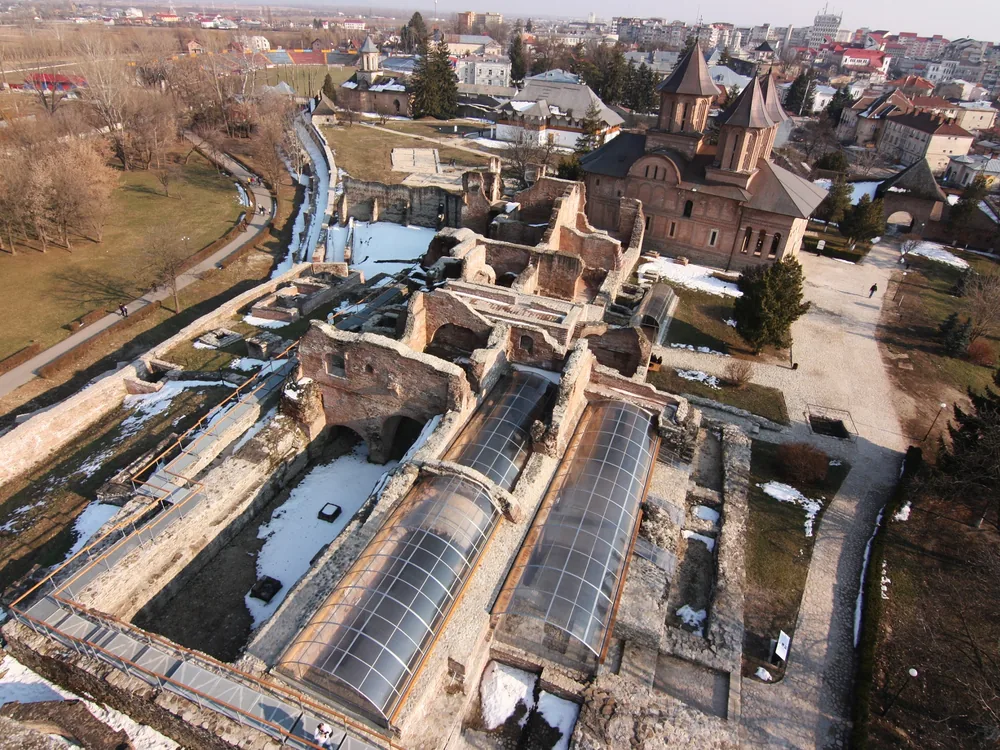
Târgoviște's Princely Court preserves the most legible physical remnant of Vlad's reign. The Chindia Tower — the tall cylindrical watchtower at the centre of the complex — was built or substantially modified during his reign and served as both a watchtower and a symbolic assertion of Wallachian sovereignty at a moment when the principality was caught between the Ottoman Empire to the south and the Hungarian Kingdom to the north. In 1462, facing an Ottoman invasion led personally by Sultan Mehmed II, Vlad staged the 'Night Attack' on the Ottoman camp at Târgoviște — a night raid with 10,000–30,000 troops that nearly captured the sultan — and retreated north through the Argeș valley toward Poenari, leaving a forest of impaled Ottoman prisoners outside the city walls as a deliberate psychological deterrent.
Poenari Castle, reached by climbing 1,480 steps cut into the cliff face above the Argeș River, was used by Vlad as a refuge and secondary fortification. The climb takes 20–30 minutes and gains approximately 300 metres of elevation; the ruins at the top are dramatic but roofless — this is a site for the views, the physical effort of the approach, and the historical imagination, not for museum interiors or guided castle rooms. A Wallachian legend holds that Vlad's wife threw herself from the north tower into the Argeș River gorge far below rather than surrender to the approaching Ottoman army in 1462 — a detail that may have contributed, through the diffuse channels of folklore, to some of the vampire mythology that later attached to the site.
The itinerary adds two stops that significantly extend the day's historical and scenic range. Curtea de Argeș Monastery, 35 kilometres south of Poenari on the return route, is one of the most important religious buildings in Romania: a 16th-century foundation with a distinctively ornamented Wallachian-Byzantine exterior and a crypt holding the remains of the Romanian royal family — Carol I and Elisabeth of Wied, Ferdinand I and Marie of Romania are all buried here. Admission to the monastery carries an extra fee not included in the base tour price. Vidraru Dam, immediately above Poenari in the Argeș valley, is Romania's largest dam: 166 metres high, built between 1960 and 1966, creating the turquoise Vidraru reservoir among the Fagaras peaks. The combined Argeș gorge and Vidraru lake scenery is among the most spectacular in southern Romania and makes the drive itself part of the experience.
This is a private tour — your group exclusively, maximum 8 people — departing from Bucharest with a guide from Nicolas Experience Tours SRL, who operates in five languages. The private format gives the guide flexibility to adapt the itinerary: Poenari Castle is a remote, weather- and maintenance-dependent site, and occasional closures do occur. The guide can use the time constructively at other stops if needed, which is the practical advantage of a private departure over a group tour that locks everyone to a fixed schedule regardless of conditions.
The price reflects the private format and the 11-hour commitment: at €310 per person this is not a budget offering, but it covers a type of historical access — personalised, expert-guided, without the 20,000-review crowds of the Bran Castle circuit — that the group tours cannot replicate. For visitors who want to understand what the historical Vlad the Impaler actually was rather than what Bram Stoker imagined him to be, this is the tour that the other Romania listings on this site cannot substitute.
Highlights
- ✓Târgoviște Royal Court — the actual princely seat of Vlad the Impaler during his three reigns, with the Chindia Tower he used as a watchtower and symbol of Wallachian sovereignty
- ✓Poenari Castle — Vlad's clifftop fortress above the Argeș gorge, reached by climbing 1,480 steps; the most historically authenticated 'Dracula's fortress' in Romania
- ✓Curtea de Argeș Monastery — a 16th-century royal foundation with the tombs of Romania's kings and queens; one of the finest examples of Wallachian-Byzantine architecture
- ✓Vidraru Dam and reservoir — Romania's largest dam, with a turquoise alpine lake in the Fagaras Mountains; scenic driving through the Argeș gorge
- ✓Private group exclusively — your party only, flexible itinerary, guide adapts if any site has an unexpected closure
- ✓Five-language guide (English, Italian, Romanian, French, Spanish) — expert context on Wallachian history beyond the folklore that dominates most Bran Castle tours
Ready to book this tour?
Free cancellation · Instant confirmation
Itinerary
The Princely Court of Târgoviște was the seat of the Wallachian princes from the late 14th century to 1714. Vlad III held court here during his three reigns; the Chindia Tower (Turnul Chindiei) — the cylindrical watchtower at the complex's centre — was built or substantially extended during his reign and remains the city's most recognisable monument. The court ruins are now an open archaeological park with a small history museum. The guide provides the political and military context of Vlad's reign: the Ottoman pressure from the south, the Hungarian pressure from the west, and the Wallachian boyar class whose shifting allegiances defined 15th-century politics in the principality.
A 16th-century royal foundation 35 kilometres north of Târgoviște in the Argeș foothills, built by Prince Neagoe Basarab between 1512 and 1517. The monastery's exterior is covered in elaborate carved stonework in the Wallachian-Byzantine style — a dense interlacing of carved tendrils, rosettes, and geometric patterns unlike anything in Transylvania or Moldavia. The crypt holds the tombs of Carol I (Romania's first king) and his wife Elisabeth of Wied, and of Ferdinand I and his queen Marie of Romania, who are credited with bringing Romania into the First World War on the Allied side. Entrance fee payable on-site; not included in the base tour price.
The climb to Poenari — 1,480 steps cut into the cliff face above the Argeș River — takes 20–30 minutes and gains approximately 300 metres of elevation. The castle at the top is a ruin: walls, towers, the outline of a great hall, and a view down into the Argeș gorge that explains immediately why Vlad chose this position. Vlad III is documented to have fortified and expanded Poenari using enslaved survivors of the boyar families who had murdered his father; it served as a secondary stronghold and retreat. No managed interior, no museum rooms — the site rewards visitors who come for the physical experience of the approach and the historical imagination of standing where Vlad's garrison stood. Occasional closures occur due to weather and maintenance. Entry fee payable on-site; not included in the base tour price.
Romania's largest dam, 166 metres high, built 1960–1966 on the Argeș River immediately above the Poenari cliff. The Vidraru reservoir stretches northward into the Fagaras Mountains — a turquoise artificial lake surrounded by alpine peaks — and the road along its western shore is one of the most scenic drives in Wallachia. The dam overlook provides views of the reservoir and the Fagaras range, and on clear days the contrast between the industrial scale of the concrete structure and the mountain landscape above it is striking. Photo stop and time to take in the landscape before the return drive to Bucharest.
What's Included
- ✓Private transport from Bucharest (round trip)
- ✓English/Italian/Romanian/French/Spanish-speaking guide
- ✓Târgoviște Royal Court entrance
- ✓Flexible itinerary — guide adapts if any site is closed
Not Included
- ✗Curtea de Argeș Monastery entrance fee (payable on-site)
- ✗Poenari Castle entrance fee (payable on-site)
- ✗Lunch and beverages
- ✗Personal expenses and gratuities
Insider Tips
Book directly through the private operator if you have flexibility questions in advance — the guide's ability to adapt the itinerary is the main practical advantage over group tours
The 1,480 steps to Poenari Castle require reasonable fitness — take water, wear comfortable shoes, and allow more time than you think; the descent is harder on the knees than the ascent
Curtea de Argeș Monastery has a modest dress code (shoulders and knees covered) — bring a scarf or light layer; the monastery provides wraps at the entrance if needed
Visit Târgoviște's Chindia Tower early — it's the first stop and the morning light on the courtyard is better than midday; the ruins are best appreciated before the heat builds in summer
Frequently Asked Questions
How is this different from the Bran Castle tours already on this site?
Bran Castle's association with Dracula is a marketing legacy — Bram Stoker never visited Romania and there is no documented evidence that Vlad III lived there. The Târgoviște Royal Court and Poenari Castle are the places Vlad actually ruled from, fortified with his own resources, and used as military strongholds. This tour is for visitors who want the historical Vlad rather than the Stoker fiction. The sites are also geographically different: Bran and the Transylvania tours operate north of the Carpathians; this tour covers Wallachia, south of the mountains, through the Argeș valley.
What happens if Poenari Castle is closed on the day?
Poenari Castle is a remote mountain site and occasional closures occur due to weather, maintenance, or seasonal conditions. Because this is a private tour with a single expert guide, the itinerary can be adapted on the day — the guide can extend time at Curtea de Argeș, add additional stops in the Argeș valley, or adjust the programme to make productive use of the time. One reviewer noted exactly this happened and the guide handled it well. A group tour with 30 passengers cannot do the same.
Is €310 per person the right price for this tour?
The price reflects an exclusively private departure (not shared with strangers), an 11-hour day, and a bilingual expert guide covering one of Romania's most remote and historically complex routes. If you are travelling as a family of four, the per-person cost is effectively lower when split. For comparison, the group Bran Castle day trips from Bucharest start around €13–46 per person but carry 30–50 passengers. The private format is a different product.
More Tours from Bucharest
Powered by GetYourGuide
From
€310
per person
Free cancellation available on most dates · Secure booking
Meeting point
Bucharest city centre — exact pickup point confirmed at booking
From
€310/ person