Departing from Cardiff
From Cardiff: Caerleon, Tintern Abbey and Three Castles Tour
Rome's Welsh fortress, Wordsworth's ruined abbey, and the largest castle in Wales — all in one day, in a small group from Cardiff
From
€220/ person
Rating
★ 5(33)
Duration
Full day (8 hours)
Rating
5 ★ (33 reviews)
Languages
English
Group size
Max 12 people
About This Tour
This Cardiff day tour covers three thousand years of Welsh history in a single 8-hour circuit — and it does so by combining two things no other Cardiff-based tour pairs: a Roman legionary fortress and three medieval Welsh castles. Most Cardiff tours choose either the Victorian Gothic legacy of the Marquess of Bute (Cardiff Castle and Castell Coch) or the medieval castle circuit of South Wales (Caerphilly, Raglan, Tretower). This tour instead starts at Caerleon — Isca Silurum, permanent base of the 2nd Augustan Legion, one of only three legionary amphitheatres surviving in Britain, just 15 kilometres from Cardiff city centre — before moving to the Wye Valley corridor for Chepstow Castle (the earliest surviving post-Conquest stone castle in Britain, built in 1067 above the Wye gorge) and Tintern Abbey (the great Cistercian ruin that inspired Wordsworth's most celebrated topographic poem and William Gilpin's Picturesque movement). Caerphilly Castle, the largest castle in Wales and the second largest in the UK, closes the medieval sequence before a final castle stop.
The tour begins with a visit to the National Museum Cardiff — a genuinely world-class collection housing Impressionist masterpieces donated by the Davies sisters from their coal fortune — before departing for Caerleon. The Roman amphitheatre at Caerleon was capable of holding 6,000 spectators drawn from the legion's garrison; the site also preserves the legionary baths (one of the best-preserved examples in Britain) and sections of barracks. Roman Caerleon (ancient name Isca Silurum, derived from the River Usk) was founded around 74–75 CE under Governor Sextus Julius Frontinus and remained in continuous military occupation until the late 3rd century.
A note on the final castle: the GetYourGuide listing for this tour shows an itinerary widget listing Castell Coch as the last stop, while the operator's own prose description names Caldicot Castle instead. The two sites are quite different — Castell Coch is William Burges's extraordinary 1876 Neo-Gothic Victorian fantasy above the Taff gorge, while Caldicot Castle is a restored Norman keep with a 19th-century residential complex in south Monmouthshire. The inconsistency appears to be an unresolved discrepancy in the operator's listing. The confirmed stops on both versions of the itinerary are Caerleon, Chepstow, Tintern, and Caerphilly; the identity of the third castle — Castell Coch or Caldicot — should be confirmed with the operator before booking if this matters to your planning.
This tour is differentiated from the three other Cardiff-based tours on this site by its inclusion of the Roman amphitheatre and the specific Wye Valley corridor (Chepstow and Tintern), which no other tour in the Cardiff cluster covers in combination with Caerphilly. The Cardiff Three Castles tour (Caerphilly, Raglan, Tretower) covers medieval rural South Wales without Tintern or Chepstow. The Wye Valley tour (Tintern, Chepstow, Caerphilly) is a smaller-group specialist border-history tour without Caerleon. The Cardiff Castle, Castell Coch and Caerphilly tour covers the Marquess of Bute's Victorian Gothic legacy and Cardiff city centre.
Highlights
- ✓Caerleon Roman Amphitheatre — the legionary fortress of Isca Silurum (2nd Augustan Legion), one of only three legionary amphitheatres in Britain, capable of 6,000 spectators; the site also preserves the legionary baths and barracks, just 15km from Cardiff
- ✓Chepstow Castle — the earliest surviving post-Conquest stone castle in Britain, built in 1067 by William Fitz Osbern above the Wye gorge; its Great Tower predates almost every other Norman stone keep on record
- ✓Tintern Abbey — the great Cistercian ruin founded 1131, inspiring William Wordsworth's 1798 poem and J.M.W. Turner's celebrated paintings; the 13th-century nave walls and choir stand almost to their original height
- ✓Caerphilly Castle — the largest castle in Wales (30 acres) and the UK's second largest, built from 1268 with three artificial lakes and two moats creating a water fortress effectively impregnable to direct assault
- ✓Third castle (Castell Coch or Caldicot) — either William Burges's 1876 Neo-Gothic fantasy in the Taff gorge or the restored Norman keep at Caldicot; confirm with operator at booking
- ✓National Museum Cardiff — the opening stop, housing one of the UK's finest art collections (Impressionists, Renoir, Rodin) with free admission; a world-class introduction to the day before leaving Cardiff
Ready to book this tour?
Free cancellation · Instant confirmation
Itinerary
The tour begins at the National Museum Cardiff in Cathays Park, one of the finest art collections in the United Kingdom. The Davies sisters — Gwendoline and Margaret — donated their collection, assembled from their coal-fortune inheritance, and it includes Monet's Waterlilies, Cézanne, Renoir, and an extraordinary concentration of Rodin bronzes (more Rodin outside France than any other collection). Admission is free. The visit serves as both an introduction to the day and a contextual frame: Cardiff's extraordinary cultural wealth derived from the same South Wales coal economy that built the castles and estates visited throughout the tour.
Caerleon (ancient Isca Silurum) was the permanent base of the Legio II Augusta — the 2nd Augustan Legion — from approximately 74–75 CE until the late 3rd century. The garrison at peak strength numbered around 5,500 legionaries, making this one of the three major permanent legionary fortresses in Roman Britain alongside York (Eboracum) and Chester (Deva Victrix). The amphitheatre, capable of holding 6,000 spectators, was used for military training exercises, gladiatorial contests, and public entertainment. It is one of only three legionary amphitheatres surviving in Britain, and its subterranean passages — through which animals and performers entered the arena — are preserved in exceptional condition. The guide covers the legion's role in the pacification of the Silures (the Iron Age tribe of southeast Wales), the administrative structure of the Roman fortress, and the site's medieval afterlife: Geoffrey of Monmouth identified Caerleon as King Arthur's court in his 12th-century Historia Regum Britanniae, a claim that shaped medieval European Arthurian literature for centuries.
Chepstow Castle, perched above the Wye gorge on a narrow limestone cliff, is the earliest surviving post-Conquest stone castle in Britain. Construction began within months of the Battle of Hastings, in 1067, at the order of William Fitz Osbern, Earl of Hereford — one of William the Conqueror's closest companions. The Great Tower (the core keep, now called the Great Hall range) predates almost every other Norman stone keep on record; most Norman military construction of this period used timber, and the decision to build in stone here reflects the site's strategic importance as the main crossing point from England into South Wales. The castle was enlarged repeatedly over the following four centuries by successive lords: the Marshal and Bigod earls added the gatehouse complex, Middle Ward, and the Marten's Tower (where the regicide Henry Marten was imprisoned for 20 years after the Restoration). The view from the walls over the Wye gorge, with the cliff dropping sheer into the river below, is one of the most dramatic in Wales.
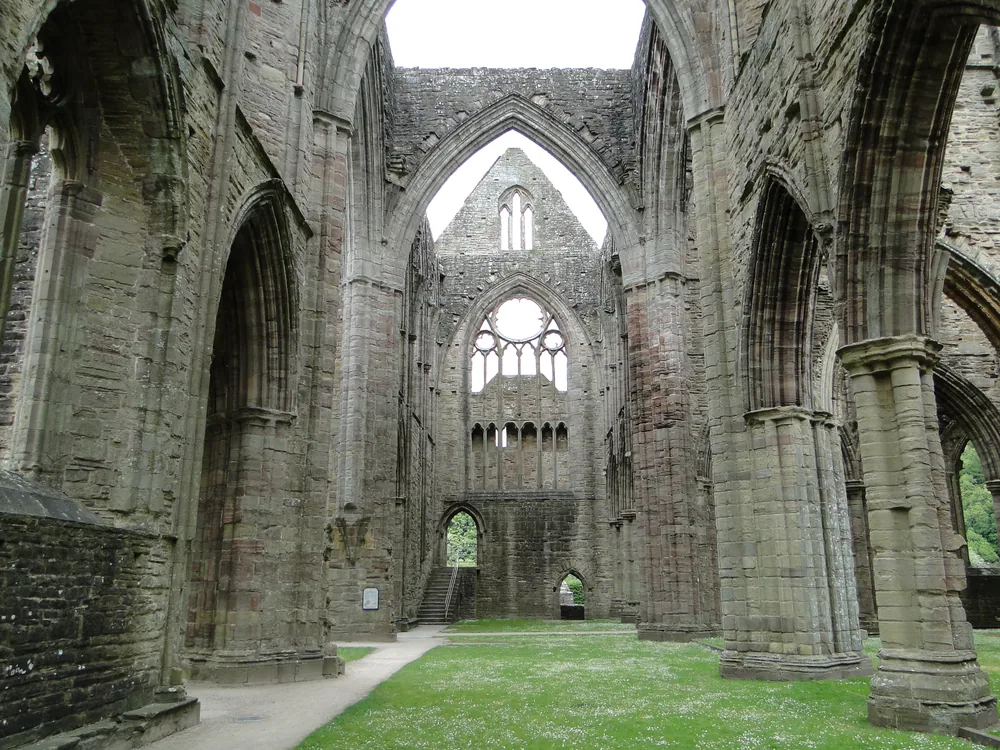
Tintern Abbey, in the wooded Wye gorge five kilometres north of Chepstow, was founded in 1131 by Walter de Clare, Lord of Chepstow, as the first Cistercian monastery in Wales. The Cistercians, who required extreme remoteness for their contemplative rule, chose the Wye Valley precisely for its isolation; the abbey remained a working community for over four centuries, until its dissolution under Henry VIII in 1536. The 13th-century church — rebuilt on a much larger scale under Roger Bigod, Earl of Norfolk, after 1270 — survives almost to its original wall height despite losing its roof; the nave walls, the great east window, and the crossing tower are among the finest Gothic ruins in Britain. Tintern's aesthetic power in the Romantic era was enormous: William Gilpin's Observations on the River Wye (1782) codified the Picturesque movement using the abbey as its central exhibit; William Wordsworth's poem 'Lines Written a Few Miles above Tintern Abbey' (1798) is one of the foundational texts of Romantic landscape poetry; J.M.W. Turner made multiple paintings of the site across several decades.
Caerphilly Castle, 13 kilometres north of Cardiff, was built between 1268 and 1271 by Gilbert de Clare in direct response to Llywelyn ap Gruffudd's growing power. At 30 acres it is the largest castle in Wales and the second largest in the UK after Windsor — its scale achieved not by height but by water: three artificial lakes, two moats, and a concentric ring of walls and towers make the site one of the most ambitious medieval water fortresses in Europe. The famous leaning tower — which tilts at a greater angle than the Leaning Tower of Pisa — was deliberately undermined during the English Civil War. The guide covers Gilbert de Clare's relationship with Edward I and the strategic logic of water-fortress design in 13th-century Wales.
The GetYourGuide listing for this tour shows an inconsistency: the structured itinerary widget names Castell Coch as the final stop, while the operator's prose description names Caldicot Castle instead. Castell Coch is William Burges's extraordinary 1876 Neo-Gothic creation in the Taff gorge — conical towers, a working drawbridge, frescoed interiors — built for the Marquess of Bute. Caldicot Castle is a restored Norman keep with a 19th-century residential complex in Monmouthshire, closer to Chepstow in geography. Both are significant but entirely different in character. Confirm which castle is scheduled for your specific date with the operator before booking.
What's Included
- ✓Return transport from Cardiff
- ✓Professional English-speaking guide
- ✓National Museum Cardiff visit (free-entry institution)
- ✓Caerleon Roman Amphitheatre access
- ✓Chepstow Castle entry
- ✓Tintern Abbey entry
- ✓Caerphilly Castle entry
- ✓Third castle entry (Castell Coch or Caldicot — confirm itinerary at booking)
- ✓Small group (max 12)
Not Included
- ✗Lunch (free time during the day — Tintern village has a pub; Caerphilly town has cafés)
- ✗Personal expenses
Insider Tips
This tour shows a strong, verified GetYourGuide rating — a reliable signal for a small-group guide-led experience.
The third castle stop (Castell Coch or Caldicot) is not consistent across the GetYourGuide listing — confirm with the operator at booking which castle will be visited on your specific date.
Caerleon is the unique element of this tour compared to all other Cardiff-based options. If Roman Britain is your primary interest, this is the only Cardiff tour that includes it.
Tintern and Chepstow also appear on the Wye Valley tour from Cardiff (max 8, entry fees NOT included) — a smaller, border-history specialist tour that doesn't include Caerleon or Caerphilly.
Caerphilly's leaning tower is best photographed from the outer ward looking south — include a vertical reference in the frame to make the lean legible.
Frequently Asked Questions
How does this tour differ from the other Cardiff day tours?
This is the only Cardiff day tour that includes Caerleon's Roman legionary amphitheatre alongside Welsh medieval castles. The Cardiff Three Castles tour (Caerphilly, Raglan, Tretower) covers rural medieval South Wales without Tintern, Chepstow or any Roman site. The Wye Valley tour (Tintern, Chepstow, Caerphilly) is a smaller specialist border-history tour without Caerleon. The Cardiff Castle & Castell Coch tour focuses on the Marquess of Bute's Victorian Gothic legacy in Cardiff city. This tour offers the broadest chronological range — Roman to medieval to Gothic Revival — in one day.
Why was Caerleon so important to the Romans?
Caerleon (Isca Silurum) was one of only three permanent legionary fortresses in Roman Britain — alongside York and Chester — and the base for the conquest and administration of Wales and the Welsh Marches. The 2nd Augustan Legion garrisoned here for over two centuries, and the fortress was designed for a community of around 5,500 soldiers with all the infrastructure of a permanent Roman town: baths, amphitheatre, barracks, granaries, and a hospital. The site's survival is exceptional: the amphitheatre subterranean passages are among the best-preserved of any Roman amphitheatre in Britain.
What is the Wordsworth connection to Tintern Abbey?
William Wordsworth visited Tintern Abbey in July 1798 and wrote 'Lines Written a Few Miles above Tintern Abbey' on the journey home — completing the poem, he later claimed, without writing down a single line until it was entirely composed in his head. The poem is one of the foundational texts of English Romantic poetry, using the ruined abbey as a starting point for a meditation on memory, nature, and the passage of time. The Wye Valley had already been made famous by William Gilpin's Observations on the River Wye (1782), which codified the 'Picturesque' aesthetic movement using Tintern as its central exhibit; Wordsworth's poem gave the site a second layer of literary celebrity.
More Tours from Cardiff
Powered by GetYourGuide
From
€220
per person
Free cancellation available on most dates · Secure booking
Meeting point
National Museum Cardiff, Cathays Park — exact meeting details confirmed at booking
From
€220/ person