
Château de Fontainebleau
Château de Fontainebleau
France · Île-de-France · Near Paris
Built 1137 · French Renaissance / Classical
This page is part of an independent travel guide and is not affiliated with, endorsed by, or operated by Château de Fontainebleau.
© Castles & Palaces
Quick Facts
- Hours
- Tue–Sun 09:30–18:00. Closed Mon
- Day trip from
- €84
- Duration
- 2–4 hours
- Best time
- Spring and autumn for smaller crowds
- Nearest city
- Paris
Featured Tour
Fontainebleau & Vaux-le-Vicomte Châteaux Day Tour from Paris
Cancellation available · Instant confirmation
Highlights
- ✦Over 1,500 rooms spanning eight centuries of French royal history — the longest-occupied royal palace in France
- ✦The Francis I Gallery is a masterpiece of French Renaissance decoration, setting the template for every royal gallery that followed
- ✦Napoleon signed his abdication here in 1814 — the Red Council Room where he did so is preserved exactly as he left it
- ✦UNESCO World Heritage Site: the palace and surrounding Fontainebleau Forest (25,000 hectares) are inscribed together
- ✦The carp pond where Napoleon fed the fish is the oldest ornamental fish pond in France — its carp are reputedly 400 years old
Tickets & tours
Book through GetYourGuide
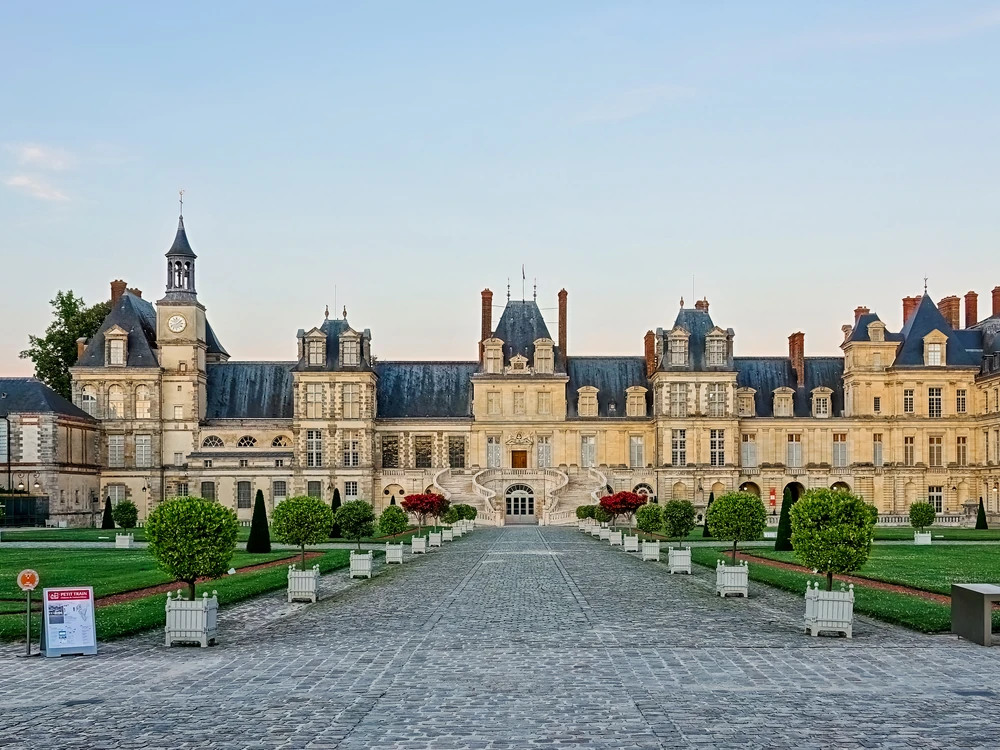
If Versailles is the palace that France shows to the world — magnificent, overscaled, designed for politics and display — Fontainebleau is the one France kept for itself. Older, more personal, more varied, and more deeply woven into the fabric of French royal history, it is the palace where every French monarch from Louis VII to Napoleon III slept, hunted, celebrated, and died. It has over 1,500 rooms spanning eight centuries, and it is the most directly autobiographical of all the great French royal residences.
The palace's greatest individual achievement is the Francis I Gallery, created between 1533 and 1540 by the Florentine artist Rosso Fiorentino with stucco frames by Primaticcio. This long corridor — full of allegorical paintings in high-relief plasterwork frames, combining Italian Renaissance motifs with French symbolism — effectively invented the French decorative tradition. Every French palace gallery that followed, including those at Versailles, derives from what was first worked out here at Fontainebleau. Standing in it is to stand at the origin of a visual language that shaped European palace decoration for the next 300 years.
The palace's other unmissable moment is historical rather than artistic: the Salle du Conseil Rouge, where Napoleon signed his abdication on 6 April 1814 following the Allied capture of Paris. The room is preserved almost exactly as it was that morning. The courtyard outside is called the Cour des Adieux — the Courtyard of Farewells — where Napoleon made his famous last speech to the Old Guard before departing for exile on Elba.
History
Fontainebleau appears in the historical record from 1137, when Louis VII granted it to the monks of a nearby priory. By the 12th century a royal hunting lodge had been established in the forest, and the Fontainebleau forest — covering 25,000 hectares — remains one of the finest in France.
The transformation from hunting lodge to royal palace began under Francis I (reigned 1515–1547), who demolished the medieval buildings and replaced them with a Renaissance palace of extraordinary ambition. He brought Italian artists — Rosso Fiorentino, Primaticcio, and Benvenuto Cellini — to create a French version of the Italian Renaissance. The result, the so-called First School of Fontainebleau, effectively transplanted the Italian Renaissance to France and launched the French artistic tradition that would eventually produce Versailles. Every subsequent French monarch from Henri II to Napoleon III left their mark on Fontainebleau, and it contains more accumulated royal history than any other building in France.
How to Visit
Getting there: Transilien N or R train from Paris Gare de Lyon to Fontainebleau-Avon station (~40–45 min, frequent departures; return ticket ~€12–15). From the station: bus Ligne 1 to the château (10 min) or walk through the town (25 min).
Tickets: Adults €14, children free. The GetYourGuide day trip combines Fontainebleau and Vaux-le-Vicomte in 9 hours from Paris — the most efficient way to see both in a single day.
Practical tips: Far less crowded than Versailles; queues are minimal on weekdays outside school holidays. Prioritise the Francis I Gallery (the starting point of French decorative tradition) and the Salle du Conseil Rouge where Napoleon signed his abdication — allow 2 hours for the interior and 1 hour for the formal gardens and carp pond.
Combine with: Château de Vaux-le-Vicomte (20 km northwest — the classic pairing, requires a taxi or car), Château de Rambouillet, and Palace of Versailles for a Paris-region royal palace circuit.
Frequently Asked Questions
Versailles was built in the late 17th century as a deliberate political statement — a purpose-built palace designed to awe Europe. Fontainebleau is 500 years older, a palace that evolved organically over eight centuries of royal occupation. Where Versailles overwhelms with scale and unity, Fontainebleau rewards with variety and depth — a Renaissance gallery here, a Napoleonic bedroom there, a medieval chapel wing, a Louis XV room. It is less perfectly coherent than Versailles and more interesting for it. Crowds are also far smaller.
Location
77300 Fontainebleau, France
Nearby Castles
Tours & Tickets
Powered by GetYourGuide
From
€84/ person