
Château de Vaux-le-Vicomte
Château de Vaux-le-Vicomte
France · Île-de-France · Near Paris
Built 1661 · French Baroque / Classical
This page is part of an independent travel guide and is not affiliated with, endorsed by, or operated by Château de Vaux-le-Vicomte.
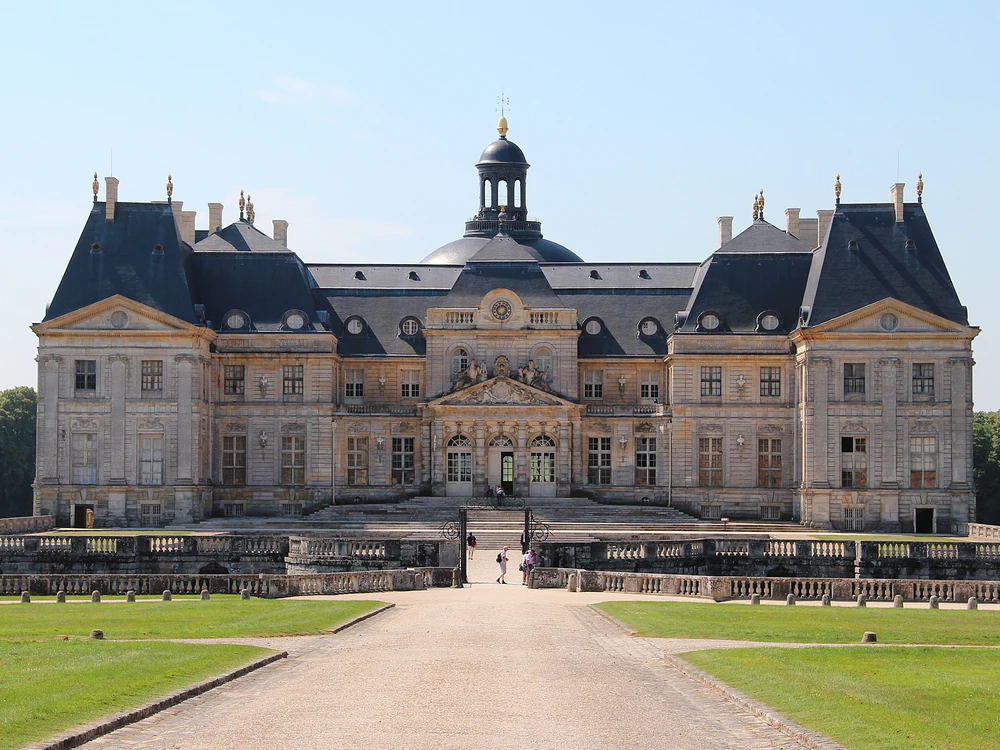
© Castles & Palaces
Quick Facts
- Hours
- Mon–Fri 10:00–18:00. Sat & Sun 10:00–20:00
- Day trip from
- €84
- Duration
- 2–4 hours
- Best time
- May to October
- Nearest city
- Paris
Featured Tour
Fontainebleau & Vaux-le-Vicomte Châteaux Day Tour from Paris
Cancellation available · Instant confirmation
Highlights
- ✦Built in just 5 years by Nicolas Fouquet — its magnificence so outshone Versailles that Louis XIV had Fouquet arrested
- ✦André Le Nôtre designed the formal gardens here before going on to create the Gardens of Versailles
- ✦Charles Le Brun's painted ceilings are among the finest in 17th-century France
- ✦Saturday evening candlelit visits with over 2,000 candles illuminate the château and gardens in extraordinary atmosphere
- ✦The complete artistic team of Vaux-le-Vicomte — Le Vau, Le Brun, Le Nôtre — were immediately hired by Louis XIV to build Versailles
Tickets & tours
Book through GetYourGuide
The story of Vaux-le-Vicomte is one of the great cautionary tales of French history, and it is perfectly embodied in the building. Nicolas Fouquet, Louis XIV's finance minister and the most powerful man in France after the king, decided to build himself a château of unprecedented magnificence. He hired the three finest artists in France — architect Louis Le Vau, painter Charles Le Brun, and landscape designer André Le Nôtre — gave them unlimited resources, and in just five years created a palace and gardens that surpassed anything in Europe.
Fouquet held a housewarming party in August 1661 — six thousand guests, fireworks, theatre, dancing, and a full dinner served from silver plate. Three weeks later, Louis XIV had him arrested on charges of embezzlement. The real reason was simpler: a subject could not be allowed to outshine a king. Fouquet died in prison seventeen years later. Louis XIV immediately hired Le Vau, Le Brun, and Le Nôtre and ordered them to do the same thing at Versailles, but bigger.
The château Fouquet built, and the gardens Le Nôtre laid out, remain almost intact today. Le Nôtre's first major garden commission is a masterpiece of perspectival illusion and classical order — from the château steps, the grand axis appears to extend to the horizon, with fountains, parterres, and canal organised into a geometry of absolute authority. The interior, with Le Brun's painted ceilings at their most inventive, is equally compelling. It is, in every possible sense, the prototype of Versailles — and it is better to visit because it is not Versailles.
History
Nicolas Fouquet (1615–1680) rose through the French legal and financial establishment to become Louis XIV's Superintendent of Finances — effectively the controller of the French state's money. In 1658, he purchased land near Melun and began building Vaux-le-Vicomte. To clear the site, he purchased and demolished three entire villages, relocating their inhabitants. At its peak, 18,000 workers laboured simultaneously on the project.
Fouquet assembled the most talented creative team in France: architect Louis Le Vau, who designed the oval salon and the overall plan; Charles Le Brun, who painted every ceiling and designed every tapestry; and André Le Nôtre, a young gardener who had never designed a project of this scale, whose formal gardens at Vaux became the defining model for French landscape design for the next two centuries. The housewarming party on 17 August 1661 was the most spectacular private entertainment in French history. On 5 September 1661, Louis XIV had Fouquet arrested by d'Artagnan of the Musketeers. After a three-year trial, Fouquet was convicted and sentenced to life imprisonment; he died in Pignerol fortress in 1680.
The château passed through several private owners after Fouquet's fall and eventually fell into serious disrepair. In 1875 it was purchased by Alfred Sommier, a sugar industrialist, who undertook a comprehensive restoration of both the château and Le Nôtre's gardens. His descendants, the Vogüé family, own and manage the château to this day — one of the most significant privately maintained historic properties in France.
How to Visit
Getting there: From Paris Gare de Lyon, take a train to Melun (25–30 min), then a taxi to the château (~10 min, ~€15). In season (March–November) shuttle buses run from Melun station on Saturdays and Sundays. By car from Paris, take the A6 to exit 16 Melun-Senart; the château is ~8 km from the motorway (~50 min from Paris).
Tickets: Walk-up admission is €21 for adults; children under 18 enter free. The GetYourGuide guided day trip combines Fontainebleau and Vaux-le-Vicomte in a 9-hour tour from Paris, including transport, and is one of the most popular day-trip combinations in the Île-de-France.
Practical tips: The Saturday evening candlelit visits (May–October) are extraordinary — over 2,000 wax candles illuminate the château and gardens with no electric light from around 20:00 to 24:00. These evenings sell out weeks ahead in summer, so book well in advance. For the daytime visit, view the grand axis from the château steps first before walking the gardens; the perspectival illusion is best appreciated from that fixed point.
Combine with: Palace of Versailles and Vaux-le-Vicomte together tell the complete story of French 17th-century ambition — Vaux provoked Versailles into existence. Château de Fontainebleau, 20 km south, pairs naturally for a full Île-de-France château day.
Frequently Asked Questions
The official charge was embezzlement — Fouquet had indeed used public funds for private enrichment, which was common practice at the time but technically illegal. The real motivation was the young Louis XIV's fury at being outshone by a subject. The party of 17 August 1661 was the most spectacular private entertainment ever held in France, and Louis — who had nothing to match it — took it as an insult. He ordered Fouquet's arrest three weeks later. The charge of treason was not proven; Fouquet was convicted only of embezzlement and sentenced to exile, which Louis changed to life imprisonment.
Location
77950 Maincy, France
Nearby Castles
Tours & Tickets
Powered by GetYourGuide
From
€84/ person