
Bianello Castle
Castello di Bianello
Italy · Emilia-Romagna — Quattro Castella, Province of Reggio Emilia · Near Reggio Emilia
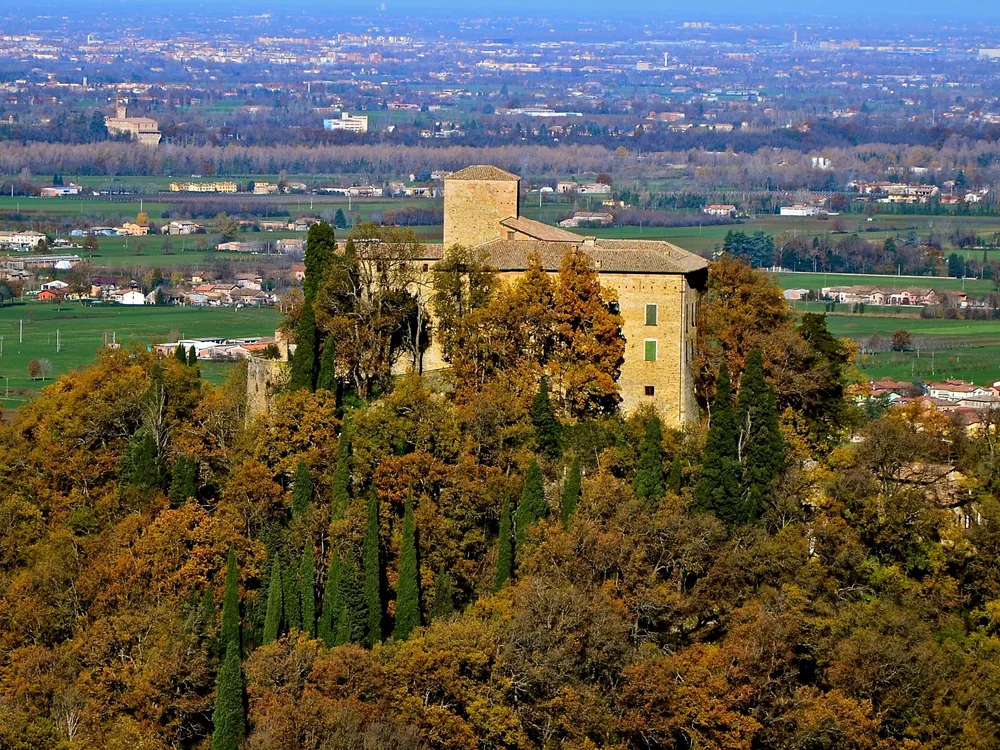
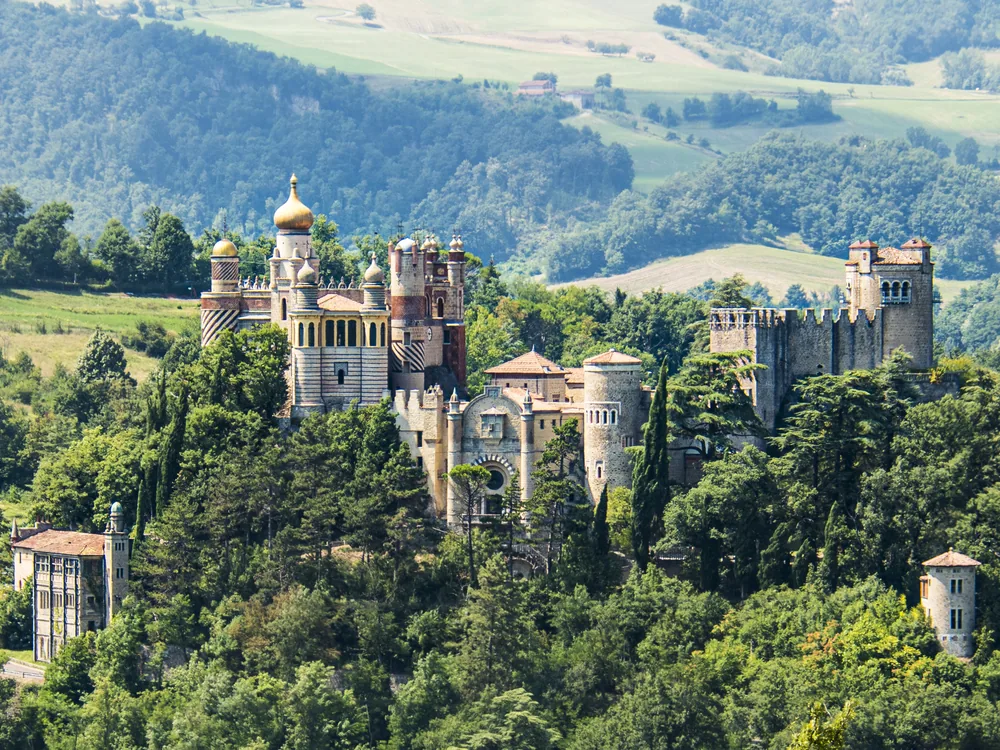
Built 1000 · Medieval hilltop castle of the 10th–11th century, richly furnished historic residence — Bianello Castle sits on a volcanic rock (one of the four isolated rock formations that give the municipality of Quattro Castella its name, the 'Four Castles') overlooking the Po Plain and the Apennine foothills of Emilia-Romagna; the medieval stone structure of the castle has been inhabited and modified across many centuries and is now a richly furnished historic residence with 17th-century frescoed apartments, chapel, state rooms, basement kitchens, billiard room, and a suite of rooms preserving the personality of long-term family ownership; the castle also retains darker elements including an original prison with inmate graffiti, a secret passage, and what local tradition calls the 'ghost room', where the spectral figure of a lady in green velvet is said to have appeared in a mirror; the portrait of Matilda of Canossa — the medieval margravine who is the castle's most historically significant association — is displayed in a dedicated room
This page is part of an independent travel guide and is not affiliated with, endorsed by, or operated by Bianello Castle.
© Castles & Palaces
Quick Facts
- Hours
- Wed–Fri 10:00–17:00. Sat & Sun 10:00–18:00. Closed Mon & Tue
- Guided tour from
- €24
- Duration
- 1.5 hours (guided tour of the full castle including basement kitchens, state rooms, frescoed apartments, chapel, prison with inmate graffiti, secret passage, ghost room, and portrait of Matilda of Canossa)
- Best time
- April to October
- Booking
- Required — book 1+ days ahead
- Nearest city
- Reggio Emilia
Featured Tour
Guided Tour of Bianello Castle: History, Mystery and Ghosts
Cancellation available · Instant confirmation
Highlights
- ✦The Road to Canossa — where Henry IV came to beg — in January 1077, Holy Roman Emperor Henry IV stood barefoot in the snow outside Castello di Canossa (the main Canossa fortress, approximately 6km away) for three days, waiting for Pope Gregory VII to lift his excommunication; before arriving at Canossa, Henry IV stayed at Bianello, a possession of Matilda of Canossa, who acted as the political broker between pope and emperor; the phrase 'going to Canossa' — a humiliating act of public submission — entered European political language from this episode; Bianello was the stage of preparation for one of the most resonant political moments of the medieval period
- ✦Matilda of Canossa (c. 1046–1115) — medieval Italy's most powerful woman — Matilda of Tuscany (also called Matilda of Canossa, from her family's chief fortress) was the dominant territorial power in northern Italy for decades and one of the most politically significant figures of 11th-century Europe; she controlled large territories across Emilia-Romagna, Tuscany, and Lombardy; she supported Pope Gregory VII against Emperor Henry IV in the Investiture Controversy and hosted the 1077 events that made her name synonymous with papal political triumph; the castle retains a room dedicated to her portrait and the period she represents
- ✦Prison with original inmate graffiti, secret passage, and ghost room — Bianello's darker attractions are genuinely atmospheric rather than reconstructed: the original prison retains the marks left by medieval and later inmates, inscriptions and carvings cut into the stone walls in the desperation or boredom of captivity; a secret passage runs through the castle fabric; and local tradition associates one chamber with the recurring apparition of a lady in green velvet, visible in a mirror, that gives the room its popular name — all of which the GYG tour title ('History, Mystery and Ghosts') fairly advertises
- ✦17th-century frescoed apartments and richly furnished state rooms — beyond the medieval and ghostly, Bianello is a genuinely well-preserved historic residence: the 17th-century frescoed apartment, the gilded sitting room, the billiard room, the chapel, and the basement kitchens give the castle an inhabited quality across multiple centuries that museum reconstructions rarely achieve; long-term family ownership accumulated the furnishings and character of a house that has been lived in, not simply preserved
- ✦Castello di Canossa — the future-batch castle of the 1077 events — the ruined Castello di Canossa, where the actual act of Henry IV's penance took place, is approximately 6km from Bianello and is the natural companion site; it has not yet been added to the Castles & Palaces directory but is a strong candidate for a future batch
Skip the queue with a guided tour
Skip-the-line tickets & expert guides
In January 1077, the Holy Roman Emperor Henry IV stood barefoot in the snow outside a castle in the Emilian Apennines and waited. He had been excommunicated by Pope Gregory VII — the most severe spiritual punishment available to the medieval papacy, one that released Henry's subjects from their oaths of loyalty and threatened to make his position politically untenable. The act of penance he performed over three days, dressed as a penitent pilgrim and barefoot in winter, was the price of having that excommunication lifted. The castle where he presented himself was Castello di Canossa, the principal fortress of Matilda of Canossa, the most powerful territorial magnate in northern Italy and the political broker who made the meeting between pope and emperor possible. Before arriving at Canossa, Henry IV stayed at Bianello.
The phrase 'going to Canossa' — a phrase that Bismarck famously invoked in 1872 when he insisted the German Empire would not submit to the papacy over the Kulturkampf — entered European political vocabulary from this January episode. It describes a humiliating public act of submission, a powerful figure compelled to self-abasement by circumstances beyond the control of their political authority. The Canossa event was a defining moment in the Investiture Controversy — the dispute between papal and imperial authority over the appointment of church officials — and it represented the high-water mark of Gregory VII's claim to supremacy over secular rulers.
Matilda of Canossa (c. 1046–1115) is the historical figure most powerfully associated with Bianello, and her portrait hangs in a room dedicated to her memory in the castle's interior. She was one of the most remarkable political figures of medieval Europe: a woman who controlled vast territories across Emilia-Romagna, Tuscany, and Lombardy; who led armies in person; who corresponded with popes and emperors as a peer; and who survived decades of conflict between the Gregorian reform papacy and the imperial party, consistently backing the papal cause. The Investiture Controversy that reached its crisis in 1077 had been a running conflict for years before Henry IV's penance, and Matilda was central to it throughout.
The castle at Bianello sits on one of four isolated volcanic rock formations that give the municipality of Quattro Castella its name — the 'Four Castles' town. From the hilltop, the view extends across the Po Plain in one direction and back toward the Apennine foothills in the other — the landscape of productive northern Italian agriculture that Matilda's family controlled and that made the County of Canossa one of the most valuable territorial holdings in medieval Italy.
The interior of Bianello is a palimpsest of several centuries' occupation. The 17th-century frescoed apartment, the gilded sitting room, the billiard room, the chapel, and the state rooms reflect the long inhabitation of the castle across the period following Matilda — families that held the property after her death leaving successive layers of furnishing and decoration. The basement kitchens, which survive in their medieval and early modern form, give the castle a domestic underside that the formal rooms above conceal.
The prison is one of Bianello's most charged spaces. Original inmate graffiti — marks, inscriptions, and carvings cut into the stone walls by people who had time, necessity, and limited means of expression — cover the surfaces in the way that documentary historians value and tour operators can point to as evidence of the real conditions of medieval and early modern custody. A secret passage runs through the castle fabric in the manner typical of fortifications where the possibility of sudden siege or departure under threat needed to be accommodated in the architecture.
The GYG guided tour (t1296628) is a 1.5-hour programme that takes visitors through the full range of the castle's spaces — medieval, aristocratic, atmospheric, and ghostly — with a licensed guide. The tour is in Italian; visitors who do not read Italian should confirm current language availability before booking. The GYG listing states the tour is wheelchair accessible, which is worth verifying directly with the castle given the typical physical character of medieval hilltop sites.
The Castello di Canossa — the ruined fortress where Henry IV's actual penance took place, approximately 6km from Bianello — is the obvious next step for visitors who have engaged with the 1077 events at Bianello. It has not yet been added to the Castles & Palaces directory but is a strong candidate for a future batch.
History
10th–11th century: Bianello Castle established on one of the volcanic rock formations of the Quattro Castella area; associated with the Canossa family, the dominant territorial power in northern Emilia-Romagna. 11th century: Matilda of Canossa (c. 1046–1115) controls Bianello as part of the Canossian territorial domain. January 1077: Holy Roman Emperor Henry IV stays at Bianello before proceeding to Castello di Canossa for his famous act of penance before Pope Gregory VII — the event that gives rise to the phrase 'going to Canossa'. 1077 onwards: the Investiture Controversy continues; Matilda supports the Gregorian papacy throughout; she dies at Bondeno di Roncore in 1115. Medieval–early modern period: castle passes through successive ownership after the Canossa family; various modifications. 17th century: frescoed apartments added; castle inhabited as an aristocratic residence. 20th–21st century: castle operated as a heritage attraction; guided tours developed. Present day: open Wednesday–Sunday; guided tours in Italian; wheelchair accessible per GYG listing.
How to Visit
Getting there: Quattro Castella is approximately 15km southwest of Reggio Emilia by road (around 20 minutes by car). By public transport: train to Reggio Emilia then a local bus to Quattro Castella (limited frequency); car is the most practical option. From Parma: approximately 30km southeast, about 35 minutes by car.
Tickets: Entry costs €24 per adult (children €14) and is only available as part of a guided tour. The GYG guided tour (t1296628, from €24) leads the full castle circuit in Italian — basement kitchens, state rooms, 17th-century frescoed apartments, chapel, prison with original inmate graffiti, secret passage, and the ghost room — with admission included. Confirm language availability before booking if you don't speak Italian.
Practical tips: Open Wednesday–Sunday only; book in advance as tour times are fixed. The GYG listing states the tour is wheelchair accessible — worth confirming directly with the castle given the medieval hilltop setting.
Combine with: The ruined Castello di Canossa — where Henry IV's actual penance took place in January 1077 — is approximately 6km from Bianello and the essential companion site for anyone following the Canossa story. It is not yet in the Castles & Palaces directory but worth the short drive.
Frequently Asked Questions
In January 1077, Holy Roman Emperor Henry IV stood barefoot as a penitent pilgrim outside Castello di Canossa for three days in winter, waiting for Pope Gregory VII to lift his excommunication. The excommunication had been imposed as part of the Investiture Controversy — the dispute between the papacy and the Holy Roman Empire over who had the authority to appoint bishops and abbots. Henry IV's penance was both a religious submission and a political act: he needed the excommunication lifted to maintain the loyalty of his German princes. Matilda of Canossa brokered the meeting between pope and emperor at her family's castle. The episode became one of the most famous scenes in medieval political history, and the phrase 'going to Canossa' has been used ever since to describe a powerful figure's humiliating public submission. Bianello was Henry IV's stopping point before the final act at Canossa — making it an ancillary but genuine part of the historical geography of these events.
Location
Castello di Bianello, Via del Castello 1, 42020 Quattro Castella (RE), Italy
Nearby Castles
Tours & Tickets
Powered by GetYourGuide
From
€24/ person