
Palazzo Te
Palazzo Te
Italy · Lombardy — Mantua (Mantova), on the island of Te outside the city walls · Near Mantua
Built 1524 · Mannerist architecture and interior decorative programme by Giulio Romano, built 1524–1534 for Federico II Gonzaga — the building is a masterwork of Mannerism, the post-High Renaissance style that combined classical forms with deliberate tension, ambiguity, and illusionistic excess; Romano (born Giulio Pippi di Jannuzzi, 1499–1546) was Raphael's most gifted pupil and principal studio assistant; after Raphael's death in 1520 he became the dominant figure in Italian painting and architecture and Palazzo Te his greatest single achievement; the building is designed around a single-storey square plan with a central courtyard, its exterior decorated with the triglyphs-slipping-out-of-place device that signals the Mannerist abandonment of Vitruvian correctness — Romano drops the triglyphs as if they are falling, a joke at the expense of the architectural rules he knows perfectly well; the interior rooms are organised around a programme of mythological and equestrian imagery that constitutes the most sustained and theatrically overwhelming decorative ensemble of the Italian 16th century
This page is part of an independent travel guide and is not affiliated with, endorsed by, or operated by Palazzo Te.
© Castles & Palaces
Quick Facts
- Hours
- Mon 13:00–18:00. Tue–Sun 09:00–18:00
- Guided tour from
- €38
- Duration
- 1.5–2 hours (self-guided); 1.5 hours (GetYourGuide guided tour, rooms fully explained)
- Best time
- April to October
- Nearest city
- Mantua
Featured Tour
Guided Tour of Palazzo Te in Mantua: the Gonzaga Family's Treasure Chest
Cancellation available · Instant confirmation
Highlights
- ✦Sala dei Giganti (Hall of the Giants) — the most overwhelming room in the palace and one of the most spectacular illusionistic interiors in Italy: Giulio Romano covered every surface — walls, ceiling, floor — in a continuous painting of the Giants' defeat, with Zeus hurling thunderbolts and stone collapsing as the giants are crushed; the architectural devices of the room (the curved ceiling merging into the walls without cornices) eliminate the normal boundary between real space and painted space; visitors stand inside the catastrophe; the room was intended as a statement of Gonzaga power and a warning to Federico's enemies
- ✦Sala di Amore e Psiche (Chamber of Cupid and Psyche) — the most celebrated and most controversial room: a programme of erotic and mythological scenes painted with the freedom of a private commission in a building outside the city walls and beyond formal court surveillance; the room was painted for Federico II's use with his mistress Isabella Boschetti, and Romano's imagery — Olympian feasts, bathing nymphs, explicit mythological encounters — operates as a sustained visual argument for aristocratic sensual licence rooted in classical precedent
- ✦Sala dei Cavalli (Hall of Horses) — six of Federico II Gonzaga's prized stallions painted life-size against a trompe l'oeil architecture of niches and columns; the Gonzaga maintained one of the finest stud farms in Europe and Federico's horses were diplomatic gifts, racing champions, and status symbols of the first order; Romano's portraits of these specific animals by name — Dario, Glorioso, Morel Favorito, Battaglia, Spadino, Glorioso — give the room a quality of courtly documentary portraiture
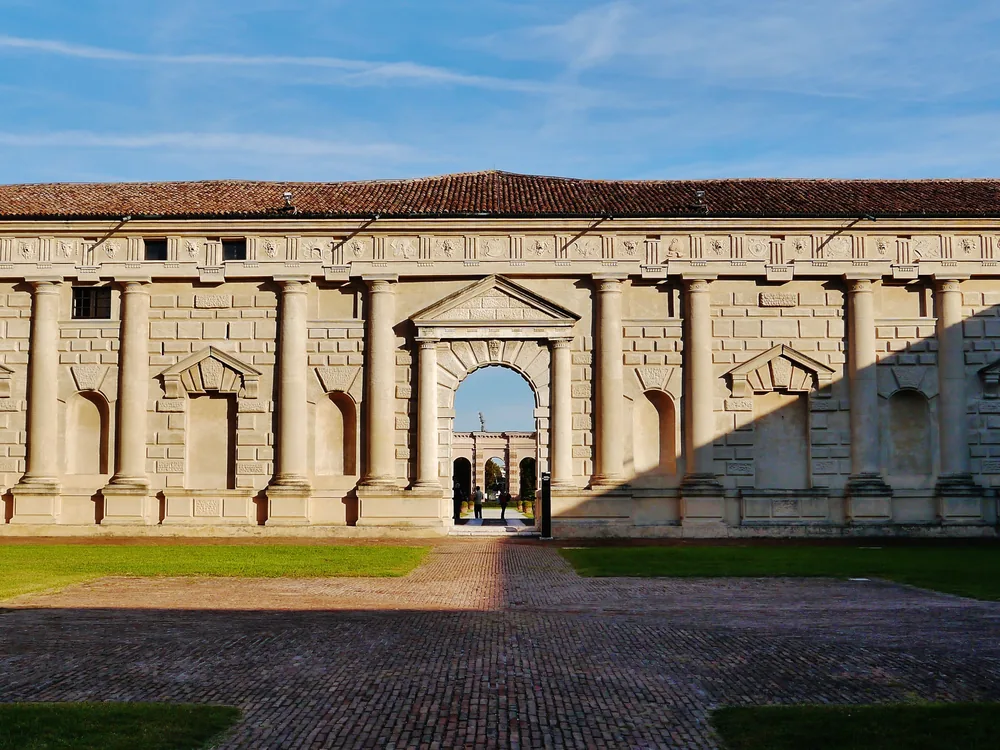
- ✦Giulio Romano's Mannerist architecture — the exterior of the building contains one of the most deliberate architectural jokes in Italian architectural history: Romano designed the Doric frieze with triglyphs (the architectural elements that by classical rules must sit above columns) so that they appear to be slipping downward out of their correct position; this subversion of Vitruvian correctness was a demonstration of mastery — only someone who knew the rules perfectly could break them so precisely
- ✦Isaac Julien's contemporary art in the Fruttiere — the restored Fruttiere (former fruit storage building of the Gonzaga) houses the permanent installation by contemporary British artist Isaac Julien; the juxtaposition of 21st-century film and installation art in a 16th-century Gonzaga outbuilding is one of the more successful contemporary-in-historic-context arrangements in northern Italy
- ✦Mantua UNESCO inscription — Mantua (Mantova) and the nearby planned city of Sabbioneta were jointly inscribed as a UNESCO World Heritage Site in 2008, recognising their exceptional Renaissance urban fabric; the Palazzo Te is among the key buildings of the inscription; the city centre, with the Palazzo Ducale (Gonzaga ducal palace) and the Basilica di Sant'Andrea (Alberti's masterpiece of Renaissance church design), is one of the most coherent Renaissance urban landscapes in Italy and is often overlooked in the Lombardy circuit dominated by Milan and the lakes
Skip the queue with a guided tour
Skip-the-line tickets & expert guides
Palazzo Te stands on a low island — the Island of Te — outside the historic walls of Mantua, positioned deliberately beyond the formality of the city. Federico II Gonzaga, first Duke of Mantua, commissioned it in 1524 from Giulio Romano as a pleasure villa: a place removed from the court protocols of the Palazzo Ducale in the city centre, designed for entertaining, for horses, and for the company of his mistress Isabella Boschetti. The building took ten years to complete (1524–1534) and emerged as the most theatrically ambitious decorative interior of the Italian Renaissance.
Giulio Romano — born Giulio Pippi di Jannuzzi in Rome around 1499 — was Raphael's principal studio assistant and most talented pupil. After Raphael's sudden death in 1520 at the age of 37, Romano became the dominant figure in Italian Mannerist painting and architecture. His move to Mantua in 1524, at Federico's invitation, gave him the opportunity and the patronage to realise his most ambitious ideas in a single sustained programme. The result is a building and decorative cycle that has no real parallel in European architecture.
The exterior announces the Mannerist programme immediately. Romano designed the Doric frieze of the facade with triglyphs that appear to be slipping downward out of their classical position — an architectural joke of precise craftsmanship, visible only to viewers who knew their Vitruvius well enough to notice what had been done wrong. It was not an error. It was a demonstration of perfect mastery exercised in the act of deliberate transgression: the signature move of Mannerism, and Romano's calling card.
The interior rooms are organised around a programme of mythology, eroticism, and political allegory that together constitute the most complete surviving decorative statement of Gonzaga power. The Sala dei Cavalli (Hall of Horses) opens the sequence: six Gonzaga stallions painted life-size against a painted architecture of columns and niches, each horse named and individuated. The Gonzaga stud farm at Marmirolo was one of the most admired in Europe; Federico's horses were diplomatic instruments, racing champions, and markers of aristocratic prestige, and Romano's portraits of them have the seriousness of a royal commission.
The Sala di Amore e Psiche is the villa's most celebrated and most discussed room. Its ceiling and walls carry a continuous programme of scenes from the myth of Cupid and Psyche — Olympian feasts, bathing goddesses, explicit mythological unions — painted with a freedom that Federico's position outside the city walls made possible. The room was designed for a private pleasure villa, not a public palace, and Romano's imagery operates accordingly. The marriage of Cupid and Psyche is the narrative frame; the erotic episodes are the content.
The Sala dei Giganti is the climax and the room that most visitors remember longest. Romano eliminated every architectural boundary — the ceiling curves into the walls without cornices; the walls reach to the floor without plinths — and covered every surface with a single continuous painting of the battle of the Gods and Giants. Zeus hurls thunderbolts from Olympus. Columns collapse. Stone falls from a fractured vault. The giants are crushed by the weight of Olympian order reasserting itself over rebellion. Standing in the room, visitors stand inside the catastrophe. The effect at the original scale — the room is substantial — remains one of the most physically affecting interiors in Italian Renaissance art.
Federico II Gonzaga had a specific political use for the imagery. He was a condottiero (mercenary military commander) who had successfully navigated the treacherous politics of the Italian Wars, maintaining Gonzaga power through a combination of military service, strategic marriages, and careful alliance management. The Gonzaga's authority rested on the performance of power as much as its exercise. The Hall of the Giants made the performance literal: the ruler who commissioned this room was the ruler under whose court the forces of chaos were crushed.
The building is now a Museo Civico (municipal museum) and houses the Isaac Julien permanent installation in the restored Fruttiere — a former Gonzaga fruit-storage building at the edge of the complex. Julien's film and installation art occupies the space with the contemporary confidence appropriate to a building that has always been about excess and spectacle.
Mantua's own UNESCO inscription (2008, jointly with the planned city of Sabbioneta) recognises the city's exceptional Renaissance urban fabric, of which the Palazzo Te is the most spectacular single element. The city centre, a short walk or cycle from the island, contains the Palazzo Ducale (a vast ensemble of Gonzaga state apartments with Mantegna's Camera degli Sposi ceiling fresco), Alberti's Basilica di Sant'Andrea, and the Renaissance piazzas that make Mantua one of the most complete and least-crowded small Renaissance cities in northern Italy.
History
Giulio Romano arrived in Mantua at Federico II Gonzaga's invitation in 1524 and immediately began work on the Villa del Te — a pleasure palace on the low-lying Island of Te, positioned deliberately outside the city walls and removed from the formal protocols of the Gonzaga court. Romano designed both the architecture and the entire painted programme between 1524 and 1534: the Sala dei Giganti, in which the gods crush the giants beneath falling mountains painted on every surface including the floor, remains one of the most psychologically overwhelming rooms in any Italian Renaissance building. Holy Roman Emperor Charles V visited in 1530 — entertained in a palace still under construction — and created Federico the first Duke of Mantua in 1536, when the building was largely complete.
The sack of Mantua in 1630 during the War of the Mantuan Succession dispersed the Gonzaga collections across Europe and left the city diminished. The Gonzaga line ended in 1708, and Palazzo Te passed into Habsburg administration. The 19th century reduced it to agricultural and stable uses. Restoration began in the 20th century, and the building was opened to the public as the Museo Civico di Palazzo Te.
Mantua and Sabbioneta were jointly inscribed as a UNESCO World Heritage Site in 2008, recognising the concentration of Renaissance ducal culture in the Po plain. The museum operates with guided tours and hosts the Isaac Julien artistic installation in the Fruttiere.
How to Visit
Getting there: Mantua is ~40 km southeast of Brescia and ~150 km from Milan; direct trains from Milano Centrale take about 1h20, from Verona ~40 minutes. From Mantua station, Palazzo Te is a 20-minute walk south through the historic centre or a short taxi/bus ride. The palace sits on the low Island of Te just outside the city walls.
Tickets: Walk-up entry €14 adult, €3 child. The GetYourGuide skip-the-line guided tour (2 hours) covers the key rooms — Sala dei Cavalli, Sala di Amore e Psiche, and Sala dei Giganti — with a guide; book in advance.
Practical tips: April to October is the best visiting season — Mantua sits on three lakes and becomes hot and humid in July–August; spring and autumn are most comfortable. The palace is open Monday afternoons only from 13:00, Tuesday–Sunday from 09:00; confirm current hours at museocivicomantovapalazzote.it. Allow 1.5–2 hours for a self-guided circuit.
Combine with: Ducal Palace of Mantua is in the city centre a 20-minute walk north — the Gonzaga's formal state residence with Mantegna's Camera degli Sposi ceiling fresco; together the two palaces give a complete picture of Gonzaga ducal patronage.
Frequently Asked Questions
Yes — and the only way to understand why is to stand in it. Romano eliminated the normal architectural distinctions (cornice lines, baseboards) that visually separate walls from ceiling and floor, and covered every surface with a continuous catastrophic scene. The painted space and the real space merge without a clear boundary. At full room scale, with the giants collapsing toward you from above and the stone falling around you, the effect is disorienting in a way that photographs — which always reduce the room to a manageable rectangle — cannot convey. It is one of the most original rooms in Italian architecture and the reason Palazzo Te is considered a major destination rather than a minor diversion.
Location
Viale Te 13, 46100 Mantova MN, Italy
Nearby Castles
Tours & Tickets
Powered by GetYourGuide
From
€38/ person