
Palazzo Farnese (Caprarola)
Palazzo Farnese di Caprarola
Italy · Lazio, Caprarola, Cimini Hills — ~50km north of Rome · Near Viterbo
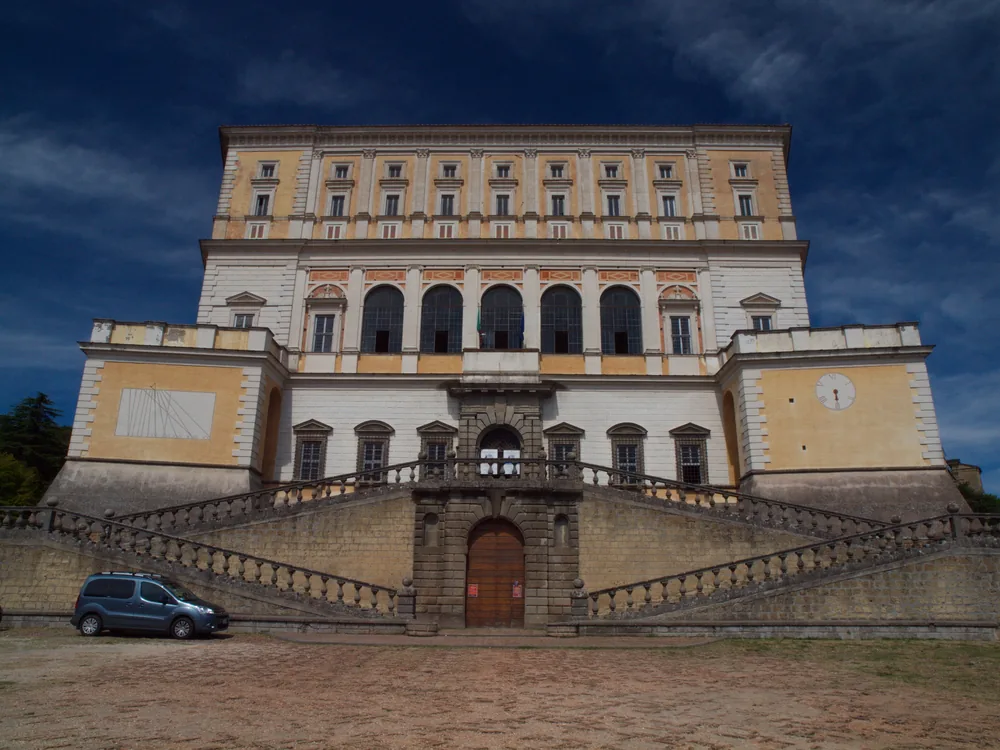
Built 1559 · Mannerist pentagonal fortress-palace — Jacopo Barozzi da Vignola's 1559–1573 conversion of Antonio da Sangallo the Elder's unfinished pentagonal fortress into a private cardinal's residence is one of the purest examples of late-Renaissance Mannerism in architecture; Vignola retained the five-bastioned pentagon of the original fortress shell but excavated a circular central courtyard within it — the juxtaposition of an angular military perimeter and a perfectly circular domestic interior is the palace's defining spatial idea; the Scala Regia, a double-helix spiral ramp wide enough for horses, litters, and mounted riders, replaces any conventional stair from the piano terreno to the piano nobile; the state rooms are frescoed floor to ceiling by Taddeo Zuccari (who died before completion) and Federico Zuccari, including one of the finest 16th-century painted cartographic programs in Italy; the Italian Renaissance garden behind the palace climbs the hillside in three formal terraced gardens with grottoes, fountains, and a casino del piacere at the summit
This page is part of an independent travel guide and is not affiliated with, endorsed by, or operated by Palazzo Farnese (Caprarola).
© Castles & Palaces
Quick Facts
- Hours
- Tue–Sun 09:00–19:00. Closed Mon
- Guided tour from
- €95
- Duration
- 1.5–2 hours (self-guided interior + garden); 1.5 hours (GetYourGuide private guided tour)
- Best time
- April to October
- Nearest city
- Viterbo
Featured Tour
Caprarola: Private Palazzo Farnese Guided Tour with Entry
Cancellation available · Instant confirmation
Highlights
- ✦The Scala Regia: the spiral ramp for horses — Vignola replaced every conventional staircase with a double-helix spiral ramp wide enough for horses, litters, and mounted courtiers to ascend from the ground floor to the principal apartments without dismounting; the ramp is supported by a sequence of paired Doric and Ionic columns, spiraling upward in a virtuoso display of geometric engineering; it is one of the most admired single architectural elements of the Italian Renaissance
- ✦A circle inside a pentagon — the palace's defining spatial move is the circular central courtyard inserted within Antonio da Sangallo the Elder's unfinished pentagonal fortress; visitors approaching across the town's main piazza see a military five-sided defensive bastion; once inside, the entire perimeter resolves into a single circular colonnade; the contrast between the martial exterior and the harmonious interior is the Mannerist idea made architectural
- ✦The Sala del Mappamondo and the Zuccari fresco cycles — Cardinal Alessandro Farnese commissioned Taddeo Zuccari (completed after his death by his brother Federico Zuccari) to paint the state rooms floor to ceiling; the Sala del Mappamondo is painted with 16th-century maps of the known world covering every wall surface, one of the most complete Renaissance cartographic painting programs in Italy; the Sala degli Angeli, the Sala dell'Aurora, and the Sala dei Giudizi complete the fresco sequence
- ✦The Mannerist garden: three terraces climbing the hillside — the Italian Renaissance garden behind the palace climbs the Cimini hillside in a formal sequence of terraced compartments with fountains, grottos, and monumental stonework; the uppermost terrace holds the Casino del Piacere, a garden retreat pavilion with its own frescoes; the garden is treated as an architectural extension of the palace rather than a separate landscape element
- ✦Cardinal Alessandro Farnese: the man who commissioned it — grandson of Pope Paul III and one of the wealthiest private individuals in 16th-century Europe, Alessandro Farnese accumulated a fortune through ecclesiastical appointments and invested it in the most ambitious private architectural program of the late Italian Renaissance; Caprarola was his principal residence, Vignola his favorite architect, and the result was a building that served simultaneously as a political statement and an architectural manifesto
- ✦GetYourGuide private guided tour with entry tickets (1.5 hours) — includes entrance fees and a private guide for the full interior and garden circuit
Skip the queue with a guided tour
Skip-the-line tickets & expert guides
The approach to Palazzo Farnese through the village of Caprarola is deliberately disorienting. You walk uphill through the small town, past ordinary houses and a medieval square, and then the street narrows into a straight ramp leading to the palace's entrance facade — a massive pentagonal military bastion whose moat, five projecting towers, and sheer stone bulk are unmistakably the form of a Renaissance fortress. You are not approaching a palace. Then you pass through the entrance, and the circular courtyard resolves: a perfect circle of two-storey arcaded loggias, a fountain at the centre, an entirely harmonious Renaissance composition. The Mannerist joke is built into the architecture itself — the fortress exterior and the palazzo interior are the same building.
The pentagon had a prior life. Antonio da Sangallo the Elder had begun a fortified stronghold on the hill above Caprarola for the Farnese family in the early 16th century, a conventional military commission that was never completed. When Cardinal Alessandro Farnese — grandson of Pope Paul III, one of the richest men in Europe, and the most significant private patron of Renaissance architecture after the papacy itself — decided to transform it into a summer residence in 1559, he engaged Jacopo Barozzi da Vignola and gave him a fundamentally strange brief: keep the five-bastioned pentagon and the corner towers, but make it a palace.
Vignola's response to that brief is what makes Caprarola one of the critical buildings of the late Italian Renaissance. He retained the five-sided perimeter entirely, preserving the military character of the exterior and its domination of the surrounding hillside. But within the pentagon he carved a circular courtyard — the circle inscribed within the irregular shell, two incommensurable geometries forced into the same building — and organized the palace's domestic sequence around this impossible center. The formal apartments, the private apartments, the service rooms, and the garden access all radiate from the circular court, which has no structural or historical justification beyond Vignola's decision to put it there.
The Scala Regia — the monumental spiral ramp connecting the floors — is the single architectural element most discussed in accounts of Caprarola and the most immediately legible expression of the building's ambitions. It is not a staircase. It is a ramp, wide enough for horses, litters, and mounted courtiers to ascend from the ground floor to the piano nobile without dismounting; the ramp spirals upward supported by a sequence of paired Doric and Ionic columns. The effect on a visitor ascending it is an escalating spatial surprise — the columns multiply and compress as you rise, the ramp curves out of view ahead, the architectural control is absolute. Vignola designed it as a demonstration that the problem of vertical movement in a building could be solved with the same ingenuity applied to any other spatial problem, and it remains one of the most admired single elements in the entire body of Italian Renaissance architecture.
The state rooms above are frescoed from floor to ceiling by Taddeo Zuccari, who died before completing the commission in 1566, and his brother Federico Zuccari, who completed the principal rooms. The Sala del Mappamondo presents the 16th-century known world in a continuous cartographic painting program covering every wall surface — maps of continents, cities, and the new territories emerging from European exploration, painted with the geographical understanding of the 1560s and framed in elaborate grotesque borders. The Sala degli Angeli, the Sala dell'Aurora, the Sala dei Giudizi, and the private chapel continue the program through mythological allegory, portrait cycles, and religious subjects. The cumulative effect of walking through rooms where not one square metre of surface is unpainted or undecorated is an experience of Renaissance pictorial ambition at its most encompassing.
Behind the palace, the formal garden climbs the Cimini hillside in three terraced levels separated by balustrades, retaining walls, and water features. Each terrace level has a different formal scheme — geometric compartments, grottoes, fountains — and the sequence culminates in the Casino del Piacere at the summit: a small pavilion with its own painted interior, used as a cool retreat from the palace's more formal spaces. The garden and the palace are designed as a single experience and should be visited together.
Cardinal Alessandro Farnese died in 1589 and the palace eventually passed through various Farnese relatives to the Bourbon rulers of Naples and subsequently to the Italian state, which now administers it as a national museum. Independent entry is approximately €5–6 and free on the first Sunday of each month.
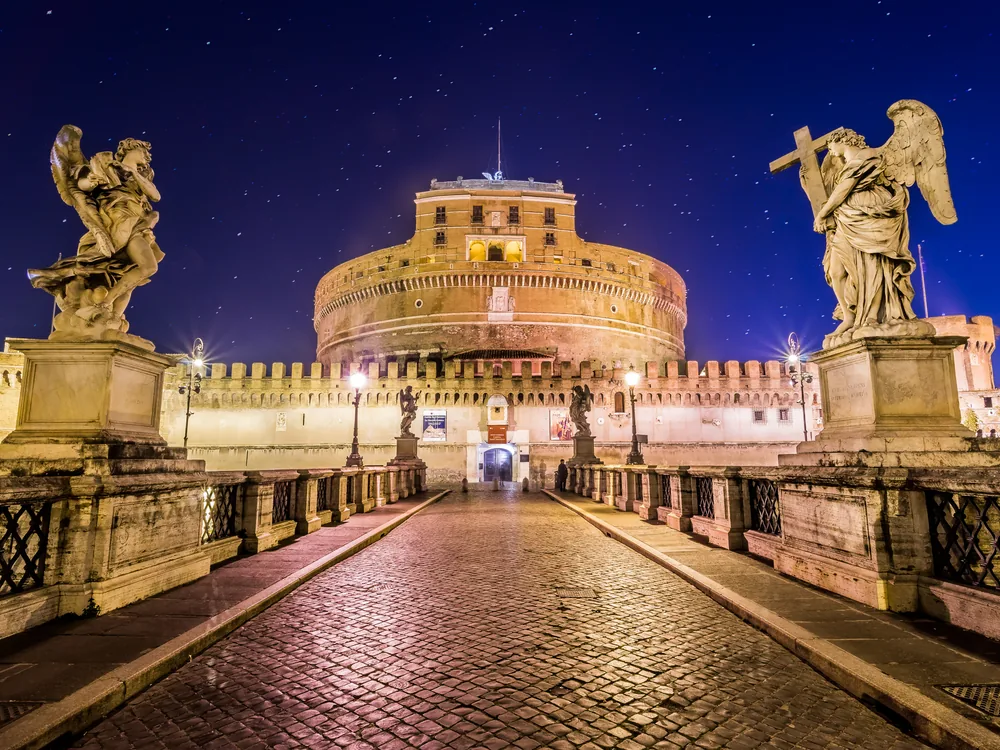
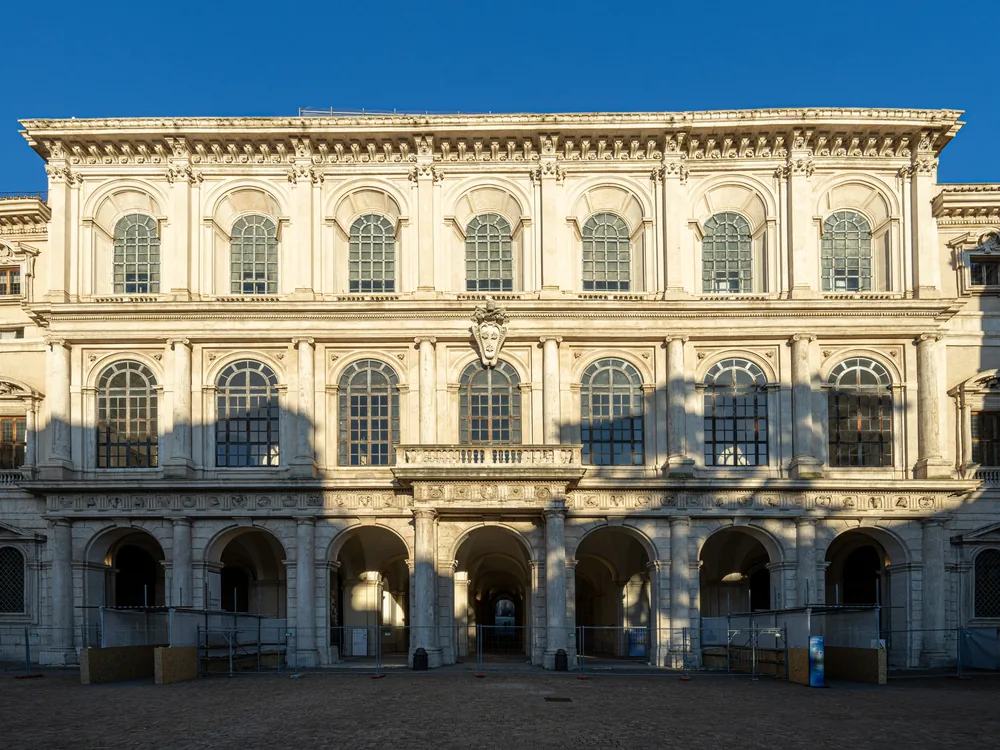
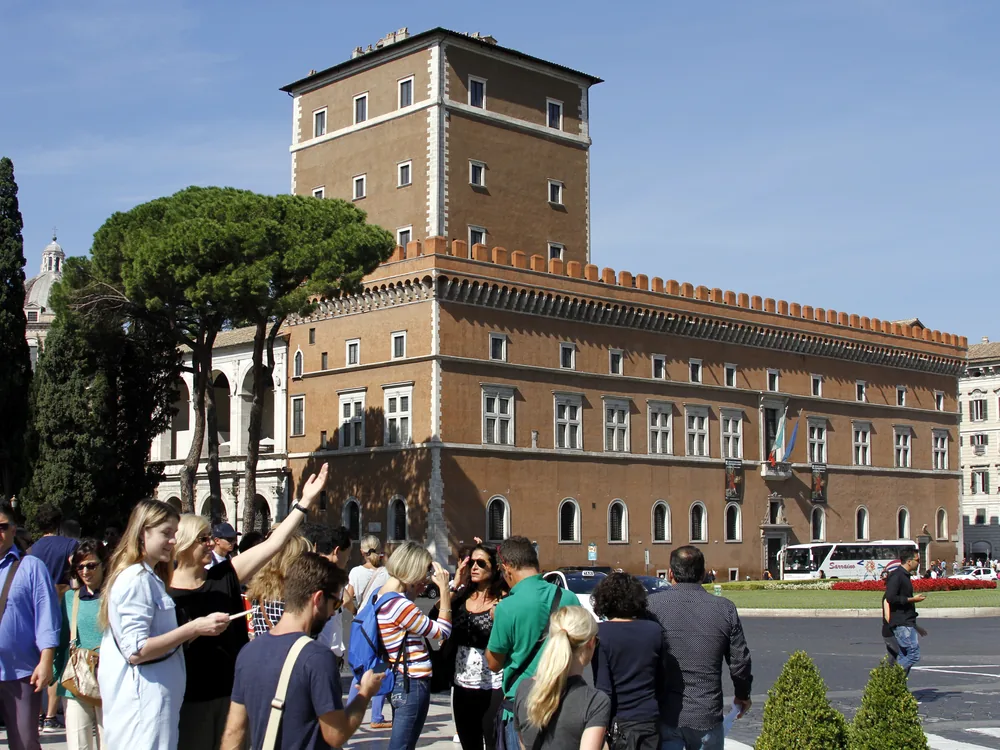
[Castel Sant'Angelo](/castles/italy/castel-santangelo), [Palazzo Barberini](/castles/italy/palazzo-barberini), and [Palazzo Venezia](/castles/italy/palazzo-venezia) in Rome, 50 kilometres south, represent the other principal strands of the Lazio palatial tradition — Castel Sant'Angelo as the mausoleum-turned-papal-fortress, Barberini and Venezia as the great Roman Baroque and Renaissance urban palaces. [The Boniface VIII Palace in Anagni](/castles/italy/boniface-viii-palace), in the Lazio hill towns east of Rome, anchors the medieval end of the regional spectrum.
History
Antonio da Sangallo the Elder began a pentagonal fortress on the hill above Caprarola for the Farnese family in the early 16th century — a project that was never completed and sat as a partial structure for decades. The family's fortunes changed dramatically when Alessandro Farnese became a cardinal in 1534, accumulating vast wealth through ecclesiastical appointments and papal connections. When Cardinal Alessandro Farnese engaged Jacopo Barozzi da Vignola in 1559 to convert the unfinished fortress into a summer residence, he gave Vignola one of the most unusual briefs in Renaissance architecture: transform a pentagonal military shell into a sophisticated courtly palace without demolishing what existed.
Vignola's solution was elegant: a circular internal courtyard fitted within the pentagonal plan, with a Scala Regia — a ceremonial helical ramp staircase — as the primary vertical connection between floors. The principal state rooms and the complete palace in its current form were achieved between 1559 and 1573. The fresco programme was begun by Taddeo Zuccari in 1563 but left incomplete when he died in 1566; his brother Federico Zuccari completed the Sala del Mappamondo and the remaining rooms. Cardinal Alessandro Farnese died in 1589, and the palace passed through successive Farnese family relations and eventually transferred to Bourbon Naples.
The Italian Ministry of Culture (Polo Museale del Lazio) administers the palace as a national museum, open Tuesday to Sunday.
How to Visit
Getting there: Caprarola is ~50 km north of Rome in the Cimini Hills — by car via the Via Cassia the drive takes about 1 hour. By public transport take the Cotral train from Roma Ostiense to Viterbo Porta Romana (~2 hours), then an infrequent Cotral bus to Caprarola; check schedules in advance as the connection is difficult without a car. Viterbo, the nearest city, is 21 km northwest.
Tickets: Walk-up entry €5 adult; free on the first Sunday of each month under the Ministerio della Cultura free-access policy. The GetYourGuide private guided tour covers a 1.5-hour circuit of the interior and garden with entrance tickets included — the fee primarily reflects the private guide rather than admission.
Practical tips: The palace is closed Mondays year-round; verify current hours at caprarola.beniculturali.it before making the trip. April to October is the best time to visit — the Mannerist terraced garden is in full display and the Cimini Hills are cooler than Rome in summer. Allow 1.5–2 hours for both the interior and the garden.
Combine with: Castel Sant'Angelo and Palazzo Barberini complete the wider Lazio palatial circuit in Rome, 50 km south.
Frequently Asked Questions
The Sala del Mappamondo (Room of the World Map) is the principal reception room of the piano nobile, painted entirely with 16th-century maps of the known world by Taddeo and Federico Zuccari. Every wall surface is covered with cartographic representations of Europe, Asia, Africa, and the Americas as they were understood in the 1560s — a period when the outlines of the continents were still being revised with each returning voyage. The combination of cartographic ambition, painted naturalism, and grotesque decorative framing makes it one of the most complete Renaissance painted-map programs in Italy. Cardinal Farnese, who had spent his career at the centre of a genuinely global political institution (the 16th-century papacy dealt with Spanish America, the Ottoman Empire, and the Chinese missions simultaneously), chose a room whose subject was the whole world as the literal centrepiece of his palace.
Location
Piazza Farnese 1, 01032 Caprarola VT, Italy
Nearby Castles
Tours & Tickets
Powered by GetYourGuide
From
€95/ person