
Villa del Principe
Villa del Principe (Palazzo del Principe)
Italy · Liguria — Genoa, Sampierdarena district (Via Adua), western edge of historic centre · Near Genoa
Built 1528 · Renaissance palace begun in 1528 on commission from Admiral Andrea Doria; the restrained exterior facade conceals the richness of the interior fresco programme; the decorative cycle by Perin del Vaga (c.1528–1547) follows the Roman High Renaissance vocabulary of Raphael's workshop — mythological narrative frescoes, grotesque decoration, illusionistic architectural framing, and sophisticated colour modelling; the garden loggia and terraced giardino pensile with sea views were integral to the original residential design and have been substantially restored
This page is part of an independent travel guide and is not affiliated with, endorsed by, or operated by Villa del Principe.
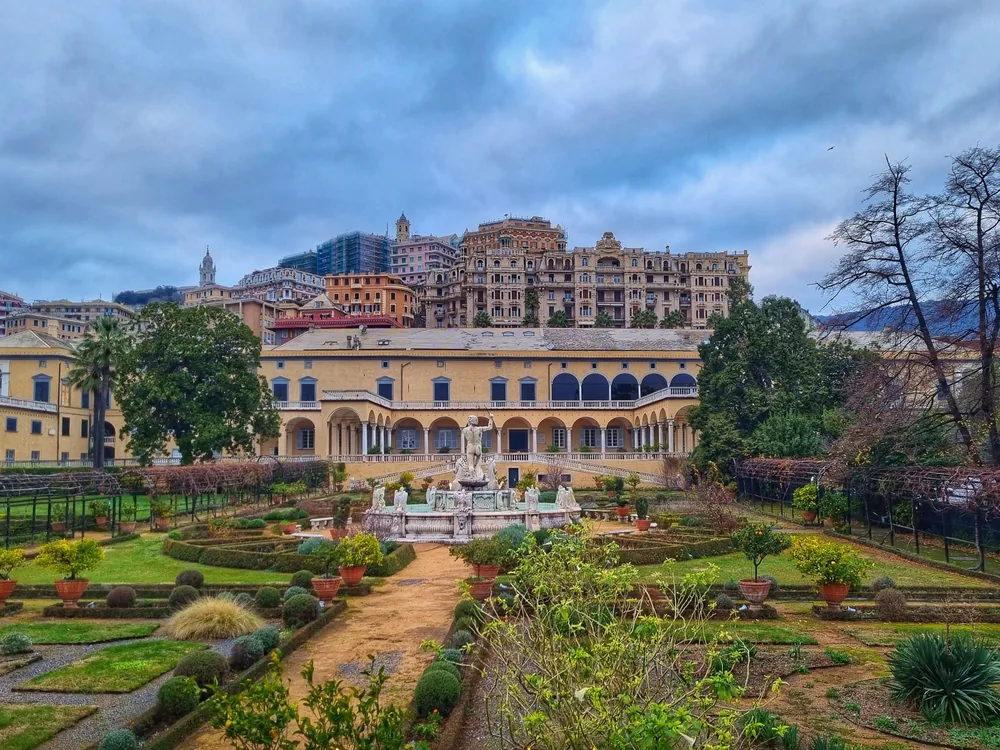
© Castles & Palaces
Quick Facts
- Hours
- Tue–Sun 10:00–18:00. Closed Mon
- Entry via GetYourGuide
- €15
- Duration
- 1.5–2 hours (self-guided)
- Best time
- Year-round
- Nearest city
- Genoa
Featured Tour
Genoa: Villa del Principe Museum Ticket
Cancellation available · Instant confirmation
Highlights
- ✦Perin del Vaga's fresco cycle (c.1528–1547) — considered the greatest achievement of Raphael's most accomplished student, a sustained programme of mythological and allegorical frescoes that established the visual vocabulary of Genoese Renaissance interior decoration for a generation
- ✦The Room of the Battle of Lepanto — added after the 1571 naval engagement in which the Doria fleet played a significant role, the room's fresco decoration records the Christian fleet's defeat of the Ottoman navy in the Gulf of Corinth; the most historically specific room in the villa
- ✦The Neptune and sea mythology rooms — the most celebrated section of Perin del Vaga's cycle, where mythological scenes of Neptune, Galatea, and marine allegories express Andrea Doria's identity as the dominant naval power of the western Mediterranean
- ✦The Italian Renaissance garden with loggia and sea views — the terraced giardino pensile restored to its original character, with views toward the Ligurian coast that Doria surveyed as Admiral; a rare example of a 16th-century Genoese palace garden in active preservation
- ✦Period furnishings, tapestries, and decorative arts — the villa retains authentic period objects in their original context, creating a layered domestic environment that the Baroque civic palaces of Via Garibaldi cannot match
Skip the queue with a guided tour
Skip-the-line tickets & expert guides
Villa del Principe — known formally as the Palazzo del Principe — occupies a position just west of Genoa's Piazza del Principe train station that understates its historical importance. Behind a restrained Renaissance façade, the villa opens into one of the finest programmes of Renaissance fresco decoration surviving in northern Italy: the cycle painted by Perin del Vaga between 1528 and the 1540s, on commission from Admiral Andrea Doria, the Genoese statesman and naval commander who dominated the western Mediterranean for three decades.
Andrea Doria commissioned the villa in 1528, the year he entered into service with the Holy Roman Emperor Charles V and engineered Genoa's new political constitution — simultaneously transforming the republic's government and beginning the construction of the residence that would express his personal power. He chose Perin del Vaga, one of the most accomplished students of Raphael and a survivor of the Sack of Rome in 1527, as the primary painter for the interior. The Genoese fresco cycle that Perin del Vaga produced over the subsequent decade is considered his finest sustained achievement and one of the most important bodies of Renaissance fresco work outside Rome and Florence.
The fresco rooms span the full scope of Doria's self-presentation. The Neptune and sea mythology rooms — where mythological scenes of Galatea, marine allegories, and images of naval dominion express Doria's identity as the pre-eminent naval power of his age — are the most celebrated. The Room of the Battle of Lepanto (1571), added after Doria's death, records the naval engagement in which the Christian fleet defeated the Ottoman navy in the Gulf of Corinth; it is the most historically specific room in the villa and connects the building's decorative programme directly to the defining event of 16th-century Mediterranean history.
The Italian Renaissance garden — a loggia and terraced giardino pensile with views toward the Ligurian coast — has been substantially restored and remains accessible as part of the museum visit. The villa's historic furnishings, tapestries, and decorative objects are displayed in their original context, creating a layered domestic environment that the Baroque civic palaces of Via Garibaldi cannot match.
For visitors to Genoa, Villa del Principe is the essential Renaissance complement to the Baroque palazzi of Via Garibaldi and the Musei di Strada Nuova. It occupies an older and more intimate register — anchored to a specific historical personality — that the Baroque civic palaces cannot provide. The GetYourGuide entry ticket provides walk-up museum access on a single-admission basis.
History
Andrea Doria was the defining figure in 16th-century Genoese politics — a naval commander whose victories for France and later for Charles V gave him leverage over the major powers of the Mediterranean, and who used that leverage to reshape Genoa's constitution in 1528 along aristocratic lines that would persist for two centuries. The villa he began that year was not a neutral architectural exercise; it was a permanent marker of his position in the Genoese landscape, constructed at the precise moment of his greatest political achievement.
He retained Perin del Vaga, freshly arrived in Genoa after the trauma of the 1527 Sack of Rome, as the primary painter for the interior. The painter remained in Doria's service for more than a decade, producing the fresco cycle that made the villa famous across the Italian states and established Perin del Vaga's reputation as the foremost decorator working outside Rome.
The palace passed to the Doria Pamphilj family — the great Roman branch of the Doria line — who maintained it through the subsequent centuries as a secondary residence. Their custodianship, rather than redevelopment, preserved the villa's original 16th-century fresco programme in a condition that makes it legible today. The villa was opened as a public museum in the 20th century, managed under the supervision of the Doria Pamphilj family trust, with the rooms retaining authentic period furnishings, tapestries, and the decorative objects that Doria and his successors accumulated.
How to Visit
Getting there: Villa del Principe is immediately adjacent to Genova Piazza Principe railway station — one of Genoa's two main stations, served by regional and Intercity trains from Milan (approximately 1.5 hours), Turin (approximately 1.5 hours), La Spezia, and the Ligurian coastal towns. Exit the station and the villa entrance is within two minutes' walk on Piazza del Principe. From the historic centre (Via Garibaldi, the Caruggi), the villa is approximately 15 minutes on foot westward or 5 minutes by bus.
Tickets: Walk-up admission is €15 for adults, €7 for children, covering all fresco rooms, period furnishings, and the garden. The GetYourGuide entry ticket provides the same single-admission access with the convenience of advance booking — useful in high season (May–September) when timed entry slots can fill; booking a few days ahead is recommended for summer visits.
Practical tips: Allow at least 1.5 to 2 hours to engage properly with the fresco rooms — the Perin del Vaga cycle is the reason to visit, and it rewards close attention. The Neptune rooms and the Lepanto room deserve unhurried time. The garden loggia is a pleasant complement to the palace rooms and is at its best April through October; the sea-view aspect is partly obscured by post-war urban development but remains evocative.
Combine with: Palazzo Doria Pamphilj — the Doria Pamphilj family's other major Genoese palace, which provides the civic counterpart to the more intimate domestic atmosphere of Villa del Principe.
Frequently Asked Questions
Perin del Vaga (1501–1547) was one of the most accomplished painters to emerge from Raphael's Roman workshop — a figure whose talents Raphael himself recognised and who absorbed the full technical repertoire of the High Renaissance before the Sack of Rome in 1527 dispersed the workshop's members. The Genoese fresco cycle at Villa del Principe, begun for Andrea Doria in 1528, is Perin del Vaga's greatest sustained achievement and one of the most important bodies of Renaissance fresco work outside Rome and Florence. Its survival in relatively good condition — owing to the Doria Pamphilj family's long custodianship — makes Villa del Principe the primary destination in Liguria for anyone seriously interested in the transmission of the Roman Renaissance style to northern Italy.
Location
Piazza del Principe, 4, 16126 Genova GE, Italy
Nearby Castles
Tours & Tickets
Powered by GetYourGuide
From
€15/ person