
Soroca Fortress
Cetatea Soroca
Moldova · Soroca District, northern Moldova, on the Dniester River at the Ukrainian border · Near Soroca
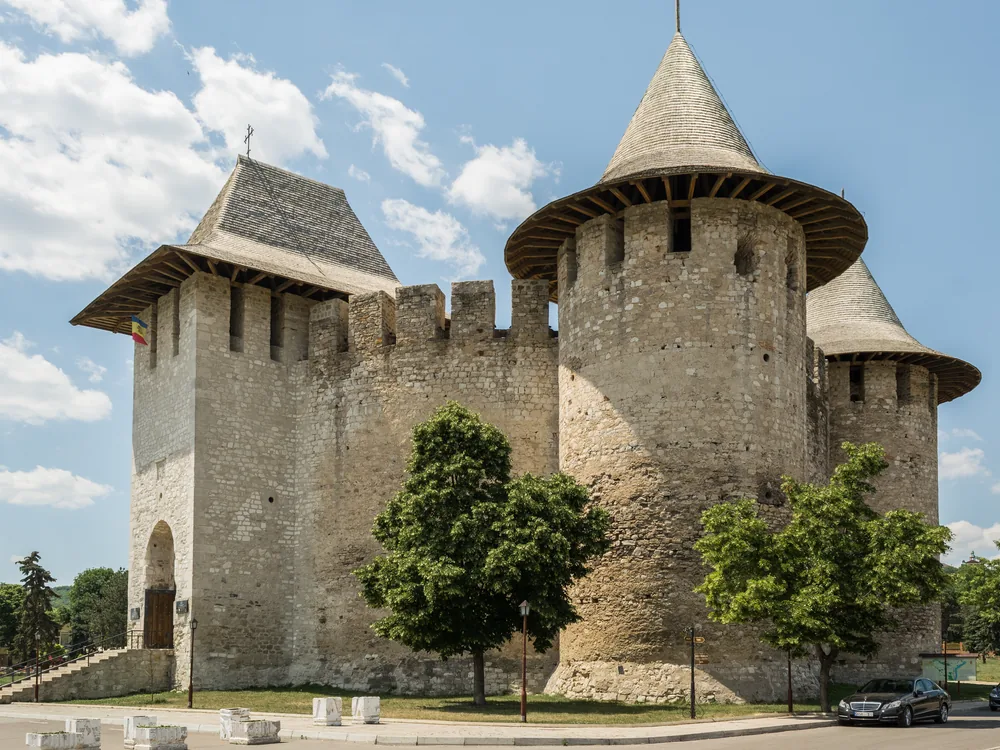
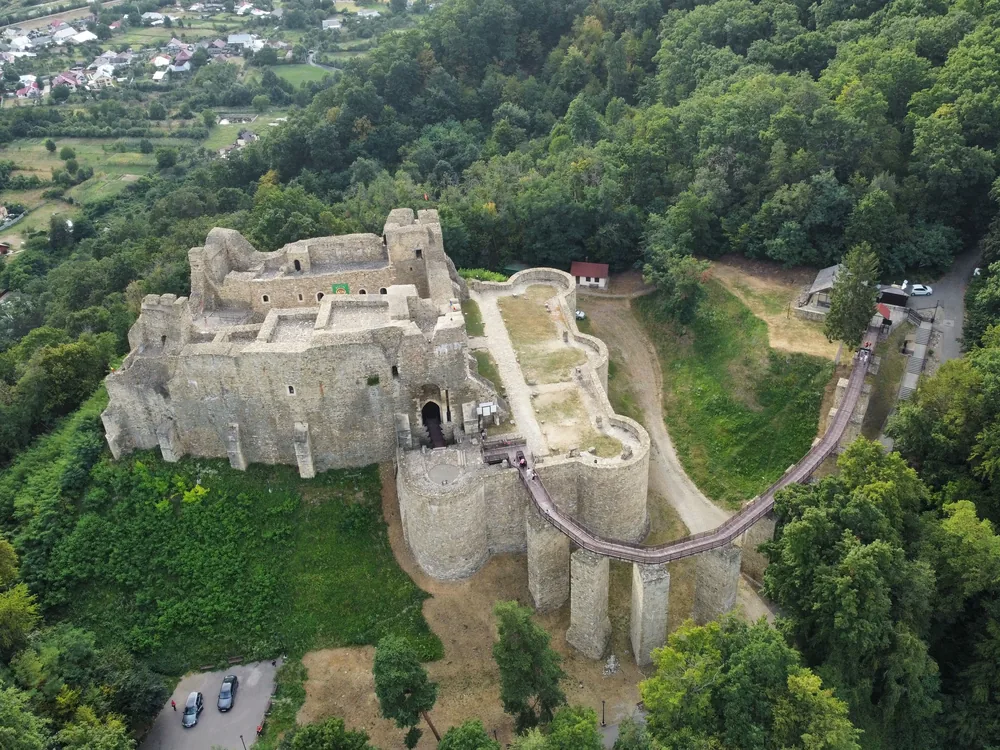
Built 1499 · Round bastioned fortress of the early Renaissance, circular plan with five semicircular bastion towers — first built in wood and earth in 1499 under Moldavian voivode Stephen the Great (Ștefan cel Mare) as part of his chain of Dniester fortifications; rebuilt in stone by Petru Rareș in the 1540s into its current distinctive circular form with five semicircular bastions equally spaced around the perimeter, a plan influenced by early Italian Renaissance military engineering (the circular bastioned plan was one of the experimental forms that preceded the angular star-fort geometry that became dominant in the late 16th century); the stone walls, approximately 2 metres thick, and the five towers have survived to a remarkable state of preservation; the interior of the circular courtyard is approximately 34 metres in diameter; the fortress stands on a terrace above the Dniester, with the river visible below
This page is part of an independent travel guide and is not affiliated with, endorsed by, or operated by Soroca Fortress.
© Castles & Palaces
Quick Facts
- Hours
- Mon–Fri 09:00–17:00. Sat & Sun 09:00–18:00
- Guided tour from
- €220
- Duration
- 1–1.5 hours (fortress interior and walls) plus 30–45 minutes for the Candle of Gratitude monument and Dniester viewpoint on the hilltop above
- Best time
- May to September
- Nearest city
- Soroca
Featured Tour
Soroca Day Tour – Moldova's Fortress of Legends
Cancellation available · Instant confirmation
Highlights
- ✦Stephen the Great (Ștefan cel Mare) — medieval Moldova's most celebrated ruler — Stephen the Great, who ruled the Principality of Moldavia from 1457 to 1504, built Soroca Fortress as part of a chain of defensive fortifications along the Dniester River; he is the defining historical figure of Moldovan national identity, credited with more than 40 military victories and the construction of numerous fortresses and churches; the Moldovan state celebrates him as its national hero, and his name and image appear throughout the country; a visit to Soroca Fortress is in part a visit to his longest-lasting physical legacy
- ✦One of Europe's finest surviving circular bastioned fortresses — the round form rebuilt in stone by Petru Rareș in the 1540s, with five semicircular bastions equally spaced around a circular perimeter, is one of the experimental defensive forms of the early Renaissance period before angular star-fort geometry became dominant; the survival of Soroca's circular plan, walls, and towers to a high state of preservation makes it exceptional among early modern fortifications in Eastern Europe
- ✦The Candle of Gratitude (Lumânarea Recunoștinței) — a 30-metre monument on the hilltop above Soroca — built in 2004, the Candle of Gratitude stands on the hill above the Dniester River opposite the fortress, commemorating Moldovan victims of war, famine, and Soviet-era deportations; the monument's hilltop position gives panoramic views over the Dniester, across the border into Ukraine, and back down to the fortress; the combination of a medieval fortress and a 21st-century memorial to historical suffering gives Soroca a layered historical weight unusual in so small a city
- ✦The Dniester River border landscape — Soroca stands directly on the Dniester, which forms the border between Moldova and Ukraine at this point; the river is visible from the fortress walls and from the hilltop monument; the border landscape has been contested and significant throughout the history of the region, from the medieval Moldavian principality through the Ottoman, Russian, and Soviet periods to the present
- ✦A city with a distinctive Romani heritage — Soroca is widely known in Moldova for its concentration of elaborately designed houses built by wealthy members of the Romani community, whose distinctive ornamental architecture reflects a tradition of expressive vernacular construction; these buildings, concentrated in a specific part of the city, are a genuinely unusual cultural landmark; respectful observation as part of a city walk extends the Soroca visit beyond the fortress into living community heritage
Skip the queue with a guided tour
Skip-the-line tickets & expert guides
The Dniester River has always been a frontier. For the medieval Principality of Moldavia — the Romanian-speaking state that occupied the region between the Carpathians and the Black Sea from the 14th century — the Dniester was the eastern boundary, separating Moldavian territory from the steppe and the powers that periodically crossed it: Tatars, Lithuanians, Ottomans. Stephen the Great, who ruled Moldavia from 1457 to 1504 in one of the most militarily active and politically successful reigns in the principality's history, understood the Dniester's strategic significance and built accordingly. Soroca Fortress, first established in 1499, was one of several fortifications he placed along the river to give the principality advance warning of crossings and a point of organised resistance when they came.
The fortress that Stephen built was initially in wood and earth — the speed of construction was the priority, and the Dniester frontier needed to be secured quickly. The durable stone structure that visitors see today was built in the 1540s, under Petru Rareș, who rebuilt the Soroca fortification in its distinctive circular form. The circular plan — five semicircular bastions equally spaced around a circular perimeter, with walls approximately two metres thick — was an experimental form in the early Renaissance military engineering of the period, a time when architects and military theorists across Europe were working out the implications of gunpowder for defensive construction. The angular star fort, with its projecting bastions designed to eliminate dead ground and provide flanking fire, would become the dominant form by the late 16th century; the round bastioned plan at Soroca represents an earlier experimental phase, when the geometric solutions to the gunpowder problem were still being worked out.
The survival of the fortress to its current state of preservation is remarkable. The walls, the five towers, and the basic structure of the circular courtyard — approximately 34 metres in diameter — are largely intact, which puts Soroca in a very small class of early Renaissance fortifications in Eastern Europe that have not been substantially destroyed or rebuilt into unrecognisability. Moldova's relative distance from the main paths of Central European development and destruction has, paradoxically, contributed to the preservation of monuments that more accessible sites might have lost to later construction or conflict.
Above the fortress, on the hilltop that looks across the Dniester toward Ukraine, stands the Candle of Gratitude (Lumânarea Recunoștinței) — a 30-metre monument completed in 2004 to commemorate Moldovan victims of war, famine, and the Soviet-era deportations that removed tens of thousands of Moldovans to Siberia and Central Asia in the 1940s and 1950s. The monument's form — a stylised candle flame in stone — and its position on the hilltop above the river give it panoramic views in all directions: the Dniester below, the Ukrainian side of the river beyond, the fortress on its terrace, and the city of Soroca in the valley. The combination of a medieval fortress and a 21st-century memorial to historical trauma in the same short walk gives Soroca a historical density that its modest size does not initially suggest.
Soroca's identity includes another dimension worth noting. The city is widely known in Moldova for its concentration of elaborately designed homes built by members of the Romani community, whose distinctive ornamental architecture — large-scale houses with elaborate facades, towers, and decorative elements reflecting a tradition of expressive vernacular construction — has made a specific part of Soroca visually distinctive in a way that is genuinely unusual in the region. This community heritage, approached respectfully as part of a city walk, extends the Soroca visit beyond the fortress into living cultural history.
The GYG day tour from Chișinău (t1329604) covers the fortress and the Candle of Gratitude in a seven-hour guided programme for small groups (maximum seven people), with skip-the-line access and transportation included. It is the most practical way to visit Soroca from the Moldovan capital without a private vehicle.
History
Stephen the Great (Ștefan cel Mare), who ruled the Principality of Moldavia from 1457 to 1504, was the most prolific builder of Dniester fortifications in Moldavian history — constructing and reinforcing multiple positions along the river to defend against Ottoman, Tatar, and Polish-Lithuanian pressure. Soroca Fortress was first established in wood and earth under his direction in 1499 as a defensive position at one of the Dniester's most strategically sensitive crossings.
The transformation into the building that survives today came in the 1540s, when Petru Rareș rebuilt Soroca in stone with the current circular plan and five semicircular bastions — a design that was among the most sophisticated fortress geometries in the eastern European frontier architecture of the period. Through the 16th and 17th centuries the fortress was in active use defending the Moldavian principality, surviving multiple sieges and a major Ottoman campaign in 1538. As the Principality of Moldavia fell under Ottoman suzerainty in the 17th and 18th centuries, the Dniester fortifications gradually lost their primary defensive function.
The Russian Empire absorbed the region as Bessarabia in the 19th century, and the fortress fell into disuse as a military installation. Bessarabia was part of the Kingdom of Romania from 1918 to 1940 and again from 1941 to 1944, then Soviet-annexed. The Candle of Gratitude monument was built on the hilltop above the Dniester in 2004 to commemorate victims of war, famine, and Soviet deportations. The fortress is now administered as a heritage museum, open year-round.
How to Visit
Getting there: Soroca is 160 km north of Chișinău — roughly 2.5 to 3 hours by car on the R2 highway. Marshrutka (shared minibuses) depart from Chișinău's North Bus Terminal (Autogara Nord) throughout the morning and take 3 to 4 hours; the fare is around 70 MDL (approximately €3.50). The fortress is in the centre of Soroca, a 5-minute walk from the bus station on the Dniester riverbank.
Tickets: Walk-up entry €3 adult, €1 child. The GYG tour (t1329604, from €220) — a 7-hour small-group day trip from Chișinău (maximum 7 people) covering the fortress and the Candle of Gratitude monument with transport and a historical guide included — is the most practical option for visitors without a car; book in advance.
Practical tips: After the fortress, allow 15 to 20 minutes to walk uphill to the Candle of Gratitude monument — the panoramic views over the Dniester into Ukraine and back across the fortress are the best in the area. Add another hour for a respectful walk through the part of the city known for its elaborately designed Romani community homes, a genuinely unusual architectural landscape. Winter hours at the fortress may be reduced; confirm before travelling.
Combine with: Soroca is currently the only Moldovan fortress on Castles & Palaces. For a multi-day Moldova trip, the cave monastery complex at Orheiul Vechi (40 km north of Chișinău) makes a natural companion, and the GYG day tour already pairs the fortress with the hilltop Candle of Gratitude in a single excursion.
Frequently Asked Questions
Stephen the Great (Ștefan cel Mare, c. 1429–1504) ruled the Principality of Moldavia from 1457 to 1504 — 47 years of continuous rule that transformed Moldavia into one of the most effective military states in Eastern Europe of the period. He defeated Polish, Hungarian, Ottoman, and Tatar forces across more than 40 military engagements, built numerous fortresses along the Dniester and other frontier rivers, and commissioned the construction of dozens of churches and monasteries as acts of commemoration and thanksgiving after victories. The Moldovan state regards him as its founding national hero — his portrait appears on Moldovan currency, his name is given to institutions, streets, and public spaces, and he was canonised by the Romanian Orthodox Church in 1992 as a saint. Soroca Fortress is one of his most physically durable legacies.
Location
Cetatea Soroca, str. Cetății 1, Soroca, Moldova
Nearby Castles
Tours & Tickets
Powered by GetYourGuide
From
€220/ person