
Guaita Tower
Torre Guaita (Prima Torre)
San marino · City of San Marino, Republic of San Marino · Near Rimini
11th century · Medieval limestone defensive tower on the western peak of Mount Titano — the oldest of San Marino's Three Towers (Guaita, Cesta, Montale); a three-storey circular tower with an outer and inner defensive wall circuit added in the 14th–15th centuries; Romanesque-Apennine military construction on a cliff-edge position 739 metres above sea level
This page is part of an independent travel guide and is not affiliated with, endorsed by, or operated by Guaita Tower.
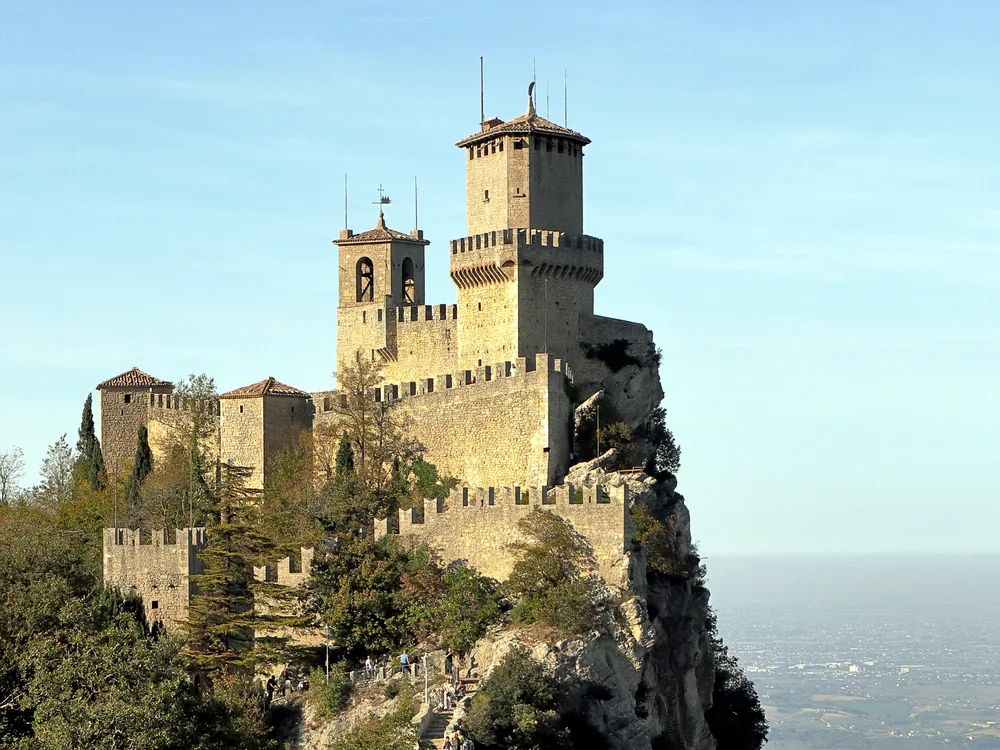
© Castles & Palaces
Quick Facts
- Hours
- Daily 09:00–18:00
- Guided tour from
- €45
- Duration
- 1–2 hours (tower alone); allow 3–4 hours with the historic centre and second tower
- Best time
- April to October
- Nearest city
- Rimini
Featured Tour
San Marino: Small-Group Guided Tour with 7-Museum & Towers Pass
Cancellation available · Instant confirmation
Highlights
- ✦Oldest surviving defensive structure in the Republic of San Marino — the Prima Torre, first built in the 11th century on the western peak of Mount Titano, with outer wall circuits added in the 14th–15th centuries against the expansionist Malatesta lords of Rimini
- ✦Part of the UNESCO World Heritage Site 'San Marino Historic Centre and Mount Titano' — inscribed in 2008 as exceptional testimony to the development of democratic self-governance over seven centuries
- ✦Panoramic views across the Adriatic Plain — on clear days the Adriatic Sea is visible 25 kilometres to the northeast, with the flat coastline of Romagna, the Po Valley, and the Italian Apennines all visible from the cliff-edge battlements
- ✦Medieval prison preserved in the lower levels — the tower served as San Marino's state prison for centuries (the last prisoner was released in 1975); the original dungeon cells and restraints are preserved as a visitor exhibit
- ✦Combined ticket with Cesta Tower — the two accessible towers of San Marino are visited together on the standard combined ticket; the GetYourGuide guided tour adds five further museums plus guided walking context for the Republic's unusual history
- ✦San Marino's coat of arms and flag — the silhouettes of the Three Towers (Guaita, Cesta, Montale) appear on both the national flag and the coat of arms; the towers are the defining symbols of the world's oldest republic
Skip the queue with a guided tour
Skip-the-line tickets & expert guides
The Guaita Tower — Prima Torre in Italian, the First Tower of San Marino — stands at 739 metres above sea level on the western peak of Mount Titano, the three-peaked limestone ridge that defines the tiny Republic of San Marino's landscape and national identity. It is the oldest, largest, and most photographed of San Marino's Three Towers (Tre Cime di San Marino): Guaita, Cesta (on the second summit), and Montale (on the third). Together they appear on the Sammarinese flag and coat of arms, having served simultaneously as the Republic's primary defence, its prison, and its enduring symbol for more than 900 years.
San Marino occupies a place unique in European history: founded, according to tradition, in 301 AD by a Christian stonemason named Marinus fleeing Diocletian's persecution, it claims to be the world's oldest republic still in existence — a constitutional democracy that predates every other surviving democratic state by more than a millennium. This claim is difficult to verify in every detail, but the Republic has maintained uninterrupted self-governance under a succession of constitutional forms since at least the 13th century, when its earliest surviving statutes were codified. The country's survival amid the Italian peninsula's centuries of warfare — through the conflicts of medieval city-states, through the Papal States, through Napoleon's conquest of Italy, through the Risorgimento and two World Wars — is in itself remarkable, and the Three Towers on Mount Titano were the instrument of that survival: an elevated, defensible position that made San Marino harder to take than the military gain was worth.
The Guaita Tower's construction date is placed in the first half of the 11th century, though the precise year is not documented. The original structure was a single defensive tower on the cliff edge; additional defensive walls and an outer circuit were added in the 14th and 15th centuries as military technology evolved and the threat from the Malatesta lords of Rimini — who controlled the plain directly below Mount Titano and sought repeatedly to incorporate San Marino into their territories — increased in urgency. The double ring of walls visible today dates primarily from this later medieval period.
The tower's lower level served as a prison through much of San Marino's medieval and early modern history. This is one of the more unexpected aspects of the site: a fortress that symbolises freedom and self-determination on the national coat of arms also housed its state prisoners for 700 years. The last prisoner was released in 1975. The original dungeon cells, with their stone walls and remaining restraints, are preserved inside and form part of the visitor circuit. The contrast between the tower's panoramic views from above and its subterranean detention function below is one of the more haunting combinations in any European castle site.
The UNESCO World Heritage inscription — 'San Marino Historic Centre and Mount Titano,' inscribed in 2008 — covers the Three Towers and the historic centre of the City of San Marino together as a single Outstanding Universal Value. The inscription recognises the ensemble as exceptional testimony to the development of representative democracy and the evolution of a self-governing community from the medieval period onward. The value of the site is primarily political and cultural: these towers are the physical apparatus of the world's oldest surviving self-governing state, and the views from their battlements have meant, for the Sammarinese, something beyond the merely scenic.
The view from the tower explains immediately why this promontory was worth defending. On a clear day the Adriatic Sea is visible 25 kilometres to the northeast, the flat coastal plain of Romagna extending between the mountain and the sea, with the Po Valley beyond. The Apennine ridgeline runs south. Rimini, directly below in the plain, is clearly visible — the San Marino-Rimini cable car (Funivia) connects the Adriatic coast to the City of San Marino above, making day visits from the coastal resorts straightforward and keeping the towers busy throughout the summer season.
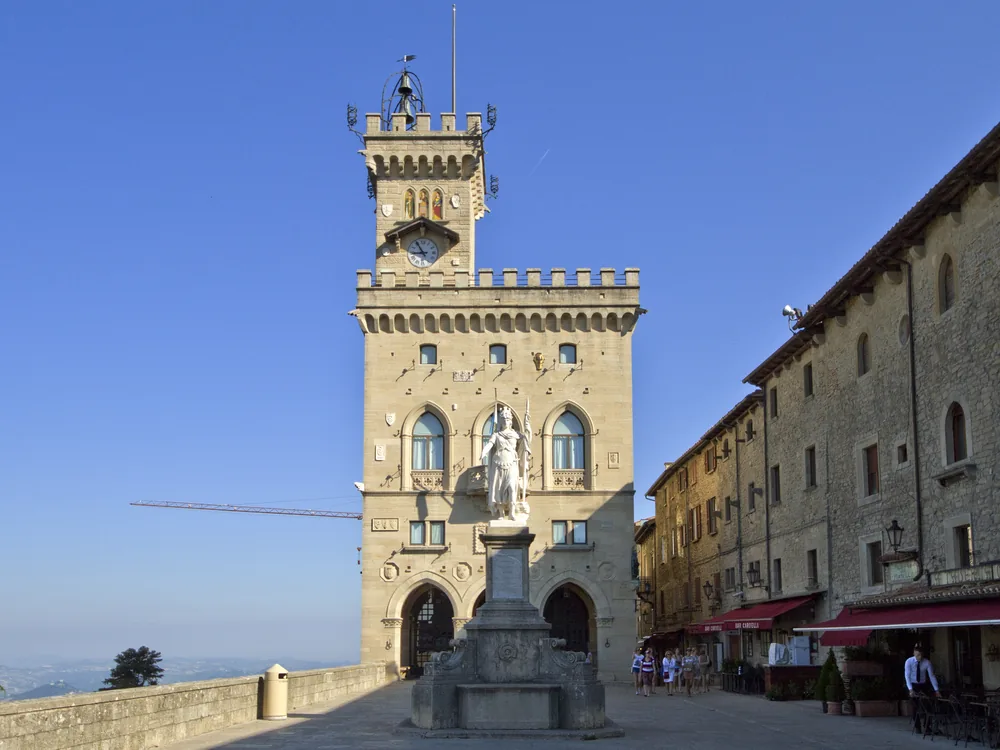
The tower circuit — walking the perimeter walls between the first and second peaks — takes 1–2 hours. Montale, the third tower, is not open to the public (it serves a municipal function). The City of San Marino below, with its medieval streets, the Palazzo Pubblico where the two Capitani Reggenti (San Marino's co-heads of state, rotated every six months) hold office, and the multiple state museums, adds a full afternoon to any tower-focused visit.
The most important context for understanding the Guaita Tower is the Sammarinese political tradition it has defended. The Republic has no standing army in the conventional sense, no nuclear deterrent, and sits entirely surrounded by Italy. It has survived because it has consistently been cheaper to leave alone than to conquer — and because the mountain, the towers, and the civic determination behind them have at every critical moment made that calculation tip toward leaving it alone.
History
Marinus establishes a Christian community on Mount Titano, traditional date 301 AD. Earliest documentary evidence of self-governance from the 11th–12th centuries. Guaita Tower first constructed in the 11th century. Outer defensive wall circuit added 14th–15th centuries against Malatesta expansion. San Marino repels multiple attempts at annexation through the medieval period. Napoleon offers to extend San Marino's territory (1797) — the offer is declined. San Marino provides refuge to Garibaldi (1849) during the Risorgimento. Both World Wars: San Marino maintains formal neutrality; briefly bombed by the British (1944) in error. UNESCO World Heritage inscription 2008. Last prisoner in Guaita Tower released 1975.
How to Visit
Getting there: San Marino has no airport or railway station. Buses run from Rimini railway station (Bonelli Bus, approximately 45 minutes). By car, take the A14 motorway to Rimini Nord, then the SS72 west into the republic (30 km from the coast). The cable car (Funivia) from Borgo Maggiore at the base of Mount Titano connects to the City of San Marino in about 3 minutes and operates roughly 07:15 to 20:45 — a more scenic arrival than driving.
Tickets: Walk-up entry €9 adult, €5 child (combined Guaita + Cesta ticket, purchased at the gate). The GetYourGuide tour — a small-group guided walking tour of the historic centre covering Guaita Tower, Cesta Tower, the Palazzo Pubblico, the State Museum, the San Francesco Art Gallery, the National Gallery, and the Stamp and Coin Museum; strongly recommended for first-time visitors who want historical context for the world's oldest republic — book in advance.
Practical tips: The Palazzo Pubblico (seat of the two Captains Regent, San Marino's rotating co-heads of state) is free to enter and well worth the visit alongside the towers. The tower approach from the City of San Marino is on steep cobblestones — wear comfortable footwear. Mornings are quieter before day-trippers arrive from the Adriatic coast resorts; summer afternoons can be very crowded.
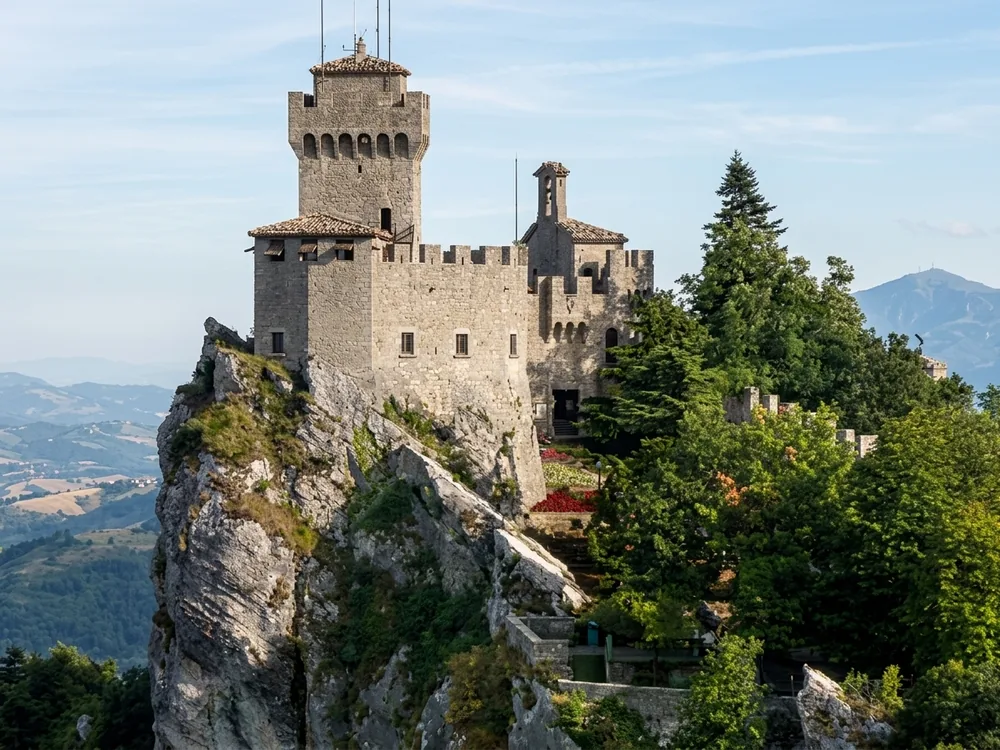
Combine with: The Cesta Tower (Seconda Torre) on Mount Titano's second peak is included in the same combined entry ticket and takes 30 minutes to add to the circuit. The medieval streets and the Palazzo Pubblico in the City of San Marino below the towers round out a full half-day in the republic.
Frequently Asked Questions
San Marino's constitution (the Statutes of 1600) is the world's oldest written constitution still in effect. The Republic's uninterrupted self-governance since at least the 13th century — with no conquest, no absorption into a larger state, and no interruption of its constitutional order — is uniquely long for any surviving democratic entity. Most European republics postdate the French Revolution (1789); San Marino predates it by half a millennium. The constitutional documents are held in the State Archives and are inscribed on UNESCO's Memory of the World register.
Location
Contrada della Guaita, 47890 San Marino
Nearby Castles
Tours & Tickets
Powered by GetYourGuide
From
€45/ person