
Departing from Vilnius
From Vilnius: Kaunas & Nemunas River Castles Tour
Four castles in one day along Lithuania's medieval frontier river — the Teutonic Order built them all, and Lithuania took them back
From
€231/ person
Duration
Full Day · 10 hours
Languages
English
Group size
Max 7 people
About This Tour
The Nemunas River is Lithuania's longest waterway — 936 kilometres from its Belarusian source through the Lithuanian heartland to the Curonian Lagoon and the Baltic Sea. For nearly two centuries, the Nemunas was also the principal military frontier between the Grand Duchy of Lithuania and the Teutonic Order, the German crusading brotherhood that had established control of Prussia and was pressing eastward into Lithuanian territory with papal backing. Every one of the four sites on this circuit was either a Teutonic Order installation or was built directly on the site of one. The Nemunas River Castles tour is, in effect, a single-day survey of what the longest sustained military conflict in medieval European history left behind in brick and stone along one river.
The tour begins at the Nemunas-Neris confluence — the geographic chokepoint that determined where the city of Kaunas would be built and why a castle there mattered enough to make it the first brick military structure the Grand Duchy of Lithuania ever constructed. Kaunas Castle, built in the early 1360s, was a rectangular Gothic fortress with round corner towers and walls up to 2.5 metres thick, designed specifically to block the Teutonic Order's access to the river corridor into the Lithuanian heartland. It was tested almost immediately: in 1362, Teutonic Knights besieged the new castle under the defence of Prince Vaidotas — one of the earliest named commanders in documented Lithuanian military history — and succeeded. Approximately one-third of the original circuit survives as a museum. It is the most historically significant medieval brick fortification in Lithuania and one of the least internationally known.
Nine kilometres northwest on the Nevėžis tributary, Raudondvaris Manor carries four distinct centuries of ownership in a single red-brick building. The site began as the Teutonic Order's Königsburg — garrisoned with 80 knights and 400 soldiers — before passing to Lithuanian royal hands after the Battle of Grunwald in 1410. In 1549, Sigismund II Augustus gave it to his wife Queen Barbara Radziwiłł, whose brief and controversial marriage to the King had generated a constitutional crisis in the Sejm; she had the red-brick manor built that named the surrounding village (Raudondvaris means Red Manor in Lithuanian) and died there two years later, aged thirty. In the 19th century, Count Tyszkiewicz rebuilt the manor as a Gothic Revival residence and reportedly assembled one of the finest private art collections in the Grand Duchy — works attributed to Leonardo da Vinci, Rubens, Caravaggio, and Jan Matejko — before the family fled the advancing Russian front in 1915 and the collection was scattered. The surviving round tower on the southern side of the complex is believed to be the oldest physical element on the site, predating every subsequent rebuild.
Further down the Nemunas, Raudonė Castle began as Bayersburg — the Teutonic Order's Bavarian Castle on the commanding high ground above the river. After Grunwald, Sigismund II Augustus granted the site to Krispin Kirschenstein, a Prussian merchant, who built the Renaissance manor and the 34-metre cylindrical tower that remains Raudonė's most distinctive feature. The tower is intact and climbable: from the top, the Nemunas floodplain extends to the horizon in both directions — the same view the Teutonic garrison once watched for Lithuanian raiding parties. The architect Laurynas Stuoka-Gucevičius — best known for designing Vilnius Cathedral in its current Neoclassical form — later worked on the manor for the Olędzki family. The tower also carries the folk legend of the White Maiden of Bayersburg, a ghost said to appear on the staircase, documented in Lithuanian folklore collections and still associated with the castle by local people in the surrounding villages.
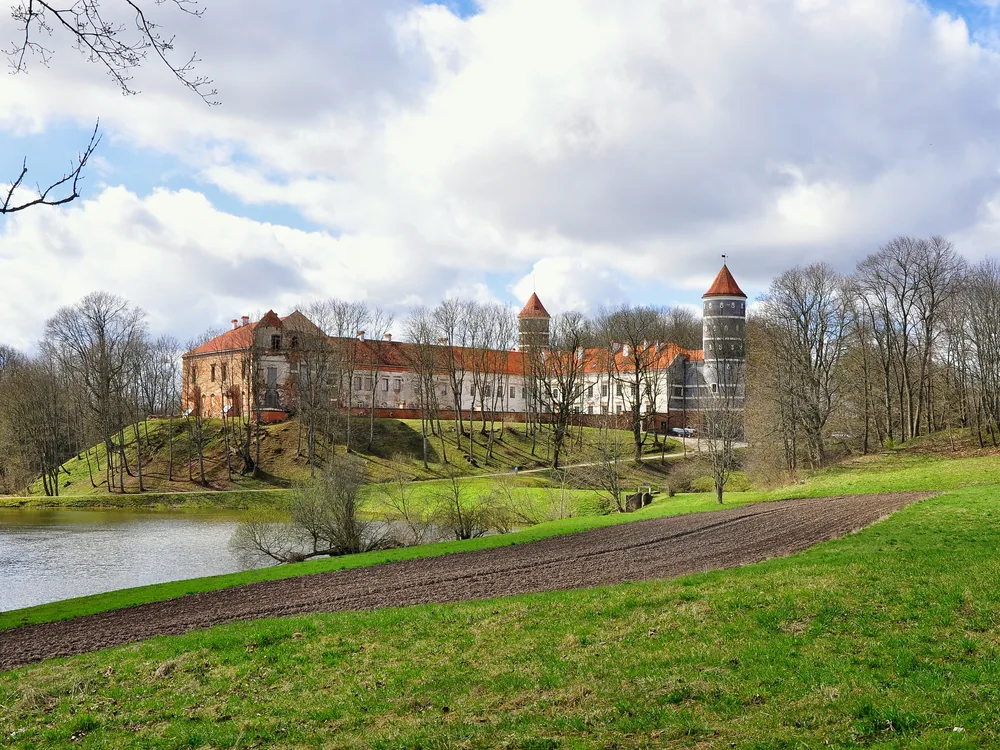
The final stop, Panemunė Castle, has the longest Teutonic pedigree of the four. The site's first documented structure was Christmemel, a Teutonic fortress established in 1313 at the mouth of the Jūra River — captured the following year by Grand Duke Vytenis in one of the earliest recorded Lithuanian military victories over the Order. The Renaissance-Baroque manor house built in 1604 by Peter Nonhardt, a Dutch-born architect working in the Polish-Lithuanian Commonwealth, replaced the military installation with a nobleman's country residence. Its most dramatic historical moment came in 1831, when the Tsarist authorities confiscated the estate immediately after its owner, Antanas Gelgaudas, died commanding the Lithuanian forces in the failed November Uprising against Russian rule — a punitive sequestration that ended 70 years of family ownership in a matter of days. Panemunė Castle is now managed by the Vilnius Academy of Arts as an exhibitions and residency venue.
The four sites share a structural arc: Teutonic frontier positions built during the Baltic Crusades that became Lithuanian royal gifts after Grunwald, then private aristocratic seats through the 16th to 19th centuries, then casualties of the 20th century's two occupations, and are now slowly recovering as heritage destinations in independent Lithuania. The tour runs for 10 hours, departs from Vilnius with an English-speaking guide and private transport, and includes a stop in Veliuona — a small historic town on the Nemunas between Raudonė and Panemunė — as well as lunch and refreshments. Maximum 7 guests. This is the richest single-day castle circuit currently available in Lithuania via GetYourGuide: four guided visits with four distinct architectural characters (Gothic fortress ruin, Gothic Revival manor, Renaissance manor with climbable tower, Baroque country house) and four separate historical stories that together constitute a coherent account of what the Teutonic-Lithuanian wars produced along the river that was their frontier for nearly two centuries.
Highlights
- ✓Four castle sites in a single day along the Nemunas River — the densest castle circuit available in Lithuania from Vilnius, covering 300 years of Teutonic Order and Grand Duchy history in one 10-hour tour
- ✓Kaunas Castle (1360s) — the first brick castle of the Grand Duchy of Lithuania, built at the Nemunas-Neris confluence to block the Teutonic Order; guided visit to the surviving western tower and museum
- ✓Raudondvaris Manor — Teutonic Order Königsburg, then Queen Barbara Radziwiłł's red-brick manor (1549), then the Tyszkiewicz family's Gothic Revival home and lost old-master art collection; the round tower believed to survive from the Teutonic period
- ✓Raudonė Castle — the Teutonic Bayersburg rebuilt as a Renaissance manor; the 34-metre cylindrical tower is climbable for the best view of the Nemunas floodplain on the entire circuit; the White Maiden ghost legend
- ✓Panemunė Castle (1604) — Dutch-designed Baroque manor on the site of the Teutonic Christmemel fortress (1313); confiscated by the Tsarist authorities in 1831 after its owner died leading the November Uprising; now managed by the Vilnius Academy of Arts
- ✓Small group (max 7), live English-speaking guide, lunch and refreshments included, private transport from Vilnius
Ready to book this tour?
Free cancellation · Instant confirmation
Itinerary
The first stop is Kaunas Castle on Pilies Street, at the precise confluence of the Nemunas and Neris rivers. Built in the 1360s as the Grand Duchy of Lithuania's first brick military structure, the castle was designed to block the Teutonic Order's primary route into the Lithuanian heartland via the Nemunas corridor. Besieged by Teutonic Knights in 1362 — while Prince Vaidotas commanded the defense — the castle became both the first significant Teutonic victory over a Lithuanian brick fortification and, after Grunwald (1410), an obsolete front-line position repurposed as an administrative centre. Approximately one-third of the original circuit survives: the western round tower and curtain wall sections house a museum with exhibits on 14th-century Lithuanian military history. The tour also includes time in the adjacent Kaunas Old Town before continuing southwest along the Nemunas.
Nine kilometres northwest on the Nevėžis tributary, Raudondvaris Manor's red brick has defined the site at every stage of its history: from the Teutonic Order's Königsburg (80 knights, 400 soldiers, established after 1392), through Queen Barbara Radziwiłł's 1549 residential manor — built during her brief and controversial marriage to Sigismund II Augustus, King of Poland and Grand Duke of Lithuania — to Count Tyszkiewicz's Gothic Revival rebuild of 1832–1855. The Tyszkiewicz family assembled a reportedly extraordinary art collection here (Leonardo, Rubens, Caravaggio, Matejko) that was dispersed after they fled the Russian front in 1915. A round tower on the southern side of the complex is believed to be the oldest surviving physical element, predating every subsequent rebuild and likely dating from the Teutonic period.
Raudonė Castle sits on high ground above the Nemunas where the Teutonic Order established Bayersburg in the early 14th century. The Renaissance manor and 34-metre cylindrical tower built by Krispin Kirschenstein in the late 16th century — after Sigismund II Augustus granted the post-Grunwald site to this Prussian merchant — are the current castle's defining features. The tower is intact and climbable; the view from the top covers the Nemunas floodplain in both directions and is the most extensive river-valley panorama accessible from any publicly open structure on the Lithuanian Nemunas. The architect Laurynas Stuoka-Gucevičius, who designed Vilnius Cathedral, worked here for a subsequent owner. The White Maiden of Bayersburg legend — a ghost said to appear on the tower stairs — is the castle's folkloric signature, documented in Lithuanian folklore collections and still associated with the site locally. A short stop in the historic town of Veliuona follows.
The westernmost stop on the circuit, Panemunė Castle preserves the longest history of the four. The site's first documented structure was the Teutonic fortress of Christmemel, established in 1313 at the Jūra-Nemunas confluence and captured the following year by Grand Duke Vytenis of Lithuania — one of the earliest documented Lithuanian military victories over the Teutonic Order. The Renaissance-Baroque manor house built in 1604 by Peter Nonhardt, a Dutch-born architect employed by the Polish-Lithuanian Commonwealth, replaced the military installation with a nobleman's country residence. After 1759, the Gelgaudas family undertook major Baroque and Neo-Classical renovations. In 1831, Antanas Gelgaudas, who commanded the Lithuanian forces in the November Uprising against Tsarist Russia, died fighting; the authorities confiscated the estate that same year. Since Lithuanian independence in 1990, the Vilnius Academy of Arts has managed the castle as an arts venue.
What's Included
- ✓Private transport from Vilnius (round trip, 10 hours)
- ✓English-speaking live guide throughout
- ✓Guided visits to Kaunas Castle, Raudondvaris Manor, Raudonė Castle, and Panemunė Castle
- ✓Visit to Kaunas Old Town and short stop in Veliuona
- ✓Lunch and refreshments
Not Included
- ✗Castle entrance fees where applicable (payable on-site)
- ✗Personal expenses and gratuities
Insider Tips
Book well in advance — maximum 7 guests means this tour sells out, particularly in June–August when Lithuania's castle tourism peaks
The Raudonė Castle tower climb is the tour's physical highlight — wear comfortable shoes; the cylindrical staircase is narrow and the view from the top is the best of the entire circuit
The four castles tell a single connected story — the guide can explain how each site relates to the others in the Teutonic-Lithuanian wars; don't hesitate to ask questions between stops, as the drive time is productive for context
Lunch is included; the Nemunas valley countryside on the return drive to Vilnius is scenic enough to justify staying awake
Frequently Asked Questions
Why are all four castles connected to the Teutonic Order?
The Nemunas River was the primary military corridor between the Teutonic Order's Prussian territory and the Lithuanian heartland during the Baltic Crusades — roughly 1230 to 1410. Every defensible high point along the river was either a Teutonic installation or a Lithuanian response to one. Kaunas Castle was built specifically to block Teutonic river access; Raudondvaris Manor began as the Teutonic Königsburg; Raudonė Castle began as Bayersburg; Panemunė Castle replaced the Teutonic Christmemel. The Battle of Grunwald in 1410 broke the Teutonic Order's military capacity, and all four sites then passed into Lithuanian royal and then private ownership. The tour is, in structural terms, a survey of what the longest military conflict in medieval Northern Europe left behind along one river.
Is the tour worth it if I've already visited Trakai Island Castle?
Trakai and the Nemunas River circuit are complementary rather than redundant. Trakai Island Castle is a 15th-century Gothic island fortress in the lake district east of Vilnius — visually spectacular, well-restored, focused on the Grand Duchy at its political peak under Vytautas the Great. The Nemunas tour covers older, more fragmentary, and architecturally more diverse sites west of Kaunas — a Gothic ruin, a Gothic Revival manor, a Renaissance tower, a Baroque country house — each telling a different chapter of the Teutonic-Lithuanian conflict that Trakai's story post-dates. Visitors with two days in Lithuania can do Trakai on day one and the Nemunas circuit on day two for a substantially complete picture of Lithuanian medieval and early modern architecture.
What is Veliuona and why is it on the itinerary?
Veliuona is a small historic town on the Nemunas between Raudonė and Panemunė, included as a short 30-minute stop between the two castle visits. It is not a castle site itself but one of the oldest documented settlements on the Lithuanian Nemunas, with hill fort earthworks and a church tower visible from the river. The stop provides a break between the longer castle visits and gives the guide time to provide context on the lower Nemunas valley before the final stop at Panemunė.
More Tours from Vilnius
Powered by GetYourGuide
From
€231
per person
Free cancellation available on most dates · Secure booking
Meeting point
Vilnius city centre pickup — exact location confirmed at booking
From
€231/ person