
Ducal Palace of Urbino
Palazzo Ducale di Urbino
Italy · Marche — Urbino, Province of Pesaro and Urbino, central Italy (on a hillside overlooking the Foglia Valley) · Near Pesaro
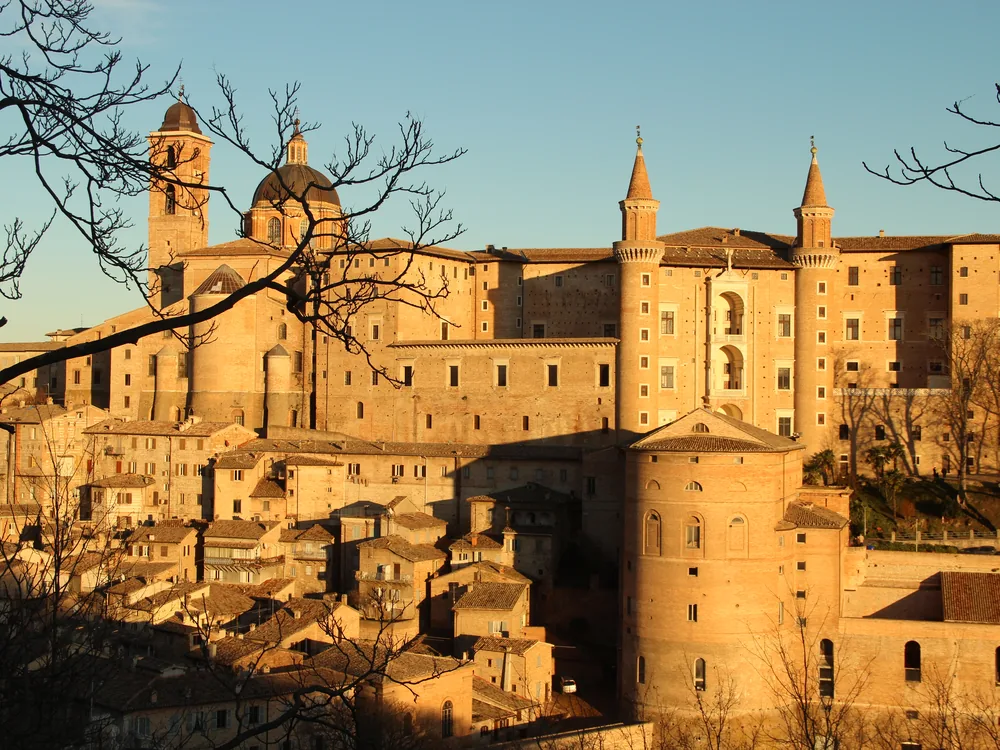
Built 1444 · Renaissance palace of exceptional architectural quality, designed principally by Luciano Laurana (the facade with twin cylindrical towers, the Courtyard of Honour, the residential apartments) and Francesco di Giorgio Martini (later additions and the spiral staircase) — commissioned by Federico da Montefeltro from 1444; the palace is the fullest built expression of the humanist Renaissance ideal that architecture, scholarship, and political power could be unified in a single place; Laurana's Courtyard of Honour (Cortile d'Onore) became a canonical model for Renaissance palace courtyards, its perfectly proportioned arches and pilasters influencing Bramante and Palladio; the palace's twin cylindrical towers on the west facade and the hanging garden (giardino pensile) over the ravine give the building its signature silhouette from the surrounding hills; the building covers approximately 3,000 sqm across four floors and was the largest private palace in Italy at the time of its completion
This page is part of an independent travel guide and is not affiliated with, endorsed by, or operated by Ducal Palace of Urbino.
© Castles & Palaces
Quick Facts
- Hours
- Tue–Sat 08:30–19:15. Sun 09:00–13:00. Closed Mon
- Entry via GetYourGuide
- €24
- Duration
- 1.5–2.5 hours (Galleria Nazionale delle Marche + Courtyard of Honour + studiolo + palace rooms)
- Best time
- April to October
- Nearest city
- Pesaro
Featured Tour
Urbino: Galleria Nazionale delle Marche Entry Ticket — Ducal Palace (1 day, wheelchair accessible)
Cancellation available · Instant confirmation
Highlights
- ✦The studiolo of Federico da Montefeltro — one of the most analysed small rooms in Italian Renaissance art: a private study decorated with intarsia (inlaid wood panels) of exceptional precision, depicting Federico's books, musical instruments, armour, and scientific tools in trompe-l'oeil panels that appear to be open cabinet doors and niches; the room embodied the Renaissance ideal of the ruler as both warrior and scholar; the original portrait busts of famous men (uomini illustri) that once covered the upper walls are now distributed between the Louvre and the Metropolitan Museum
- ✦Luciano Laurana's Courtyard of Honour (Cortile d'Onore) — the architectural centrepiece of the palace: a two-storey arcaded courtyard of perfectly proportioned Corinthian pilasters and arches that became the canonical model for Renaissance palace courtyards; Bramante studied at Urbino before moving to Rome, and the influence of Laurana's courtyard on the Cortile del Belvedere at the Vatican and on Palladio's subsequent palace architecture is direct and documented
- ✦Piero della Francesca's 'Flagellation of Christ' and 'Ideal City' — the Galleria Nazionale delle Marche holds two of the most discussed small paintings in Italian art: Piero's Flagellation (whose unusual composition and spatial logic have generated a century of art-historical controversy) and the panel of the Ideal City (attributed to Piero's circle or the Urbino workshop), one of the most influential depictions of Renaissance urban vision ever produced; both are small paintings that reward long looking
- ✦Federico da Montefeltro — the patron whose ambition defines the building: Federico (1422–1482) was the most successful condottiero of the Italian 15th century and simultaneously one of its most serious humanist scholars; he maintained the finest library in Italy after the Vatican's, employed the leading architects and painters of his generation, corresponded with the leading scholars of Europe, and never lost a battle; his portrait (the famous profile, by Piero della Francesca) hangs in the Uffizi and his palace at Urbino was the demonstration in stone of what he believed a ruler should be
- ✦Twin cylindrical towers and the hanging garden — the west facade of the palace, overlooking the ravine and the hills beyond Urbino, is one of the most distinctive palace elevations of the Italian Renaissance: two tall cylindrical towers frame a three-storey loggia that projects into the landscape, with the giardino pensile (hanging garden) extending over the hillside below; this is the view that Renaissance artists, rulers, and scholars who visited Federico's court encountered first, arriving from the valley
- ✦Raphael's Urbino — Raphael Sanzio was born in Urbino in 1483, the son of the court painter Giovanni Santi; his childhood was spent in and around the Gonzaga palace and its artistic community; the palace's collection of drawings includes early Raphael works, and the Raphael birthplace museum (Casa Natale di Raffaello) is a short walk from the palace in the city centre
Tickets & tours
Book through GetYourGuide
The Ducal Palace of Urbino stands on the highest point of the hill city of Urbino, its twin cylindrical towers and loggia facade visible for miles across the Marche landscape. Built from 1444 onward by Federico da Montefeltro — condottiero, humanist, and the most ambitious Renaissance ruler of the Italian 15th century — the palace was intended to be the most complete physical expression of the Renaissance ideal that a ruler could be: equally expert in warfare and scholarship, in the management of power and the patronage of beauty.
Federico da Montefeltro (1422–1482) was the illegitimate son of the Count of Montefeltro, raised in the household of the Gonzaga in Mantua, who became the most consistently successful military commander of his generation in Italy. He earned enormous fees as a condottiero for Florence, Naples, Milan, and the papacy, and spent a remarkable proportion of those earnings on a library, an architectural programme, and the recruitment of the best artists and architects in Italy to his court at Urbino. His library — at its height the finest in Italy after the Vatican's — contained manuscripts commissioned and copied specifically for him. His palace was the building.
The principal architect was Luciano Laurana (c.1420–1479), a Dalmatian architect who had worked in Naples before Federico brought him to Urbino in the 1460s. Laurana's contribution was the Courtyard of Honour (Cortile d'Onore), the west facade with its twin towers and loggia, and the residential apartments on the principal floor. The Courtyard became the architectural canon for the Renaissance palace courtyard: two storeys of arcaded loggia supported on Corinthian pilasters, their proportions geometrically precise, the ornamental detail of the capitals and entablature among the finest stone carving of the 15th century. Bramante, who worked in Urbino as a young artist before moving to Rome, knew the Courtyard well; its influence on his Cortile del Belvedere at the Vatican is the most important single instance of direct architectural inheritance in the Italian Renaissance.
Francesco di Giorgio Martini (1439–1501) completed the palace after Laurana's departure in the 1470s, designing the spiral staircase and several of the later rooms. Di Giorgio was also the author of a theoretical treatise on architecture that, in its illustrated manuscript form, circulated widely in the following century; Leonardo da Vinci annotated a copy.
The studiolo of Federico is the palace's most discussed room. It is small — approximately 3.6 by 3.4 metres — and decorated from floor to ceiling with intarsia panels of extraordinary technical and artistic quality: trompe-l'oeil depictions of open cabinets, books, musical instruments, armour, a mathematical compass, and other objects of the ideal humanist-scholar-warrior's study. The panels appear to be real objects until examined at close range; the illusionistic rendering of three-dimensional space in flat wood inlay is as sophisticated as any trompe-l'oeil painting of the period. The upper walls originally held portraits of famous men (uomini illustri) — poets, philosophers, rulers, and church fathers — painted by Justus van Gent and Pedro Berruguete; most are now in Paris (Louvre) and New York (Metropolitan Museum).
The Galleria Nazionale delle Marche — the state art collection that now occupies the palace's principal floor — holds works of exceptional importance for the history of Italian painting, among them Piero della Francesca's 'Flagellation of Christ' and the 'Ideal City' panel. The Flagellation is a small painting (58 by 81 cm) whose unusual spatial construction (three figures in the foreground, the flagellation itself relegated to a background loggia) has generated more art-historical commentary than almost any other Italian painting of its scale. The Ideal City panel is one of the most influential images of Renaissance urban vision — a perspectivally perfect city with no people, constructed for analytical contemplation rather than habitation.
A note for visitors managing expectations: the Galleria Nazionale delle Marche presents its collection primarily as paintings on walls rather than a fully furnished period reconstruction of the Gonzaga state apartments. Visitors hoping for the experience of walking through complete ducal rooms as they were in Federico's time may find the installation mode relatively austere; the architectural settings and the art justify the visit independently, but the palace reads as museum rather than time-capsule. The ticket pickup process via GetYourGuide has drawn some visitor confusion — arriving with the GetYourGuide booking reference and heading to the box office for clarification is advisable.
Urbino is the site's first Marche entry — a region of central Italy between the Apennines and the Adriatic coast that is notably underrepresented in English-language heritage tourism relative to its cultural density.
History
Federico da Montefeltro, born in Gubbio in 1422 and raised at the Gonzaga court in Mantua, commissioned the first phase of the Ducal Palace in 1444 — a project that would expand over four decades into the defining monument of Italian Renaissance court architecture. In the 1460s, the Dalmatian architect Luciano Laurana was appointed chief architect and designed the Courtyard of Honour, the twin cylindrical towers of the west facade, and the principal apartments: a composition of such clarity and intellectual precision that it became a model studied by architects across Italy and beyond. Francesco di Giorgio Martini continued the construction after Laurana's departure, and the palace was largely complete by Federico's death in 1482. Pope Sixtus IV had created Federico Duke of Urbino in 1474, adding a formal title to the authority Federico had long exercised as the most successful condottiero of his generation.
His son Guidobaldo I inherited a court that Baldassare Castiglione would later immortalise in The Book of the Courtier — the literary record of the cultural conversation at Urbino. Guidobaldo was temporarily expelled by Cesare Borgia in 1502 but restored in 1503; he died in 1508, ending the main Montefeltro line. The dukedom passed to Francesco Maria I della Rovere. Papal annexation of Urbino in 1631 dispersed the ducal collections to Rome, where much of the Montefeltro library and artworks were absorbed into the Vatican.
The palace became a state monument in the 19th and 20th centuries, with the Galleria Nazionale delle Marche established in the principal apartments. The Historic Centre of Urbino received UNESCO World Heritage inscription in 1998.
How to Visit
Getting there: Urbino has no train station. By public transport: train to Pesaro (served from Bologna, Rimini, and Ancona), then Adriabus to Urbino (~45 minutes). By car: 36 km from Pesaro via SS423. Park on the outskirts of the historic centre — the old town is largely pedestrian, with an uphill walk from the bus terminus or car parks to the palace. Pesaro is the practical base for arrival.
Tickets: Walk-up entry €10 adult, €2 child. The GetYourGuide ticket provides advance access to the Galleria Nazionale delle Marche, the Courtyard of Honour, the studiolo, and the principal palace rooms — bring the booking confirmation to the box office to collect the physical ticket — book in advance, especially for weekends.
Practical tips: Open Tuesday–Saturday 08:30–19:15, Sunday 09:00–13:00 (short morning-only hours), closed Monday. Plan 1.5–2.5 hours for the visit. The historic centre of Urbino is hilly — wear comfortable shoes for the walk up from the bus stop or car parks. Early morning or late afternoon light gives the best views of the twin-towered west facade from the surrounding hills.
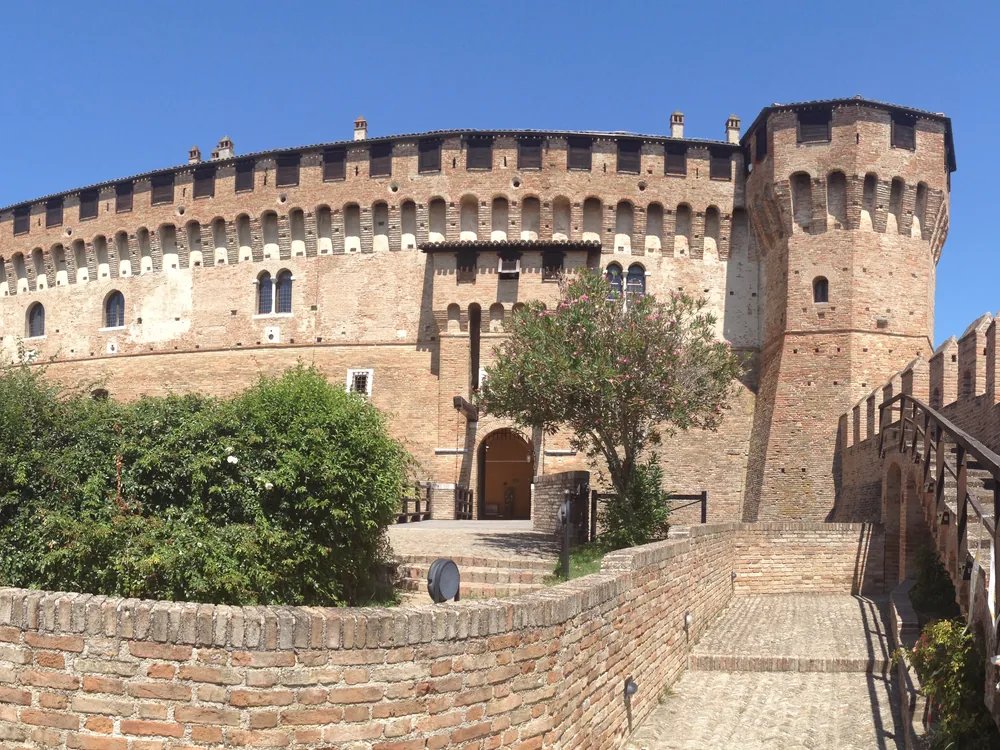
Combine with: Rocca of Gradara — a well-preserved medieval fortress near Pesaro, about 40 km from Urbino and convenient to combine on a Marche itinerary.
Frequently Asked Questions
Primarily a painting gallery — the Galleria Nazionale delle Marche presents its collection as art hung on walls in the palace's principal rooms rather than a fully period-furnished ducal apartment reconstruction. The rooms themselves are architecturally extraordinary (particularly the Courtyard of Honour, the throne room, and the studiolo with its intarsia panels), and the paintings are of major art-historical significance; but visitors expecting every room to be furnished as it was in Federico's time will find the installation more museum-like. The studiolo is the one room that gives the strongest sense of the original interior purpose.
Location
Piazza Duca Federico 107, 61029 Urbino PU, Italy
Nearby Castles
Tours & Tickets
Powered by GetYourGuide
From
€24/ person